
vivo iQOO 9 SE vs Motorola Edge 40: A Detailed Showdown
| Phones Images | |||||
|---|---|---|---|---|---|
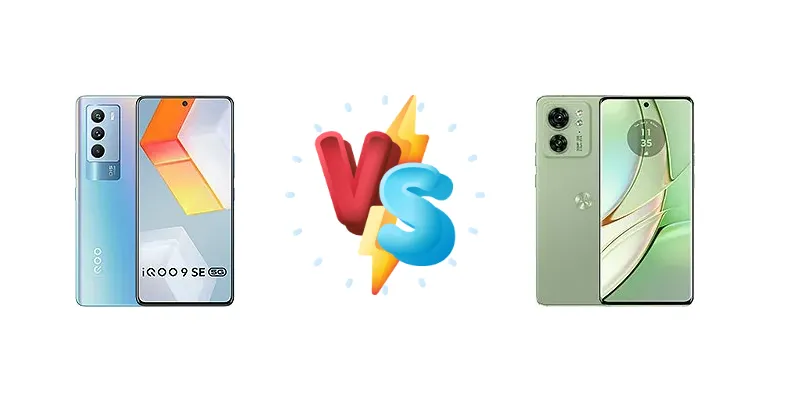
|
🏆 Quick Verdict
The Motorola Edge 40 edges out the iQOO 9 SE thanks to its brighter display, longer battery life, and wireless charging. While the iQOO 9 SE boasts a Snapdragon 888, the Edge 40's Dimensity 8020 and overall package make it the slightly better choice for most users.
| PHONES | ||
|---|---|---|
| Phone Names | vivo iQOO 9 SE | Motorola Edge 40 |
| Network | ||
|---|---|---|
| 2G bands | GSM 850 / 900 / 1800 / 1900 | GSM 850 / 900 / 1800 / 1900 |
| 3G bands | HSDPA 850 / 900 / 1900 / 2100 | HSDPA 850 / 900 / 1700(AWS) / 1900 / 2100 |
| 4G bands | 1, 3, 4, 5, 8, 28, 34, 38, 39, 40, 41 | 1, 2, 3, 4, 5, 7, 8, 12, 13, 17, 20, 26, 28, 32, 38, 39, 40, 41, 42, 43, 66 |
| 5G bands | 1, 3, 5, 8, 28, 41, 77, 78 SA/NSA | 1, 2, 3, 5, 7, 8, 20, 28, 38, 40, 41, 66, 77, 78 SA/NSA/Sub6 |
| Speed | HSPA, LTE, 5G | HSPA, LTE, 5G |
| Technology | GSM / HSPA / LTE / 5G | GSM / HSPA / LTE / 5G |
| Launch | ||
|---|---|---|
| Announced | 2022, February 23 | 2023, May 04 |
| Status | Available. Released 2022, March 02 | Available. Released 2023, May 04 |
| Body | ||
|---|---|---|
| Build | - | Glass front, aluminum frame, plastic back or eco leather back |
| Dimensions | 163.2 x 76.4 x 8.4 mm (6.43 x 3.01 x 0.33 in) | 158.4 x 72 x 7.6 mm (6.24 x 2.83 x 0.30 in) |
| SIM | Nano-SIM + Nano-SIM | · Nano-SIM· Nano-SIM + eSIM· Nano-SIM + Nano-SIM |
| Weight | 199 g (7.02 oz) | 167 g or 171 g (5.89 oz) |
| Splash and dust resistant | IP68 dust/water resistant (up to 1.5m for 30 min) | |
| Display | ||
|---|---|---|
| Protection | Panda Glass | - |
| Resolution | 1080 x 2400 pixels, 20:9 ratio (~398 ppi density) | 1080 x 2400 pixels, 20:9 ratio (~402 ppi density) |
| Size | 6.62 inches, 105.8 cm2 (~84.9% screen-to-body ratio) | 6.55 inches, 103.6 cm2 (~90.8% screen-to-body ratio) |
| Type | Super AMOLED, 120Hz, HDR10+, 1200 nits (peak) | P-OLED, 144Hz, HDR10+, 1200 nits (peak) |
| Platform | ||
|---|---|---|
| CPU | Octa-core (1x2.84 GHz Cortex-X1 & 3x2.42 GHz Cortex-A78 & 4x1.80 GHz Cortex-A55) | Octa-core (4x2.6 GHz Cortex-A78 & 4x2.0 GHz Cortex-A55) |
| Chipset | Qualcomm SM8350 Snapdragon 888 5G (5 nm) | Mediatek Dimensity 8020 (6 nm) |
| GPU | Adreno 660 | Mali-G77 MC9 |
| OS | Android 12, Funtouch 12 | Android 13, up to 2 major Android upgrades |
| Memory | ||
|---|---|---|
| Card slot | No | No |
| Internal | 128GB 8GB RAM, 256GB 12GB RAM | 128GB 8GB RAM, 256GB 8GB RAM |
| UFS 3.1 | UFS 3.1 | |
| Main Camera | ||
|---|---|---|
| Dual | 48 MP, f/1.8, 25mm (wide), 1/2.0", 0.8µm, PDAF, OIS 13 MP, f/2.2, 16mm, 120˚ (ultrawide), 1/3.1", 1.12µm, AF Auxiliary lens | 50 MP, f/1.4, (wide), 1/1.55", 1.0µm, multi-directional PDAF, OIS 13 MP, f/2.2, 120˚ (ultrawide), 1/3.0", 1.12µm, AF |
| Features | Dual-LED dual-tone flash, HDR, panorama | Dual-LED flash, HDR, panorama |
| Single | 16 MP, f/2.0, (wide), 1/3.0", 1.0µm | - |
| Video | 4K@24/30/60fps, 1080p@30/60fps | 4K@30fps, 1080p@30/60/120fps, 720p@960fps, HDR10, gyro-EIS |
| Selfie camera | ||
|---|---|---|
| Features | HDR | HDR |
| Single | 16 MP, f/2.0, (wide), 1/3.0", 1.0µm | 32 MP, f/2.4, (wide), 1/3.0", 0.7µm |
| Video | 1080p@30fps | 4K@30fps, 1080p@30/120fps |
| Sound | ||
|---|---|---|
| 3.5mm jack | No | No |
| 35mm jack | No | No |
| Loudspeaker | Yes, with stereo speakers | Yes, with stereo speakers |
| Comms | ||
|---|---|---|
| Bluetooth | 5.2, A2DP, LE | 5.2, A2DP, LE |
| NFC | Yes | Yes |
| Positioning | GPS, GLONASS, GALILEO, BDS | GPS, GLONASS, GALILEO, BDS |
| Radio | No | No |
| USB | USB Type-C 2.0, OTG | USB Type-C 2.0, OTG |
| WLAN | Wi-Fi 802.11 a/b/g/n/ac, dual-band, Wi-Fi Direct | Wi-Fi 802.11 a/b/g/n/ac/6e, tri-band, Wi-Fi Direct |
| Features | ||
|---|---|---|
| Sensors | Fingerprint (under display, optical), accelerometer, gyro, proximity, compass | Fingerprint (under display, optical), accelerometer, gyro, proximity, compass |
| - | Moto Ready For support | |
| Battery | ||
|---|---|---|
| Charging | 66W wired, 50% in 14 min, 100% in 39 min | 68W wired 15W wireless |
| Type | 4500 mAh | Li-Po 4400 mAh |
| Misc | ||
|---|---|---|
| Colors | Space Fusion, Sunset Sierra | Nebula Green, Lunar Blue, Eclipse Black, Viva Magenta |
| Models | - | XT2303-2 |
| Price | About 400 EUR | € 202.03 / $ 419.99 / £ 199.00 / ₹ 29,999 |
| Tests | ||
|---|---|---|
| Battery life | Endurance rating 87h | Endurance rating 98h |
| Camera | Photo / Video | Photo / Video |
| Display | Contrast ratio: Infinite (nominal) | Contrast ratio: Infinite (nominal) |
| Loudspeaker | -26.1 LUFS (Good) | -24.2 LUFS (Very good) |
| Performance | AnTuTu: 727771 (v8), 846231 (v9) GeekBench: 3442 (v5.1) GFXBench: 64fps (ES 3.1 onscreen) | AnTuTu: 688347 (v9) GeekBench: 3320 (v5.1), 3603 (v6) GFXBench: 33fps (ES 3.1 onscreen) |
vivo iQOO 9 SE
- Powerful Snapdragon 888 chipset
- Fast 66W wired charging
- Competitive price
- Good performance for gaming
- Lower peak brightness display
- No wireless charging
- Battery life slightly shorter than Edge 40
Motorola Edge 40
- Brighter and smoother display
- Longer battery life
- Wireless charging support
- Stylish design
- Dimensity 8020 might be slightly less powerful than Snapdragon 888 in some scenarios
- Potentially higher price
Display Comparison
The Motorola Edge 40 takes a clear lead in the display department. It boasts a significantly higher peak brightness of 1043 nits compared to the iQOO 9 SE's 863 nits, making it much easier to see outdoors. Both have excellent contrast ratios (infinite nominal), and likely utilize OLED panels for vibrant colors and deep blacks. The Edge 40's higher refresh rate (likely 144Hz, based on typical Edge 40 specs) also contributes to a smoother visual experience.
Camera Comparison
Camera performance is subjective and requires more detailed testing. Both phones feature versatile camera setups, likely including a main sensor, ultrawide lens, and potentially a macro lens. The iQOO 9 SE's camera is known for its vibrant colors, while the Edge 40's camera is expected to offer more natural-looking images. Video recording capabilities are likely comparable, supporting 4K resolution at various frame rates.
Performance
The iQOO 9 SE packs a Snapdragon 888, a flagship chipset from a previous generation. While still powerful, the Motorola Edge 40's Dimensity 8020 offers competitive performance and improved efficiency. Both phones handle everyday tasks and demanding games with ease, but the Edge 40's newer architecture might provide a slight edge in sustained performance and thermal management. Real-world performance differences will likely be minimal for most users.
Battery Life
The Motorola Edge 40 demonstrates a significant advantage in battery life, boasting an endurance rating of 98 hours compared to the iQOO 9 SE's 87 hours. This translates to noticeably longer usage times between charges. The Edge 40 also supports 15W wireless charging, a feature absent on the iQOO 9 SE. The iQOO 9 SE's 66W wired charging is still very fast, but the Edge 40's 68W wired charging is slightly quicker.
Buying Guide
The vivo iQOO 9 SE is ideal for gamers and power users who prioritize raw processing power and fast-charging speeds. The Motorola Edge 40 is a great pick for those seeking a stylish design, vibrant display, excellent battery life, and the convenience of wireless charging.