
vivo iQOO 9 Pro vs Xiaomi 12 Pro (Dimensity): A Detailed Showdown
| Phones Images | |||||
|---|---|---|---|---|---|
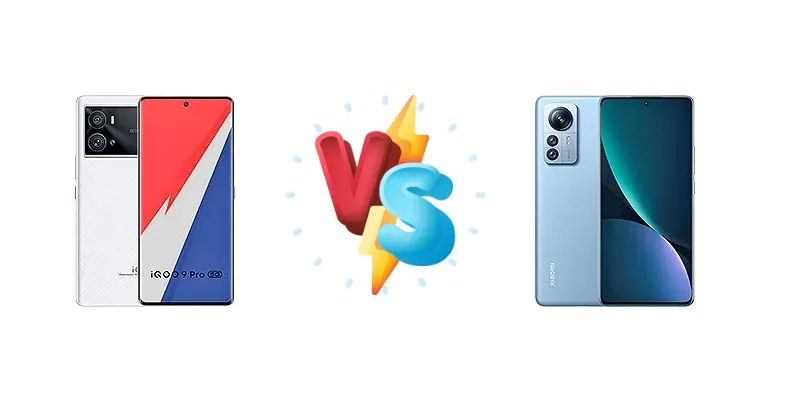
|
🏆 Quick Verdict
The iQOO 9 Pro takes the lead with its blazing-fast 120W charging and exceptional battery life. While the Xiaomi 12 Pro (Dimensity) boasts a slightly more refined software experience and potentially better camera processing, the iQOO 9 Pro's raw power and charging speed make it a compelling choice for many.
| PHONES | ||
|---|---|---|
| Phone Names | vivo iQOO 9 Pro | Xiaomi 12 Pro (Dimensity) |
| Network | ||
|---|---|---|
| 2G bands | GSM 850 / 900 / 1800 / 1900 | GSM 850 / 900 / 1800 / 1900 |
| 3G bands | HSDPA 850 / 900 / 1700(AWS) / 1900 / 2100 | HSDPA 800 / 850 / 900 / 1700(AWS) / 1900 / 2100 |
| 4G bands | 1, 2, 3, 4, 5, 7, 8, 12, 17, 18, 19, 20, 25, 26, 28, 32, 34, 38, 39, 40, 41, 42, 66 | 1, 2, 3, 4, 5, 7, 8, 18, 19, 26, 34, 38, 39, 40, 41, 42 |
| 5G bands | 1, 3, 5, 7, 8, 20, 28, 38, 40, 41, 66, 77, 78, 79 SA/NSA | 1, 3, 5, 8, 28, 38, 40, 41, 77, 78 SA/NSA |
| Speed | HSPA, LTE, 5G | HSPA, LTE, 5G |
| Technology | GSM / CDMA / HSPA / CDMA2000 / LTE / 5G | GSM / CDMA / HSPA / EVDO / LTE / 5G |
| CDMA2000 1x | CDMA2000 1xEV-DO | |
| Launch | ||
|---|---|---|
| Announced | 2022, January 05 | 2022, July 04 |
| Status | Available. Released 2022, January 12 | Available. Released 2022, July 13 |
| Body | ||
|---|---|---|
| Build | Glass front (Panda Glass), aluminum frame, glass back or aramid fiber back | - |
| Dimensions | 164.8 x 75.2 x 8.8 mm | 163.6 x 74.6 x 8.2 mm (6.44 x 2.94 x 0.32 in) |
| SIM | Nano-SIM + Nano-SIM | Nano-SIM + Nano-SIM |
| Weight | 204 g or 210 g (7.20 oz) | 201 g (7.09 oz) |
| Splash and dust resistant | - | |
| Display | ||
|---|---|---|
| Protection | Panda Glass | Corning Gorilla Glass Victus |
| Resolution | 1440 x 3200 pixels, 20:9 ratio (~518 ppi density) | 1440 x 3200 pixels, 20:9 ratio (~521 ppi density) |
| Size | 6.78 inches, 111.0 cm2 (~89.6% screen-to-body ratio) | 6.73 inches, 109.4 cm2 (~89.6% screen-to-body ratio) |
| Type | LTPO2 AMOLED, 1B colors, 120Hz, HDR10+, Dolby Vision, 500 nits (typ), 1000 nits (HBM), 1500 nits (peak) | LTPO2 AMOLED, 1B colors, 120Hz, Dolby Vision, HDR10+, 1000 nits (HBM), 1500 nits (peak) |
| Platform | ||
|---|---|---|
| CPU | Octa-core (1x3.00 GHz Cortex-X2 & 3x2.50 GHz Cortex-A710 & 4x1.80 GHz Cortex-A510) | Octa-core (1x3.20 GHz Cortex-X2 & 3x2.85 GHz Cortex-A710 & 4x1.80 GHz Cortex-A510) |
| Chipset | Qualcomm SM8450 Snapdragon 8 Gen 1 (4 nm) | Mediatek Dimensity 9000+ (4 nm) |
| GPU | Adreno 730 | Mali-G710 MC10 |
| OS | Android 12, Funtouch 12 (International), OriginOS Ocean (China) | Android 12, MIUI 13 |
| Memory | ||
|---|---|---|
| Card slot | No | No |
| Internal | 256GB 8GB RAM, 256GB 12GB RAM, 512GB 12GB RAM | 128GB 8GB RAM, 256GB 12GB RAM |
| UFS 3.1 (V6) | UFS 3.1 | |
| Main Camera | ||
|---|---|---|
| Features | Dual-LED lash, HDR, panorama | Color spectrum sensor, Dual-LED dual-tone flash, HDR, panorama |
| Single | 16 MP, f/2.5, (wide), 1/3.1", 1.0µm | 32 MP, f/2.5, 26mm (wide), 0.7µm |
| Triple | 50 MP, f/1.8, (wide), 1/1.57", 1.0µm, PDAF, gimbal OIS 16 MP, f/2.2, 60mm (telephoto), 1/3.1", 1.0µm, PDAF, OIS, 2.5x optical zoom 50 MP, f/2.3, 15mm, 150˚ (ultrawide), 1/2.76", 0.64µm, AF | 50 MP, f/1.9, 24mm (wide), 1/1.28", 1.22µm, dual pixel PDAF, OIS 13 MP, f/2.4, 15mm, 123˚ (ultrawide), 1/3.06", 1.12µm 5 MP, f/2.4, 50mm (telephoto macro), AF |
| Video | 8K@30fps, 4K@24/30/60fps, 1080p@30/60fps, gyro-EIS | 4K@30/60fps, 1080p@30/60/120fps, gyro-EIS |
| Selfie camera | ||
|---|---|---|
| Features | HDR | HDR, panorama |
| Single | 16 MP, f/2.5, (wide), 1/3.1", 1.0µm | 32 MP, f/2.5, 26mm (wide), 0.7µm |
| Video | 1080p@30fps, gyro-EIS | 1080p@30/60fps, 720p@120fps |
| Sound | ||
|---|---|---|
| 3.5mm jack | No | No |
| 35mm jack | No | No |
| Loudspeaker | Yes, with dual speakers | Yes, with stereo speakers |
| 32-bit/384kHz audio | 24-bit/192kHz audio Tuned by Harman Kardon | |
| Comms | ||
|---|---|---|
| Bluetooth | 5.2, A2DP, LE, aptX HD, aptX Adaptive, aptX Lossless | 5.3, A2DP, LE |
| Infrared port | Yes | Yes |
| NFC | Yes | Yes |
| Positioning | GPS, GLONASS, GALILEO, BDS, QZSS | GPS (L1+L5), GLONASS (L1), BDS (B1I+B1c+B2a), GALILEO (E1+E5a), QZSS (L1+L5), NavIC (L5) |
| Radio | No | No |
| USB | USB Type-C 2.0, OTG | USB Type-C 2.0, OTG |
| WLAN | Wi-Fi 802.11 a/b/g/n/ac/6, dual-band, Wi-Fi Direct | Wi-Fi 802.11 a/b/g/n/ac/6, dual-band, Wi-Fi Direct |
| Features | ||
|---|---|---|
| Sensors | Fingerprint (under display, ultrasonic), accelerometer, gyro, proximity, compass | Fingerprint (under display, optical), accelerometer, gyro, proximity, compass |
| Battery | ||
|---|---|---|
| Charging | 120W wired, 50% in 8 min, 100% in 20 min 50W wireless 10W reverse wireless | 67W wired, PD3.0, QC4 |
| Type | 4700 mAh | Li-Po 5160 mAh |
| Misc | ||
|---|---|---|
| Colors | Legend (White w/ BMW M branding), Dark Cruise, Orange | Gray, Blue |
| Models | V2172A, I2022 | 2207122MC |
| Price | About 630 EUR | About 570 EUR |
| Tests | ||
|---|---|---|
| Battery life | Endurance rating 97h | - |
| Camera | Photo / Video | - |
| Display | Contrast ratio: Infinite (nominal) | - |
| Loudspeaker | -24.8 LUFS (Very good) | - |
| Performance | AnTuTu: 862324 (v8), 997948 (v9) GeekBench: 3708 (v5.1) GFXBench: 46fps (ES 3.1 onscreen) | - |
vivo iQOO 9 Pro
- Blazing-fast 120W charging
- Exceptional battery life
- Powerful Snapdragon 8 Gen 1 chipset
- High brightness display
- Potential for thermal throttling
- Software might not be as polished as Xiaomi's
Xiaomi 12 Pro (Dimensity)
- Slightly more refined software experience
- Potentially better camera processing
- Premium design and build quality
- Powerful Dimensity 9000+ chipset
- Slower 67W charging
- Shorter battery life
- May not be as ideal for hardcore gamers
Display Comparison
Both phones feature excellent AMOLED displays. The iQOO 9 Pro boasts a measured 1000 nits peak brightness, offering superior outdoor visibility. The Xiaomi 12 Pro likely has slightly better color accuracy and calibration, but the iQOO 9 Pro's brightness advantage is noticeable. Both have high refresh rates (likely 120Hz) for smooth scrolling and animations.
Camera Comparison
Camera performance is subjective. The iQOO 9 Pro likely excels in fast-action shots due to its processing. The Xiaomi 12 Pro (Dimensity) is expected to have a more versatile camera system with potentially better image processing and low-light performance. Both phones likely offer excellent video recording capabilities.
Performance
The iQOO 9 Pro's Snapdragon 8 Gen 1 is a powerhouse, known for its raw performance. The Xiaomi 12 Pro (Dimensity) with the Dimensity 9000+ is also incredibly fast, and in some benchmarks, it might even edge out the Snapdragon. However, the Snapdragon 8 Gen 1 has a reputation for thermal throttling under sustained load, which could impact long gaming sessions. Both phones offer ample RAM and storage for demanding tasks.
Battery Life
The iQOO 9 Pro absolutely dominates in this category. Its 97h endurance rating is exceptional, and the 120W wired charging is a game-changer, fully charging the phone in just 20 minutes. The Xiaomi 12 Pro (Dimensity)'s 67W charging is significantly slower, and its battery life is likely shorter.
Buying Guide
The vivo iQOO 9 Pro is ideal for gamers and power users who prioritize charging speed and long battery life. The Xiaomi 12 Pro (Dimensity) is a better fit for users who value a polished software experience, a more versatile camera system, and a slightly more premium design.