
vivo iQOO 9 Pro vs Xiaomi 12 Pro: A Detailed Showdown
| Phones Images | |||||
|---|---|---|---|---|---|
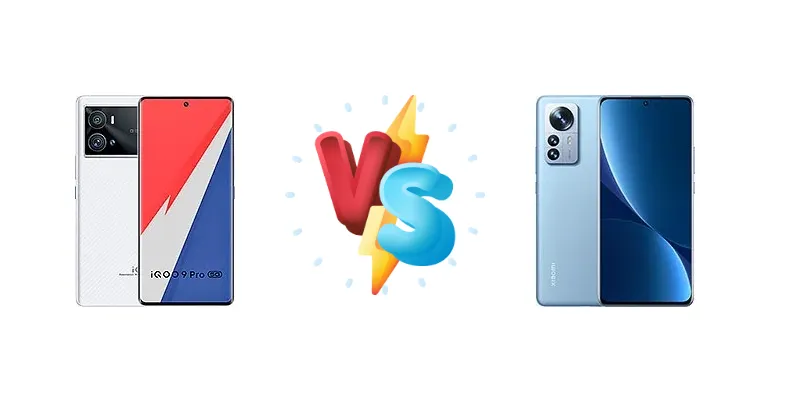
|
🏆 Quick Verdict
The iQOO 9 Pro takes the lead with significantly better battery life and blazing-fast 120W wired charging. While the Xiaomi 12 Pro boasts a slightly brighter display, the iQOO 9 Pro's endurance and charging speed make it a compelling choice for power users.
| PHONES | ||
|---|---|---|
| Phone Names | vivo iQOO 9 Pro | Xiaomi 12 Pro |
| Network | ||
|---|---|---|
| 2G bands | GSM 850 / 900 / 1800 / 1900 | GSM 850 / 900 / 1800 / 1900 |
| 3G bands | HSDPA 850 / 900 / 1700(AWS) / 1900 / 2100 | HSDPA 800 / 850 / 900 / 1700(AWS) / 1900 / 2100 |
| 4G bands | 1, 2, 3, 4, 5, 7, 8, 12, 17, 18, 19, 20, 25, 26, 28, 32, 34, 38, 39, 40, 41, 42, 66 | 1, 2, 3, 4, 5, 7, 8, 12, 13, 17, 18, 19, 20, 25, 26, 28, 32, 38, 39, 40, 41, 42, 48, 66 - International |
| 5G bands | 1, 3, 5, 7, 8, 20, 28, 38, 40, 41, 66, 77, 78, 79 SA/NSA | 1, 3, 5, 7, 8, 20, 28, 38, 40, 41, 66, 77, 78, 79 SA/NSA - International |
| Speed | HSPA, LTE, 5G | HSPA, LTE, 5G |
| Technology | GSM / CDMA / HSPA / CDMA2000 / LTE / 5G | GSM / CDMA / HSPA / EVDO / LTE / 5G |
| CDMA2000 1x | 1, 3, 5, 8, 28, 38, 40, 41, 77, 78, 79 SA/NSA - China | |
| Launch | ||
|---|---|---|
| Announced | 2022, January 05 | 2021, December 28 |
| Status | Available. Released 2022, January 12 | Available. Released 2021, December 31 |
| Body | ||
|---|---|---|
| Build | Glass front (Panda Glass), aluminum frame, glass back or aramid fiber back | Glass front (Gorilla Glass Victus), glass back, aluminum frame |
| Dimensions | 164.8 x 75.2 x 8.8 mm | 163.6 x 74.6 x 8.2 mm (6.44 x 2.94 x 0.32 in) |
| SIM | Nano-SIM + Nano-SIM | Nano-SIM + Nano-SIM |
| Weight | 204 g or 210 g (7.20 oz) | 204 g or 205 g (7.20 oz) |
| Splash and dust resistant | - | |
| Display | ||
|---|---|---|
| Protection | Panda Glass | Corning Gorilla Glass Victus |
| Resolution | 1440 x 3200 pixels, 20:9 ratio (~518 ppi density) | 1440 x 3200 pixels, 20:9 ratio (~521 ppi density) |
| Size | 6.78 inches, 111.0 cm2 (~89.6% screen-to-body ratio) | 6.73 inches, 109.4 cm2 (~89.6% screen-to-body ratio) |
| Type | LTPO2 AMOLED, 1B colors, 120Hz, HDR10+, Dolby Vision, 500 nits (typ), 1000 nits (HBM), 1500 nits (peak) | LTPO AMOLED, 1B colors, 120Hz, Dolby Vision, HDR10+, 1000 nits (HBM), 1500 nits (peak) |
| Platform | ||
|---|---|---|
| CPU | Octa-core (1x3.00 GHz Cortex-X2 & 3x2.50 GHz Cortex-A710 & 4x1.80 GHz Cortex-A510) | Octa-core (1x3.00 GHz Cortex-X2 & 3x2.50 GHz Cortex-A710 & 4x1.80 GHz Cortex-A510) |
| Chipset | Qualcomm SM8450 Snapdragon 8 Gen 1 (4 nm) | Qualcomm SM8450 Snapdragon 8 Gen 1 (4 nm) |
| GPU | Adreno 730 | Adreno 730 |
| OS | Android 12, Funtouch 12 (International), OriginOS Ocean (China) | Android 12, MIUI 13 |
| Memory | ||
|---|---|---|
| Card slot | No | No |
| Internal | 256GB 8GB RAM, 256GB 12GB RAM, 512GB 12GB RAM | 128GB 8GB RAM, 256GB 8GB RAM, 256GB 12GB RAM |
| UFS 3.1 (V6) | UFS 3.1 | |
| Main Camera | ||
|---|---|---|
| Features | Dual-LED lash, HDR, panorama | Color spectrum sensor, Dual-LED dual-tone flash, HDR, panorama |
| Single | 16 MP, f/2.5, (wide), 1/3.1", 1.0µm | 32 MP, f/2.5, 26mm (wide), 0.7µm |
| Triple | 50 MP, f/1.8, (wide), 1/1.57", 1.0µm, PDAF, gimbal OIS 16 MP, f/2.2, 60mm (telephoto), 1/3.1", 1.0µm, PDAF, OIS, 2.5x optical zoom 50 MP, f/2.3, 15mm, 150˚ (ultrawide), 1/2.76", 0.64µm, AF | 50 MP, f/1.9, 24mm (wide), 1/1.28", 1.22µm, dual pixel PDAF, OIS 50 MP, f/1.9, 48mm (telephoto), PDAF, 2x optical zoom 50 MP, f/2.2, 115˚ (ultrawide) |
| Video | 8K@30fps, 4K@24/30/60fps, 1080p@30/60fps, gyro-EIS | 8K@24fps (HDR), 4K@30/60fps (HDR10+), 1080p@30/120/240/960fps, 720p@1920fps, gyro-EIS |
| Selfie camera | ||
|---|---|---|
| Features | HDR | HDR, panorama |
| Single | 16 MP, f/2.5, (wide), 1/3.1", 1.0µm | 32 MP, f/2.5, 26mm (wide), 0.7µm |
| Video | 1080p@30fps, gyro-EIS | 1080p@30/60fps, 720p@120fps, HDR10+ |
| Sound | ||
|---|---|---|
| 3.5mm jack | No | No |
| 35mm jack | No | No |
| Loudspeaker | Yes, with dual speakers | Yes, with stereo speakers (4 speakers) |
| 32-bit/384kHz audio | 24-bit/192kHz audio Tuned by Harman Kardon | |
| Comms | ||
|---|---|---|
| Bluetooth | 5.2, A2DP, LE, aptX HD, aptX Adaptive, aptX Lossless | 5.2, A2DP, LE, aptX HD, aptX Adaptive |
| Infrared port | Yes | Yes |
| NFC | Yes | Yes (market/region dependent) |
| Positioning | GPS, GLONASS, GALILEO, BDS, QZSS | GPS (L1+L5), GLONASS (L1), BDS (B1I+B1c+B2a), GALILEO (E1+E5a), QZSS (L1+L5), NavIC (L5) |
| Radio | No | No |
| USB | USB Type-C 2.0, OTG | USB Type-C 2.0, OTG |
| WLAN | Wi-Fi 802.11 a/b/g/n/ac/6, dual-band, Wi-Fi Direct | Wi-Fi 802.11 a/b/g/n/ac/6 or 6e (market dependent), dual-band, Wi-Fi Direct |
| Features | ||
|---|---|---|
| Sensors | Fingerprint (under display, ultrasonic), accelerometer, gyro, proximity, compass | Fingerprint (under display, optical), accelerometer, gyro, compass, barometer |
| - | Virtual Proximity Sensing | |
| Battery | ||
|---|---|---|
| Charging | 120W wired, 50% in 8 min, 100% in 20 min 50W wireless 10W reverse wireless | 120W wired, PD3.0, QC4, 100% in 18 min 50W wireless, 100% in 42 min 10W reverse wireless |
| Type | 4700 mAh | Li-Po 4600 mAh |
| Misc | ||
|---|---|---|
| Colors | Legend (White w/ BMW M branding), Dark Cruise, Orange | Gray, Blue, Purple, Green |
| Models | V2172A, I2022 | 2201122C, 2201122G |
| Price | About 630 EUR | € 317.40 / $ 349.99 / £ 364.66 / ₹ 41,999 |
| SAR | - | 1.09 W/kg (head) 1.05 W/kg (body) |
| SAR EU | - | 0.60 W/kg (head) 1.00 W/kg (body) |
| Tests | ||
|---|---|---|
| Battery life | Endurance rating 97h | Endurance rating 74h |
| Camera | Photo / Video | Photo / Video |
| Display | Contrast ratio: Infinite (nominal) | Contrast ratio: Infinite (nominal) |
| Loudspeaker | -24.8 LUFS (Very good) | -29.5 LUFS (Average) |
| Performance | AnTuTu: 862324 (v8), 997948 (v9) GeekBench: 3708 (v5.1) GFXBench: 46fps (ES 3.1 onscreen) | AnTuTu: 985226 (v9) GeekBench: 3682 (v5.1) GFXBench: 46fps (ES 3.1 onscreen) |
vivo iQOO 9 Pro
- Exceptional battery life
- Blazing-fast 120W wired charging
- Smooth 120Hz display
- Potentially better low-light camera performance
- Funtouch OS may not appeal to everyone
- Design might be less premium than Xiaomi
Xiaomi 12 Pro
- Slightly brighter display
- Polished MIUI software
- Good daylight camera performance
- Premium design
- Shorter battery life
- Slower charging compared to iQOO 9 Pro
Display Comparison
Both phones feature excellent AMOLED displays with vibrant colors and deep blacks. The Xiaomi 12 Pro edges out the iQOO 9 Pro with a slightly higher peak brightness of 1050 nits versus 1000 nits, making it marginally better for outdoor visibility. Both have infinite contrast ratios, typical of OLED panels. However, the iQOO 9 Pro's display is known for its smooth 120Hz refresh rate, contributing to a fluid user experience.
Camera Comparison
Camera performance is a complex area. Both phones feature versatile camera systems, but their strengths differ. The Xiaomi 12 Pro generally excels in daylight photography with accurate colors and good dynamic range. The iQOO 9 Pro, often utilizes a co-engineered camera system with Zeiss, and may offer a slightly different color science and potentially better low-light performance in certain scenarios. Video recording capabilities are comparable, both supporting 8K recording.
Performance
Powered by the Snapdragon 8 Gen 1, both devices offer flagship-level performance. Expect smooth multitasking, demanding games to run flawlessly, and snappy app launches. Real-world performance differences are likely to be minimal, though the iQOO 9 Pro's cooling system might offer slightly more sustained performance during extended gaming sessions. Software optimization plays a key role here, with Xiaomi's MIUI often being praised for its features, while iQOO's Funtouch OS focuses on gaming enhancements.
Battery Life
This is where the iQOO 9 Pro truly shines. Its 97h endurance rating significantly surpasses the Xiaomi 12 Pro's 74h. The iQOO 9 Pro's 120W wired charging is also a game-changer, fully charging the phone in just 20 minutes, compared to the Xiaomi 12 Pro's 18 minutes (though the Xiaomi utilizes PD3.0, QC4). Both offer 50W wireless charging and 10W reverse wireless charging.
Buying Guide
The vivo iQOO 9 Pro is ideal for gamers and users who prioritize battery life and rapid charging. The Xiaomi 12 Pro is a great option for those who value a slightly brighter display and a more polished software experience, though battery life is a compromise.