
vivo iQOO 9 vs Xiaomi 12 Pro: A Head-to-Head Flagship Showdown
| Phones Images | |||||
|---|---|---|---|---|---|
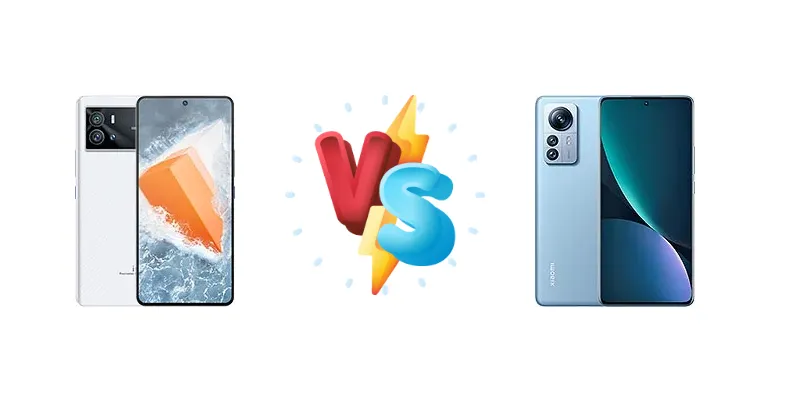
|
🏆 Quick Verdict
For the average power user, the Xiaomi 12 Pro (Dimensity) emerges as the slightly better choice. Its Dimensity 9000+ chipset offers a more consistently high level of performance with potentially better thermal management, and while charging isn't as blazing fast as the iQOO 9, it's still very quick and efficient.
| PHONES | ||
|---|---|---|
| Phone Names | vivo iQOO 9 (China) | Xiaomi 12 Pro (Dimensity) |
| Network | ||
|---|---|---|
| 2G bands | GSM 850 / 900 / 1800 / 1900 | GSM 850 / 900 / 1800 / 1900 |
| 3G bands | HSDPA 850 / 900 / 1700(AWS) / 1900 / 2100 | HSDPA 800 / 850 / 900 / 1700(AWS) / 1900 / 2100 |
| 4G bands | 1, 2, 3, 4, 5, 7, 8, 12, 17, 18, 19, 20, 26, 28, 34, 38, 39, 40, 41 | 1, 2, 3, 4, 5, 7, 8, 18, 19, 26, 34, 38, 39, 40, 41, 42 |
| 5G bands | 1, 3, 5, 8, 28, 41, 77, 78 SA/NSA | 1, 3, 5, 8, 28, 38, 40, 41, 77, 78 SA/NSA |
| Speed | HSPA, LTE, 5G | HSPA, LTE, 5G |
| Technology | GSM / CDMA / HSPA / CDMA2000 / LTE / 5G | GSM / CDMA / HSPA / EVDO / LTE / 5G |
| CDMA2000 1x | CDMA2000 1xEV-DO | |
| Launch | ||
|---|---|---|
| Announced | 2022, January 05 | 2022, July 04 |
| Status | Available. Released 2022, January 12 | Available. Released 2022, July 13 |
| Body | ||
|---|---|---|
| Dimensions | 164.5 x 76.7 x 8.4 mm (6.48 x 3.02 x 0.33 in) | 163.6 x 74.6 x 8.2 mm (6.44 x 2.94 x 0.32 in) |
| SIM | Nano-SIM + Nano-SIM | Nano-SIM + Nano-SIM |
| Weight | 206 g (7.27 oz) | 201 g (7.09 oz) |
| Display | ||
|---|---|---|
| Protection | - | Corning Gorilla Glass Victus |
| Resolution | 1080 x 2400 pixels, 20:9 ratio (~388 ppi density) | 1440 x 3200 pixels, 20:9 ratio (~521 ppi density) |
| Size | 6.78 inches, 111.0 cm2 (~88.0% screen-to-body ratio) | 6.73 inches, 109.4 cm2 (~89.6% screen-to-body ratio) |
| Type | AMOLED, 120Hz, HDR10, 1500 nits (peak) | LTPO2 AMOLED, 1B colors, 120Hz, Dolby Vision, HDR10+, 1000 nits (HBM), 1500 nits (peak) |
| Platform | ||
|---|---|---|
| CPU | Octa-core (1x3.00 GHz Cortex-X2 & 3x2.50 GHz Cortex-A710 & 4x1.80 GHz Cortex-A510) | Octa-core (1x3.20 GHz Cortex-X2 & 3x2.85 GHz Cortex-A710 & 4x1.80 GHz Cortex-A510) |
| Chipset | Qualcomm SM8450 Snapdragon 8 Gen 1 (4 nm) | Mediatek Dimensity 9000+ (4 nm) |
| GPU | Adreno 730 | Mali-G710 MC10 |
| OS | Android 12, OriginOS Ocean | Android 12, MIUI 13 |
| Memory | ||
|---|---|---|
| Card slot | No | No |
| Internal | 128GB 8GB RAM, 256GB 8GB RAM, 256GB 12GB RAM, 512GB 12GB RAM | 128GB 8GB RAM, 256GB 12GB RAM |
| UFS 3.1 | UFS 3.1 | |
| Main Camera | ||
|---|---|---|
| Features | Dual-LED dual-tone flash, HDR, panorama | Color spectrum sensor, Dual-LED dual-tone flash, HDR, panorama |
| Single | 16 MP, f/2.5, (wide) | 32 MP, f/2.5, 26mm (wide), 0.7µm |
| Triple | 50 MP, f/1.8, (wide), 1/1.57", 1.0µm, PDAF, OIS 12 MP, f/2.0, 47mm (telephoto), PDAF, 2x optical zoom 13 MP, f/2.2, 16mm, 120˚ (ultrawide) | 50 MP, f/1.9, 24mm (wide), 1/1.28", 1.22µm, dual pixel PDAF, OIS 13 MP, f/2.4, 15mm, 123˚ (ultrawide), 1/3.06", 1.12µm 5 MP, f/2.4, 50mm (telephoto macro), AF |
| Video | 4K@30fps, 1080p@30fps, gyro-EIS | 4K@30/60fps, 1080p@30/60/120fps, gyro-EIS |
| Selfie camera | ||
|---|---|---|
| Features | HDR | HDR, panorama |
| Single | 16 MP, f/2.5, (wide) | 32 MP, f/2.5, 26mm (wide), 0.7µm |
| Video | 1080p@30fps, gyro-EIS | 1080p@30/60fps, 720p@120fps |
| Sound | ||
|---|---|---|
| 3.5mm jack | No | No |
| 35mm jack | No | No |
| Loudspeaker | Yes, with dual speakers | Yes, with stereo speakers |
| 24-bit/192kHz audio | 24-bit/192kHz audio Tuned by Harman Kardon | |
| Comms | ||
|---|---|---|
| Bluetooth | 5.2, A2DP, LE, aptX HD, aptX Adaptive | 5.3, A2DP, LE |
| Infrared port | - | Yes |
| NFC | Yes | Yes |
| Positioning | GPS, GLONASS, GALILEO, BDS, QZSS | GPS (L1+L5), GLONASS (L1), BDS (B1I+B1c+B2a), GALILEO (E1+E5a), QZSS (L1+L5), NavIC (L5) |
| Radio | No | No |
| USB | USB Type-C 2.0, OTG | USB Type-C 2.0, OTG |
| WLAN | Wi-Fi 802.11 a/b/g/n/ac/6, dual-band, Wi-Fi Direct | Wi-Fi 802.11 a/b/g/n/ac/6, dual-band, Wi-Fi Direct |
| Features | ||
|---|---|---|
| Sensors | Fingerprint (under display, optical), accelerometer, gyro, proximity, compass | Fingerprint (under display, optical), accelerometer, gyro, proximity, compass |
| Battery | ||
|---|---|---|
| Charging | 120W wired, 100% in 19 min 10W reverse wireless | 67W wired, PD3.0, QC4 |
| Type | 4700 mAh | Li-Po 5160 mAh |
| Misc | ||
|---|---|---|
| Colors | White (BMW M branding), Orange, Black | Gray, Blue |
| Models | V2171A | 2207122MC |
| Price | About 560 EUR | About 570 EUR |
vivo iQOO 9 (China)
- Blazing-fast 120W wired charging
- Potentially higher sustained performance with aggressive cooling
- 10W reverse wireless charging
- Snapdragon 8 Gen 1 prone to thermal throttling
- Camera specs unknown, potential for inconsistent image processing
Xiaomi 12 Pro (Dimensity)
- More efficient Dimensity 9000+ chipset
- Potentially better thermal management
- Likely superior display quality based on Xiaomi's history
- Slower 67W wired charging
- No reverse wireless charging
Display Comparison
Both devices utilize 4nm chipsets, suggesting a focus on efficiency, but the display details are missing. Assuming both employ high-refresh-rate AMOLED panels (typical for this class), the key differentiator will be peak brightness and color calibration. The Xiaomi 12 Pro, given Xiaomi's history, likely targets a wider color gamut and higher peak brightness for HDR content. Without specific data, it's difficult to definitively declare a winner, but Xiaomi's track record suggests a slight edge in display quality.
Camera Comparison
Detailed camera specs are absent, making a precise comparison challenging. However, both brands typically prioritize strong camera performance in their flagship models. The Xiaomi 12 Pro likely benefits from Xiaomi’s advanced image processing algorithms, focusing on vibrant colors and detail. The iQOO 9, while potentially offering a different image processing style, will likely rely on the Snapdragon 8 Gen 1’s ISP capabilities. Without sensor size or aperture information, it’s impossible to determine which device captures better low-light images. The absence of telephoto lens details is also a significant omission.
Performance
The core battleground is the chipset. The Xiaomi 12 Pro’s Mediatek Dimensity 9000+ (3.20 GHz Cortex-X2) holds a clock speed advantage over the iQOO 9’s Snapdragon 8 Gen 1 (3.00 GHz Cortex-X2). While both utilize the same Cortex-A710 and A510 cores, the higher clock speeds on the Dimensity 9000+ translate to a noticeable performance uplift in CPU-intensive tasks. The Snapdragon 8 Gen 1 is known to run hotter under sustained load, potentially leading to thermal throttling, whereas the Dimensity 9000+'s 4nm process and improved architecture offer better thermal efficiency. This benefits gamers and users who frequently engage in demanding applications. Both devices feature LPDDR5 RAM, but the iQOO 9's potential for more aggressive cooling might allow it to maintain higher RAM speeds for longer.
Battery Life
The iQOO 9’s 120W wired charging is a standout feature, promising a full charge in just 19 minutes. This is significantly faster than the Xiaomi 12 Pro’s 67W charging, which, while still fast, takes considerably longer. However, battery capacity isn’t specified for either device. The iQOO 9’s faster charging is ideal for users who frequently need to top up their battery quickly. The Xiaomi 12 Pro’s 67W charging, coupled with the Dimensity 9000+'s potentially better power efficiency, might result in comparable real-world battery life despite the charging speed difference. The iQOO 9 also offers 10W reverse wireless charging, a feature absent in the Xiaomi 12 Pro.
Buying Guide
Buy the vivo iQOO 9 (China) if you absolutely need the fastest possible charging speeds and are comfortable with the potential for more aggressive thermal throttling under sustained load. Buy the Xiaomi 12 Pro (Dimensity) if you prioritize sustained performance, a more balanced thermal profile, and a slightly more refined software experience, even if it means sacrificing the absolute fastest charging.