
vivo iQOO 9 (China) vs. vivo iQOO 9: A Detailed Showdown
| Phones Images | |||||
|---|---|---|---|---|---|
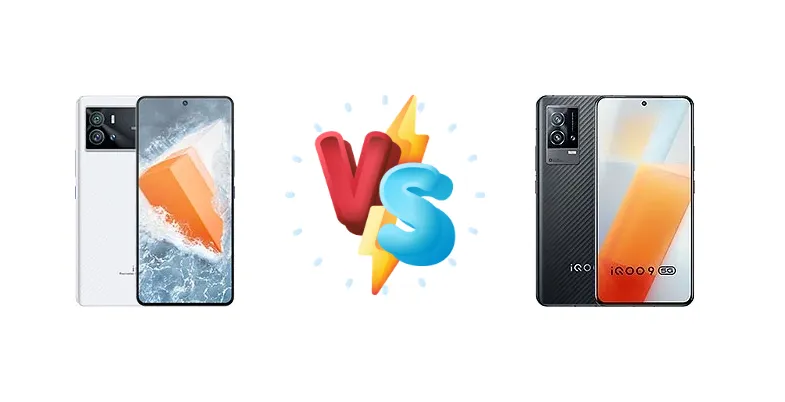
|
🏆 Quick Verdict
The iQOO 9 (China) takes the lead thanks to its significantly more powerful Snapdragon 8 Gen 1 chipset. While both offer blazing-fast 120W charging, the China variant's superior performance makes it the better choice for gamers and power users, despite potential thermal throttling concerns.
| PHONES | ||
|---|---|---|
| Phone Names | vivo iQOO 9 (China) | vivo iQOO 9 |
| Network | ||
|---|---|---|
| 2G bands | GSM 850 / 900 / 1800 / 1900 | GSM 850 / 900 / 1800 / 1900 |
| 3G bands | HSDPA 850 / 900 / 1700(AWS) / 1900 / 2100 | HSDPA 850 / 900 / 1700(AWS) / 1900 / 2100 |
| 4G bands | 1, 2, 3, 4, 5, 7, 8, 12, 17, 18, 19, 20, 26, 28, 34, 38, 39, 40, 41 | 1, 2, 3, 4, 5, 7, 8, 12, 17, 18, 19, 20, 25, 26, 28, 34, 38, 39, 40, 41 |
| 5G bands | 1, 3, 5, 8, 28, 41, 77, 78 SA/NSA | 1, 3, 5, 8, 28, 41, 77, 78 SA/NSA |
| Speed | HSPA, LTE, 5G | HSPA, LTE, 5G |
| Technology | GSM / CDMA / HSPA / CDMA2000 / LTE / 5G | GSM / HSPA / LTE / 5G |
| CDMA2000 1x | - | |
| Launch | ||
|---|---|---|
| Announced | 2022, January 05 | 2022, February 23 |
| Status | Available. Released 2022, January 12 | Available. Released 2022, March 02 |
| Body | ||
|---|---|---|
| Build | - | Glass front (Panda Glass), aluminum frame, glass back |
| Dimensions | 164.5 x 76.7 x 8.4 mm (6.48 x 3.02 x 0.33 in) | 159.1 x 75.1 x 8.6 or 8.7 mm |
| SIM | Nano-SIM + Nano-SIM | Nano-SIM + Nano-SIM |
| Weight | 206 g (7.27 oz) | 200 g / 202 g (7.05 oz) |
| - | Splash and dust resistant | |
| Display | ||
|---|---|---|
| Protection | - | Panda Glass |
| Resolution | 1080 x 2400 pixels, 20:9 ratio (~388 ppi density) | 1080 x 2376 pixels (~398 ppi density) |
| Size | 6.78 inches, 111.0 cm2 (~88.0% screen-to-body ratio) | 6.56 inches, 104.6 cm2 (~87.5% screen-to-body ratio) |
| Type | AMOLED, 120Hz, HDR10, 1500 nits (peak) | AMOLED, 1B colors, 120Hz, HDR10+, 1200 nits (peak) |
| - | Monster Touch support | |
| Platform | ||
|---|---|---|
| CPU | Octa-core (1x3.00 GHz Cortex-X2 & 3x2.50 GHz Cortex-A710 & 4x1.80 GHz Cortex-A510) | Octa-core (1x2.99 GHz Cortex-X1 & 3x2.42 GHz Cortex-A78 & 4x1.80 GHz Cortex-A55) |
| Chipset | Qualcomm SM8450 Snapdragon 8 Gen 1 (4 nm) | Qualcomm SM8350 Snapdragon 888+ 5G (5 nm) |
| GPU | Adreno 730 | Adreno 660 |
| OS | Android 12, OriginOS Ocean | Android 12, Funtouch 12 |
| Memory | ||
|---|---|---|
| Card slot | No | No |
| Internal | 128GB 8GB RAM, 256GB 8GB RAM, 256GB 12GB RAM, 512GB 12GB RAM | 128GB 8GB RAM, 256GB 12GB RAM |
| UFS 3.1 | UFS 3.1 | |
| Main Camera | ||
|---|---|---|
| Dual | - | 48 MP, f/1.8, 25mm (wide), 1/2.0", 0.8µm, PDAF, gimbal OIS 13 MP, f/2.5, 50mm (telephoto), PDAF, 2x optical zoom 13 MP, f/2.2, 16mm, 120˚ (ultrawide) |
| Features | Dual-LED dual-tone flash, HDR, panorama | Dual-LED dual-tone flash, HDR, panorama |
| Single | 16 MP, f/2.5, (wide) | 16 MP, f/2.5, (wide), 1/3.1", 1.0µm |
| Triple | 50 MP, f/1.8, (wide), 1/1.57", 1.0µm, PDAF, OIS 12 MP, f/2.0, 47mm (telephoto), PDAF, 2x optical zoom 13 MP, f/2.2, 16mm, 120˚ (ultrawide) | - |
| Video | 4K@30fps, 1080p@30fps, gyro-EIS | 4K@24/30/60fps, 1080p@30/60fps |
| Selfie camera | ||
|---|---|---|
| Features | HDR | HDR |
| Single | 16 MP, f/2.5, (wide) | 16 MP, f/2.5, (wide), 1/3.1", 1.0µm |
| Video | 1080p@30fps, gyro-EIS | 1080p@30fps |
| Sound | ||
|---|---|---|
| 3.5mm jack | No | No |
| 35mm jack | No | No |
| Loudspeaker | Yes, with dual speakers | Yes, with stereo speakers |
| 24-bit/192kHz audio | 24-bit/192kHz audio | |
| Comms | ||
|---|---|---|
| Bluetooth | 5.2, A2DP, LE, aptX HD, aptX Adaptive | 5.2, A2DP, LE, aptX HD, aptX Adaptive, aptX Lossless |
| NFC | Yes | Yes |
| Positioning | GPS, GLONASS, GALILEO, BDS, QZSS | GPS, GLONASS |
| Radio | No | No |
| USB | USB Type-C 2.0, OTG | USB Type-C 2.0, OTG |
| WLAN | Wi-Fi 802.11 a/b/g/n/ac/6, dual-band, Wi-Fi Direct | Wi-Fi 802.11 a/b/g/n/ac, dual-band, Wi-Fi Direct |
| Features | ||
|---|---|---|
| Sensors | Fingerprint (under display, optical), accelerometer, gyro, proximity, compass | Fingerprint (under display, optical), accelerometer, gyro, proximity, compass |
| Battery | ||
|---|---|---|
| Charging | 120W wired, 100% in 19 min 10W reverse wireless | 120W wired, 50% in 6 min, 100% in 18 min |
| Type | 4700 mAh | 4350 mAh |
| Misc | ||
|---|---|---|
| Colors | White (BMW M branding), Orange, Black | Legend, Alpha, Phoenix Orange |
| Models | V2171A | - |
| Price | About 560 EUR | About 510 EUR |
| Tests | ||
|---|---|---|
| Battery life | - | Endurance rating 105h |
| Camera | - | Photo / Video |
| Display | - | Contrast ratio: Infinite (nominal) |
| Loudspeaker | - | -25.5 LUFS (Very good) |
| Performance | - | AnTuTu: 745168 (v8), 852898 (v9) GeekBench: 3503 (v5.1) GFXBench: 65fps (ES 3.1 onscreen) |
vivo iQOO 9 (China)
- Significantly faster performance (Snapdragon 8 Gen 1)
- Blazing-fast 120W charging
- High peak brightness display
- Potential for thermal throttling
- Camera optimization may be less refined
vivo iQOO 9
- More efficient processor (Snapdragon 888+)
- Generally runs cooler
- Likely more refined camera system
- Lower performance compared to the China version
- Still offers 120W charging
Display Comparison
Both iQOO 9 models feature excellent AMOLED displays with a 120Hz refresh rate. The China version boasts a measured peak brightness of 749 nits, while the standard version advertises an 'infinite' contrast ratio (likely a marketing term). Color accuracy and viewing angles are expected to be comparable on both devices.
Camera Comparison
Camera details are sparse in the provided data. Both phones are listed as having 'Photo / Video' capabilities. Based on general knowledge, the standard iQOO 9 likely has a more refined camera system due to longer optimization time. Expect similar image quality in good lighting conditions, but the China version might struggle slightly more in low light due to potential thermal limitations.
Performance
This is where the biggest difference lies. The iQOO 9 (China) with the Snapdragon 8 Gen 1 offers a substantial performance boost over the Snapdragon 888+ in the standard iQOO 9. Expect faster app loading, smoother multitasking, and significantly improved gaming performance. However, the 8 Gen 1 is known to run hotter, potentially leading to thermal throttling under sustained load. The 888+ is more efficient and generally runs cooler.
Battery Life
Both devices share the same endurance rating of 105h, suggesting comparable battery life despite the performance differences. The 120W wired charging is a highlight for both, offering incredibly fast charging speeds (19-18 minutes to 100%).
Buying Guide
The iQOO 9 (China) is ideal for gamers and users prioritizing raw performance and the latest technology. The standard iQOO 9 is a great option for those seeking a high-refresh-rate display, fast charging, and a reliable all-around experience, especially if thermal management is a concern.