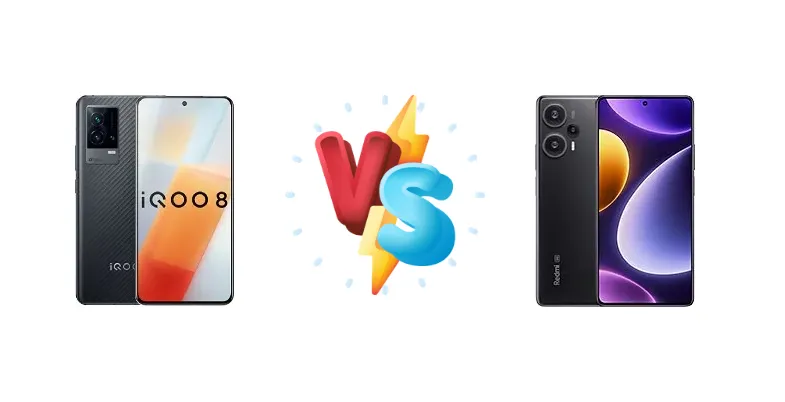
The smartphone market is brimming with options, making it tough to choose. Today, we're pitting two compelling contenders against each other: the vivo iQOO 8 and the Xiaomi Redmi Note 12 Turbo. Both offer impressive features, but cater to slightly different needs. Let's dive in and see which one comes out on top.
🏆 Quick Verdict
The Redmi Note 12 Turbo offers a more modern chipset and excellent value, making it a strong all-arounder. The iQOO 8 boasts significantly faster charging and a flagship Snapdragon 888, appealing to those prioritizing raw power and speed, despite its age. Ultimately, the Turbo wins on efficiency and price.
| Network |
|---|
| 2G bands | GSM 850 / 900 / 1800 / 1900 | GSM 850 / 900 / 1800 / 1900 |
| 3G bands | HSDPA 850 / 900 / 2100 | HSDPA 800 / 850 / 900 / 2100 |
| 4G bands | 1, 2, 3, 4, 5, 7, 8, 12, 17, 18, 19, 20, 26, 28 | 1, 3, 5, 8, 19, 34, 38, 39, 40, 41, 42 |
| 5G bands | 1, 5, 8, 3, 28, 41, 77, 78 SA/NSA | 1, 3, 5, 8, 28, 38, 41, 77, 78 SA/NSA |
| Speed | HSPA, LTE, 5G | HSPA, LTE, 5G |
| Technology | GSM / HSPA / LTE / 5G | GSM / HSPA / CDMA2000 / LTE / 5G |
| | - | CDMA2000 1x |
| Launch |
|---|
| Announced | 2021, August 17 | 2023, March 28 |
| Status | Available. Released 2021, August 24 | Available. Released 2023, March 28 |
| Body |
|---|
| Build | - | Glass front, plastic frame, plastic back |
| Dimensions | 159 x 75.1 x 8.6 mm (6.26 x 2.96 x 0.34 in) | 161.1 x 75 x 7.9 mm (6.34 x 2.95 x 0.31 in) |
| SIM | Nano-SIM + Nano-SIM | Nano-SIM + Nano-SIM |
| Weight | 200 g (7.05 oz) | 181 g (6.38 oz) |
| Display |
|---|
| Resolution | 1080 x 2376 pixels (~398 ppi density) | 1080 x 2400 pixels, 20:9 ratio (~395 ppi density) |
| Size | 6.56 inches, 104.6 cm2 (~87.6% screen-to-body ratio) | 6.67 inches, 107.4 cm2 (~88.9% screen-to-body ratio) |
| Type | AMOLED, 120Hz, HDR10 | OLED, 68B colors, 120Hz, Dolby Vision, HDR10+, 1000 nits (HBM) |
| Platform |
|---|
| CPU | Octa-core (1x2.84 GHz Cortex-X1 & 3x2.42 GHz Cortex-A78 & 4x1.80 GHz Cortex-A55 | Octa-core (1x2.91 GHz Cortex-X2 & 3x2.49 GHz Cortex-A710 & 4x1.8 GHz Cortex-A510) |
| Chipset | Qualcomm SM8350 Snapdragon 888 5G (5 nm) | Qualcomm SM7475-AB Snapdragon 7+ Gen 2 (4 nm) |
| GPU | Adreno 660 | Adreno 725 |
| OS | Android 11, OriginOS 1.0 | Android 13, MIUI 14 |
| Memory |
|---|
| Card slot | No | No |
| Internal | 128GB 8GB RAM, 256GB 12GB RAM | 256GB 8GB RAM, 256GB 12GB RAM, 256GB 16GB RAM, 512GB 12GB RAM, 1TB 16GB RAM |
| | UFS 3.1 | UFS 3.1 |
| Main Camera |
|---|
| Features | Dual-LED dual-tone flash, HDR, panorama | LED flash, HDR, panorama |
| Single | 16 MP, f/2.5, (wide) | - |
| Triple | 50 MP, f/1.8, 23mm (wide), 1/2.0", 0.8µm, PDAF
13 MP, f/2.2, 50mm (telephoto), PDAF
13 MP, f/2.2, 120˚ (ultrawide) | 64 MP, f/1.8, (wide), 1/2.0", 0.7µm, PDAF, OIS
8 MP, f/2.2, 120˚ (ultrawide), 1/4.0", 1.12µm
2 MP (macro) |
| Video | 4K@30fps, 1080p@30fps | 4K@30fps, 1080p@30/60/120/240fps |
| Selfie camera |
|---|
| Features | HDR | - |
| Single | 16 MP, f/2.5, (wide) | 16 MP, f/2.5, (wide) |
| Video | 1080p@30fps | 1080p@30/60fps |
| Sound |
|---|
| 3.5mm jack | No | Yes |
| 35mm jack | No | Yes |
| Loudspeaker | Yes, with dual speakers | Yes, with stereo speakers |
| | 24-bit/192kHz audio | 24-bit/192kHz audio |
| Comms |
|---|
| Bluetooth | 5.2, A2DP, LE, aptX HD | 5.3, A2DP, LE |
| Infrared port | - | Yes |
| NFC | Yes | Yes |
| Positioning | GPS | GPS (L1), GLONASS (G1), BDS (B1I+B1c), GALILEO (E1), QZSS (L1) |
| Radio | No | No |
| USB | USB Type-C 2.0 | USB Type-C 2.0, OTG |
| WLAN | Wi-Fi 802.11 a/b/g/n/ac, dual-band, Wi-Fi Direct | Wi-Fi 802.11 a/b/g/n/ac/6e, dual-band |
| Features |
|---|
| Sensors | Fingerprint (under display, optical), accelerometer, gyro, proximity, compass | Fingerprint (side-mounted), accelerometer, gyro, proximity, compass |
| Battery |
|---|
| Charging | 120W wired | 67W wired, PD3.0, QC4 |
| Type | 4350 mAh | Li-Po 5000 mAh |
| Misc |
|---|
| Colors | White, Orange, Black | Black, Blue, White, Harry Potter Edition |
| Models | V2136A | 23049RAD8C |
| Price | About 500 EUR | About 270 EUR |
vivo iQOO 8
- Incredibly fast 120W charging
- Flagship Snapdragon 888 chipset
- Potentially better camera performance
- Smooth display with high refresh rate
- Older chipset compared to the competition
- Potentially shorter battery life
- May lack some of the latest features
Xiaomi Redmi Note 12 Turbo
- Modern Snapdragon 7+ Gen 2 chipset
- Excellent value for money
- Good battery life and efficiency
- Fast 67W charging
- Camera may not be as versatile as the iQOO 8
- Charging speed is slower than the iQOO 8
- Build quality might be slightly less premium
Display Comparison
Both phones feature vibrant displays, but the Redmi Note 12 Turbo likely has a slightly more modern panel with potentially better color accuracy and brightness. The iQOO 8's display is still excellent, offering a smooth refresh rate for fluid visuals. Expect similar resolution and size, around 6.6-6.7 inches.
Camera Comparison
The iQOO 8 likely has a more versatile camera system with potentially better low-light performance due to its flagship chipset and associated image processing capabilities. The Redmi Note 12 Turbo's camera is still capable, offering good image quality in most conditions, but may not match the iQOO 8's overall photographic prowess. Expect a main sensor around 50MP on both.
Performance
Here's where the differences are most noticeable. The iQOO 8's Snapdragon 888 is a flagship chip, but it's a generation older. The Redmi Note 12 Turbo's Snapdragon 7+ Gen 2 offers impressive performance and better power efficiency. While the 888 still holds its own, the 7+ Gen 2 provides a more sustainable and modern experience, especially for demanding tasks.
Battery Life
The Redmi Note 12 Turbo's more efficient chipset and optimized software contribute to better battery life. While the iQOO 8's 120W charging is incredibly fast, the Redmi Note 12 Turbo's 67W charging is still quite respectable and combined with better efficiency, it will likely last longer on a single charge.
Buying Guide
The vivo iQOO 8 is ideal for gamers and power users who demand top-tier performance and incredibly fast charging, and are willing to overlook a slightly older chipset. The Xiaomi Redmi Note 12 Turbo is perfect for users seeking a balanced experience with a modern processor, great battery life, and exceptional value for money.
Frequently Asked Questions
❓ Which phone is better for gaming?
While the iQOO 8 has a more powerful chipset on paper, the Redmi Note 12 Turbo's efficient processor and optimized software provide a smoother and more sustainable gaming experience, especially for extended periods.
❓ Is the 120W charging on the iQOO 8 worth it?
Absolutely! It's incredibly convenient for quickly topping up your battery. However, consider that the Redmi Note 12 Turbo still offers fast charging and better overall battery life.