
iQOO 8 vs OnePlus 9 Pro: A Deep Dive into Flagship Performance and Charging
| Phones Images | |||||
|---|---|---|---|---|---|
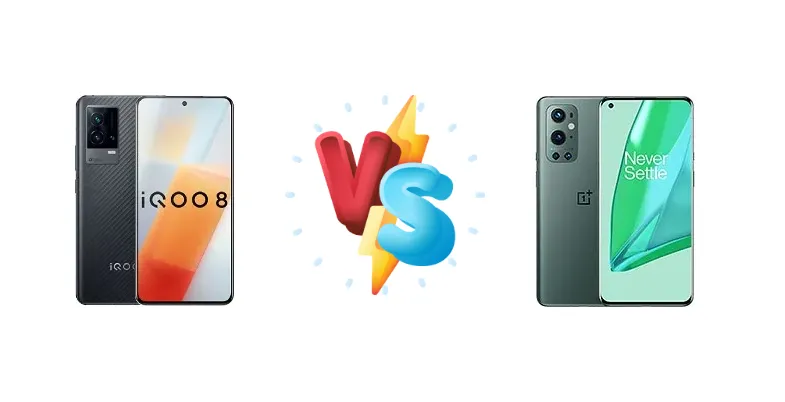
|
🏆 Quick Verdict
For users prioritizing blazing-fast charging and peak performance, the iQOO 8 is the clear winner. Its 120W charging dwarfs the OnePlus 9 Pro’s 65W, and while both share the Snapdragon 888, the iQOO’s focus on cooling suggests better sustained performance. However, the OnePlus 9 Pro offers a more polished software experience and a potentially more versatile camera.
| PHONES | ||
|---|---|---|
| Phone Names | vivo iQOO 8 | OnePlus 9 Pro |
| Network | ||
|---|---|---|
| 2G bands | GSM 850 / 900 / 1800 / 1900 | GSM 850 / 900 / 1800 / 1900 |
| 3G bands | HSDPA 850 / 900 / 2100 | HSDPA 800 / 850 / 900 / 1700(AWS) / 1800 / 1900 / 2100 |
| 4G bands | 1, 2, 3, 4, 5, 7, 8, 12, 17, 18, 19, 20, 26, 28 | 1, 2, 3, 4, 5, 7, 8, 12, 13, 17, 18, 19, 20, 25, 26, 28, 32, 38, 39, 40, 41, 66 - EU |
| 5G bands | 1, 5, 8, 3, 28, 41, 77, 78 SA/NSA | 1, 3, 5, 7, 8, 20, 28, 38, 40, 41, 66, 78 SA/NSA - EU |
| Speed | HSPA, LTE, 5G | HSPA 42.2/5.76 Mbps, LTE Cat20 2000/200 Mbps, 5G |
| Technology | GSM / HSPA / LTE / 5G | GSM / CDMA / HSPA / LTE / 5G |
| - | 1, 3, 28, 41, 78, 79 SA/NSA - CN | |
| Launch | ||
|---|---|---|
| Announced | 2021, August 17 | 2021, March 23 |
| Status | Available. Released 2021, August 24 | Available. Released 2021, March 30 |
| Body | ||
|---|---|---|
| Build | - | Glass front (Gorilla Glass 5), glass back (Gorilla Glass 5), aluminum frame |
| Dimensions | 159 x 75.1 x 8.6 mm (6.26 x 2.96 x 0.34 in) | 163.2 x 73.6 x 8.7 mm (6.43 x 2.90 x 0.34 in) |
| SIM | Nano-SIM + Nano-SIM | · Nano-SIM· Nano-SIM + Nano-SIM |
| Weight | 200 g (7.05 oz) | 197 g (6.95 oz) |
| - | IP68 dust/water resistant (up to 1.5m for 30 min) | |
| Display | ||
|---|---|---|
| Protection | - | Corning Gorilla Glass 5 |
| Resolution | 1080 x 2376 pixels (~398 ppi density) | 1440 x 3216 pixels, 20:9 ratio (~525 ppi density) |
| Size | 6.56 inches, 104.6 cm2 (~87.6% screen-to-body ratio) | 6.7 inches, 108.4 cm2 (~90.3% screen-to-body ratio) |
| Type | AMOLED, 120Hz, HDR10 | LTPO Fluid2 AMOLED, 1B colors, 120Hz, HDR10+, 1300 nits (peak) |
| - | Always-on display | |
| Platform | ||
|---|---|---|
| CPU | Octa-core (1x2.84 GHz Cortex-X1 & 3x2.42 GHz Cortex-A78 & 4x1.80 GHz Cortex-A55 | Octa-core (1x2.84 GHz Cortex-X1 & 3x2.42 GHz Cortex-A78 & 4x1.80 GHz Cortex-A55 |
| Chipset | Qualcomm SM8350 Snapdragon 888 5G (5 nm) | Qualcomm SM8350 Snapdragon 888 5G (5 nm) |
| GPU | Adreno 660 | Adreno 660 |
| OS | Android 11, OriginOS 1.0 | Android 11, upgradable to Android 14, OxygenOS 14 |
| Memory | ||
|---|---|---|
| Card slot | No | No |
| Internal | 128GB 8GB RAM, 256GB 12GB RAM | 128GB 8GB RAM, 256GB 8GB RAM, 256GB 12GB RAM |
| UFS 3.1 | UFS 3.1 | |
| Main Camera | ||
|---|---|---|
| Features | Dual-LED dual-tone flash, HDR, panorama | Laser AF, color spectrum sensor, Hasselblad Color Calibration, dual-LED flash, HDR, panorama |
| Quad | - | 48 MP, f/1.8, 23mm (wide), 1/1.43", 1.12µm, multi-directional PDAF, OIS 8 MP, f/2.4, 77mm (telephoto), 1.0µm, PDAF, OIS, 3.3x optical zoom 50 MP, f/2.2, 14mm (ultrawide), 1/1.56", 1.0µm, AF 2 MP, f/2.4, (monochrome) |
| Single | 16 MP, f/2.5, (wide) | 16 MP, f/2.4, (wide), 1/3.06", 1.0µm |
| Triple | 50 MP, f/1.8, 23mm (wide), 1/2.0", 0.8µm, PDAF 13 MP, f/2.2, 50mm (telephoto), PDAF 13 MP, f/2.2, 120˚ (ultrawide) | - |
| Video | 4K@30fps, 1080p@30fps | 8K@30fps, 4K@30/60/120fps, 1080p@30/60/240fps, Auto HDR, gyro-EIS |
| Selfie camera | ||
|---|---|---|
| Features | HDR | HDR |
| Single | 16 MP, f/2.5, (wide) | 16 MP, f/2.4, (wide), 1/3.06", 1.0µm |
| Video | 1080p@30fps | 1080p@30fps, gyro-EIS |
| Sound | ||
|---|---|---|
| 3.5mm jack | No | No |
| 35mm jack | No | No |
| Loudspeaker | Yes, with dual speakers | Yes, with stereo speakers |
| 24-bit/192kHz audio | 24-bit/192kHz audio | |
| Comms | ||
|---|---|---|
| Bluetooth | 5.2, A2DP, LE, aptX HD | 5.2, A2DP, LE, aptX HD |
| NFC | Yes | Yes |
| Positioning | GPS | GPS (L1+L5), GLONASS (G1), BDS (B1), GALILEO (E1+E5a) |
| Radio | No | No |
| USB | USB Type-C 2.0 | USB Type-C 3.1, OTG |
| WLAN | Wi-Fi 802.11 a/b/g/n/ac, dual-band, Wi-Fi Direct | Wi-Fi 802.11 a/b/g/n/ac/6, dual-band, Wi-Fi Direct, DLNA |
| Features | ||
|---|---|---|
| Sensors | Fingerprint (under display, optical), accelerometer, gyro, proximity, compass | Fingerprint (under display, optical), accelerometer, gyro, proximity, compass |
| Battery | ||
|---|---|---|
| Charging | 120W wired | 65W wired, PD, 100% in 29 min 50W wireless, 100% in 43 min 5W reverse wireless |
| Type | 4350 mAh | Li-Po 4500 mAh |
| Misc | ||
|---|---|---|
| Colors | White, Orange, Black | Morning Mist, Forest Green, Stellar Black |
| Models | V2136A | LE2121, LE2125, LE2123, LE2120, LE2127 |
| Price | About 500 EUR | € 246.17 / $ 264.95 / £ 287.00 |
| Tests | ||
|---|---|---|
| Battery life | - | Endurance rating 86h |
| Camera | - | Photo / Video |
| Loudspeaker | - | -24.1 LUFS (Very good) |
vivo iQOO 8
- Industry-leading 120W wired charging
- Potentially better sustained performance due to cooling
- Aggressive focus on raw power
- Missing details on camera specifications
- No wireless or reverse wireless charging
OnePlus 9 Pro
- Balanced feature set with strong camera and display
- Wireless and reverse wireless charging
- Refined software experience
- Slower charging speed compared to iQOO 8
- Snapdragon 888 can be prone to throttling under sustained load
Display Comparison
Both the iQOO 8 and OnePlus 9 Pro utilize the Qualcomm Snapdragon 888 5G chipset, meaning core performance will be very similar. However, the OnePlus 9 Pro boasts a measured peak brightness of 859 nits, suggesting a more visible display in direct sunlight. While panel technology details for the iQOO 8 are missing, OnePlus’s display is likely LTPO, enabling variable refresh rates for improved efficiency. Bezels are expected to be comparable, but color accuracy will depend on calibration profiles, a detail not provided in the source data.
Camera Comparison
Both phones feature capable camera systems, but the source data only indicates 'Photo / Video' capabilities for both. The OnePlus 9 Pro, benefiting from Hasselblad’s color science, is likely to offer a more refined and consistent image processing style. Sensor size and lens apertures are crucial details missing from the iQOO 8’s specifications. The OnePlus 9 Pro’s camera system is known for its versatility, including strong video recording capabilities. Without specific details on the iQOO 8’s camera hardware, it’s difficult to make a direct comparison beyond acknowledging both are flagship-level systems.
Performance
Both devices are powered by the Qualcomm SM8350 Snapdragon 888 5G (5 nm) with an identical CPU configuration – a Cortex-X1 prime core, three A78 performance cores, and four A55 efficiency cores. This means CPU-bound tasks will perform similarly. The key differentiator lies in thermal management. While not explicitly stated, iQOO’s branding often emphasizes gaming performance, suggesting a more robust cooling solution to mitigate the Snapdragon 888’s known throttling tendencies. RAM speed (likely LPDDR5) is also expected to be comparable, but the iQOO 8’s focus on performance could translate to more aggressive memory management.
Battery Life
The OnePlus 9 Pro has an endurance rating of 86 hours, indicating solid battery life. However, the iQOO 8’s defining feature is its 120W wired charging, capable of fully charging the battery significantly faster than the OnePlus 9 Pro’s 65W (29 minutes). The OnePlus 9 Pro also offers 50W wireless charging (43 minutes) and 5W reverse wireless charging, features absent from the iQOO 8’s specifications. While the iQOO 8’s battery capacity is unknown, the faster charging speed effectively mitigates concerns about a potentially smaller battery.
Buying Guide
Buy the vivo iQOO 8 if you need the absolute fastest charging available, frequently game on your phone, and prioritize raw processing power. Buy the OnePlus 9 Pro if you prefer a more refined software experience, value a well-rounded camera system with strong video capabilities, and appreciate the convenience of wireless charging and reverse wireless charging.