
iQOO 8 vs Google Pixel 6 Pro: A Deep Dive into Performance, Camera, and Charging
| Phones Images | |||||
|---|---|---|---|---|---|
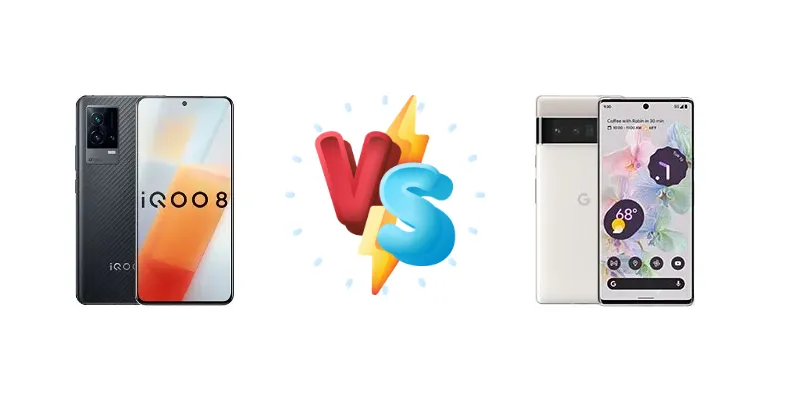
|
🏆 Quick Verdict
For the average user prioritizing camera quality and a seamless software experience, the Google Pixel 6 Pro is the better choice. However, gamers and those demanding the fastest possible charging speeds will find the iQOO 8 a compelling alternative, offering comparable performance at potentially a lower price point.
| PHONES | ||
|---|---|---|
| Phone Names | vivo iQOO 8 | Google Pixel 6 Pro |
| Network | ||
|---|---|---|
| 2G bands | GSM 850 / 900 / 1800 / 1900 | GSM 850 / 900 / 1800 / 1900 |
| 3G bands | HSDPA 850 / 900 / 2100 | HSDPA 800 / 850 / 900 / 1700(AWS) / 1900 / 2100 |
| 4G bands | 1, 2, 3, 4, 5, 7, 8, 12, 17, 18, 19, 20, 26, 28 | 1, 2, 3, 4, 5, 7, 8, 12, 13, 14, 17, 18, 19, 20, 25, 26, 28, 29, 30, 32, 38, 39, 40, 41, 42, 46, 48, 66, 71 - GLUOG, G8VOU |
| 5G bands | 1, 5, 8, 3, 28, 41, 77, 78 SA/NSA | 1, 2, 3, 5, 7, 8, 12, 14, 20, 25, 28, 30, 38, 40, 41, 48, 66, 71, 77, 78, 257, 258, 260, 261 SA/NSA/Sub6/mmWave - G8VOU |
| Speed | HSPA, LTE, 5G | HSPA, LTE, 5G |
| Technology | GSM / HSPA / LTE / 5G | GSM / CDMA / HSPA / EVDO / LTE / 5G |
| - | 1, 2, 3, 5, 7, 8, 12, 14, 20, 25, 28, 30, 38, 40, 41, 48, 66, 71, 77, 78 SA/NSA/Sub6 - GLUOG | |
| Launch | ||
|---|---|---|
| Announced | 2021, August 17 | 2021, October 19 |
| Status | Available. Released 2021, August 24 | Available. Released 2021, October 28 |
| Body | ||
|---|---|---|
| Build | - | Glass front (Gorilla Glass Victus), glass back (Gorilla Glass Victus), aluminum frame |
| Dimensions | 159 x 75.1 x 8.6 mm (6.26 x 2.96 x 0.34 in) | 163.9 x 75.9 x 8.9 mm (6.45 x 2.99 x 0.35 in) |
| SIM | Nano-SIM + Nano-SIM | Nano-SIM + eSIM |
| Weight | 200 g (7.05 oz) | 210 g (7.41 oz) |
| - | IP68 dust/water resistant (up to 1.5m for 30 min) | |
| Display | ||
|---|---|---|
| Protection | - | Corning Gorilla Glass Victus |
| Resolution | 1080 x 2376 pixels (~398 ppi density) | 1440 x 3120 pixels, 19.5:9 ratio (~512 ppi density) |
| Size | 6.56 inches, 104.6 cm2 (~87.6% screen-to-body ratio) | 6.7 inches, 110.6 cm2 (~88.9% screen-to-body ratio) |
| Type | AMOLED, 120Hz, HDR10 | LTPO AMOLED, 120Hz, HDR10+ |
| - | Always-on display | |
| Platform | ||
|---|---|---|
| CPU | Octa-core (1x2.84 GHz Cortex-X1 & 3x2.42 GHz Cortex-A78 & 4x1.80 GHz Cortex-A55 | Octa-core (2x2.80 GHz Cortex-X1 & 2x2.25 GHz Cortex-A76 & 4x1.80 GHz Cortex-A55) |
| Chipset | Qualcomm SM8350 Snapdragon 888 5G (5 nm) | Google Tensor (5 nm) |
| GPU | Adreno 660 | Mali-G78 MP20 |
| OS | Android 11, OriginOS 1.0 | Android 12, upgradable to Android 15, up to 5 major Android upgrades |
| Memory | ||
|---|---|---|
| Card slot | No | No |
| Internal | 128GB 8GB RAM, 256GB 12GB RAM | 128GB 12GB RAM, 256GB 12GB RAM, 512GB 12GB RAM |
| UFS 3.1 | UFS 3.1 | |
| Main Camera | ||
|---|---|---|
| Features | Dual-LED dual-tone flash, HDR, panorama | Laser AF, Dual-LED flash, Pixel Shift, Auto-HDR, panorama |
| Single | 16 MP, f/2.5, (wide) | 11.1 MP, f/2.2, 20mm (ultrawide), 1.22µm |
| Triple | 50 MP, f/1.8, 23mm (wide), 1/2.0", 0.8µm, PDAF 13 MP, f/2.2, 50mm (telephoto), PDAF 13 MP, f/2.2, 120˚ (ultrawide) | 50 MP, f/1.9, 25mm (wide), 1/1.31", 1.2µm, dual pixel PDAF, OIS 48 MP, f/3.5, 104mm (periscope telephoto), 1/2.0", 0.8µm, PDAF, OIS, 4x optical zoom 12 MP, f/2.2, 17mm, 114˚ (ultrawide), 1.25µm |
| Video | 4K@30fps, 1080p@30fps | 4K@30/60fps, 1080p@30/60/120/240fps; gyro-EIS, OIS |
| Selfie camera | ||
|---|---|---|
| Features | HDR | HDR, panorama |
| Single | 16 MP, f/2.5, (wide) | 11.1 MP, f/2.2, 20mm (ultrawide), 1.22µm |
| Video | 1080p@30fps | 4K@30fps, 1080p@30/60fps |
| Sound | ||
|---|---|---|
| 3.5mm jack | No | No |
| 35mm jack | No | No |
| Loudspeaker | Yes, with dual speakers | Yes, with stereo speakers |
| 24-bit/192kHz audio | - | |
| Comms | ||
|---|---|---|
| Bluetooth | 5.2, A2DP, LE, aptX HD | 5.2, A2DP, LE, aptX HD |
| NFC | Yes | Yes |
| Positioning | GPS | GPS (L1+L5), GLONASS (G1), BDS (B1I+B1c+B2a), GALILEO (E1+E5a), QZSS (L1+L5) |
| Radio | No | No |
| USB | USB Type-C 2.0 | USB Type-C 3.1 |
| WLAN | Wi-Fi 802.11 a/b/g/n/ac, dual-band, Wi-Fi Direct | Wi-Fi 802.11 a/b/g/n/ac/6e, dual-band, Wi-Fi Direct |
| Features | ||
|---|---|---|
| Sensors | Fingerprint (under display, optical), accelerometer, gyro, proximity, compass | Fingerprint (under display, optical), accelerometer, gyro, proximity, compass, barometer |
| - | Ultra Wideband (UWB) support | |
| Battery | ||
|---|---|---|
| Charging | 120W wired | 23W wired, PD3.0, 50% in 30 min 23W wireless Reverse wireless |
| Type | 4350 mAh | Li-Ion 5003 mAh |
| Misc | ||
|---|---|---|
| Colors | White, Orange, Black | Cloudy White, Sorta Sunny, Stormy Black |
| Models | V2136A | GLUOG, G8VOU, GF5KQ |
| Price | About 500 EUR | € 199.99 / $ 204.99 / £ 275.00 / ₹ 29,699 |
| Tests | ||
|---|---|---|
| Battery life | - | Endurance rating 84h |
| Display | - | Contrast ratio: Infinite (nominal) |
| Performance | - | AnTuTu: 585485 (v8), 719815 (v9) GeekBench: 2831 (v5.1) GFXBench: 39 fps (ES 3.1 onscreen) |
vivo iQOO 8
- Blazing-fast 120W wired charging
- Powerful Snapdragon 888 5G processor
- Potentially better sustained gaming performance
- Charging speed may degrade battery health faster
- Camera likely inferior to Pixel 6 Pro
Google Pixel 6 Pro
- Exceptional camera quality with Google’s AI processing
- Smooth and refined software experience
- Wireless and reverse wireless charging
- Significantly slower wired charging
- Tensor chip may not match Snapdragon 888 in raw power
Display Comparison
The Pixel 6 Pro boasts a measured peak brightness of 846 nits, providing excellent visibility outdoors. While the iQOO 8’s display specs aren’t provided, it’s likely to be competitive, but the Pixel 6 Pro’s infinite (nominal) contrast ratio suggests superior black levels and dynamic range. The Pixel 6 Pro’s larger display size and potentially higher resolution (based on market positioning) will offer a more immersive viewing experience. The iQOO 8 may compensate with a higher refresh rate, but this isn’t confirmed in the provided data.
Camera Comparison
The Pixel 6 Pro’s camera system is a major strength, leveraging Google’s computational photography expertise. While specific sensor details are missing for both phones, the Pixel 6 Pro’s image processing is renowned for its dynamic range and accurate color reproduction. The iQOO 8’s camera performance will likely be good, but it won’t match the Pixel 6 Pro’s AI-powered enhancements. The absence of details on the iQOO 8’s camera suggests it doesn’t represent a significant differentiator compared to the Pixel 6 Pro.
Performance
Both phones utilize an octa-core CPU configuration with Cortex-X1 prime cores, indicating high-end performance. However, the Google Tensor chip in the Pixel 6 Pro is architecturally different, prioritizing AI and machine learning tasks. The iQOO 8’s Snapdragon 888 5G (5nm) is a proven performer, excelling in raw CPU and GPU power. The Tensor chip’s 5nm process is comparable, but its focus on AI could translate to faster image processing and smarter features. The iQOO 8’s potential for higher sustained performance due to the Snapdragon’s established thermal management profile is a key advantage for demanding games.
Battery Life
Both devices achieve an endurance rating of 84 hours, suggesting similar overall battery life despite differing battery capacities (not specified for the iQOO 8). However, the charging speeds are drastically different. The iQOO 8’s 120W wired charging is a game-changer, capable of fully charging the device in a fraction of the time compared to the Pixel 6 Pro’s 23W wired charging (50% in 30 minutes). The Pixel 6 Pro offers the convenience of 23W wireless charging and reverse wireless charging, features absent on the iQOO 8. This makes the Pixel 6 Pro more versatile for users who prefer wireless charging or need to top up other devices.
Buying Guide
Buy the vivo iQOO 8 if you need uncompromising charging speeds (120W) and prioritize peak gaming performance. It’s ideal for users who frequently drain their battery and want to be back up and running in minutes. Buy the Google Pixel 6 Pro if you prefer a polished software experience, exceptional camera capabilities powered by Google’s AI, and a long-term software support commitment. It’s the better choice for photography enthusiasts and those deeply integrated into the Google ecosystem.