
iQOO 8 vs iPhone 13 Pro Max: A Deep Dive into Android and iOS Flagships
| Phones Images | |||||
|---|---|---|---|---|---|
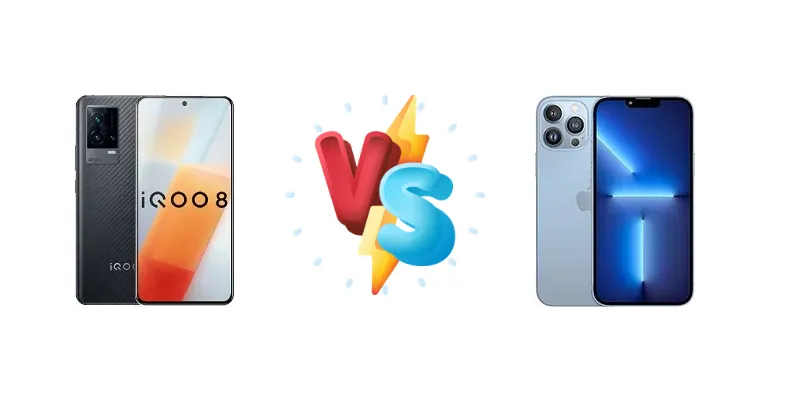
|
🏆 Quick Verdict
For the average user prioritizing longevity, ecosystem integration, and a polished user experience, the iPhone 13 Pro Max is the superior choice. However, the iQOO 8 delivers a compelling value proposition for gamers and power users who demand the fastest charging and aren't tied to the Apple ecosystem.
| PHONES | ||
|---|---|---|
| Phone Names | vivo iQOO 8 | Apple iPhone 13 Pro Max |
| Network | ||
|---|---|---|
| 2G bands | GSM 850 / 900 / 1800 / 1900 | GSM 850 / 900 / 1800 / 1900 |
| 3G bands | HSDPA 850 / 900 / 2100 | HSDPA 850 / 900 / 1700(AWS) / 1900 / 2100 |
| 4G bands | 1, 2, 3, 4, 5, 7, 8, 12, 17, 18, 19, 20, 26, 28 | 1, 2, 3, 4, 5, 7, 8, 12, 13, 17, 18, 19, 20, 25, 26, 28, 30, 32, 34, 38, 39, 40, 41, 42, 46, 48, 66 - A2643, A2644, A2645 |
| 5G bands | 1, 5, 8, 3, 28, 41, 77, 78 SA/NSA | 1, 2, 3, 5, 7, 8, 12, 20, 25, 28, 30, 38, 40, 41, 48, 66, 77, 78, 79 SA/NSA/Sub6 - A2643, A2644 |
| Speed | HSPA, LTE, 5G | HSPA, LTE, 5G, EV-DO Rev.A 3.1 Mbps |
| Technology | GSM / HSPA / LTE / 5G | GSM / CDMA / HSPA / EVDO / LTE / 5G |
| - | 1, 2, 3, 5, 7, 8, 12, 20, 25, 28, 29, 30, 38, 40, 41, 48, 66, 71, 77, 78, 79 SA/NSA/Sub6 - A2641 | |
| Launch | ||
|---|---|---|
| Announced | 2021, August 17 | 2021, September 14 |
| Status | Available. Released 2021, August 24 | Available. Released 2021, September 24 |
| Body | ||
|---|---|---|
| Build | - | Glass front, glass back, stainless steel frame |
| Dimensions | 159 x 75.1 x 8.6 mm (6.26 x 2.96 x 0.34 in) | 160.8 x 78.1 x 7.7 mm (6.33 x 3.07 x 0.30 in) |
| SIM | Nano-SIM + Nano-SIM | · Nano-SIM + eSIM· Nano-SIM + Nano-SIM |
| Weight | 200 g (7.05 oz) | 240 g (8.47 oz) |
| - | IP68 dust/water resistant (up to 6m for 30 min) Apple Pay (Visa, MasterCard, AMEX certified) | |
| Display | ||
|---|---|---|
| Protection | - | Ceramic Shield glass |
| Resolution | 1080 x 2376 pixels (~398 ppi density) | 1284 x 2778 pixels, 19.5:9 ratio (~458 ppi density) |
| Size | 6.56 inches, 104.6 cm2 (~87.6% screen-to-body ratio) | 6.7 inches, 109.8 cm2 (~87.4% screen-to-body ratio) |
| Type | AMOLED, 120Hz, HDR10 | Super Retina XDR OLED, 120Hz, HDR10, Dolby Vision, 1000 nits (HBM), 1200 nits (peak) |
| Platform | ||
|---|---|---|
| CPU | Octa-core (1x2.84 GHz Cortex-X1 & 3x2.42 GHz Cortex-A78 & 4x1.80 GHz Cortex-A55 | Hexa-core (2x3.23 GHz Avalanche + 4x1.82 GHz Blizzard) |
| Chipset | Qualcomm SM8350 Snapdragon 888 5G (5 nm) | Apple A15 Bionic (5 nm) |
| GPU | Adreno 660 | Apple GPU (5-core graphics) |
| OS | Android 11, OriginOS 1.0 | iOS 15, upgradable to iOS 26.1 |
| Memory | ||
|---|---|---|
| Card slot | No | No |
| Internal | 128GB 8GB RAM, 256GB 12GB RAM | 128GB 6GB RAM, 256GB 6GB RAM, 512GB 6GB RAM, 1TB 6GB RAM |
| UFS 3.1 | NVMe | |
| Main Camera | ||
|---|---|---|
| Features | Dual-LED dual-tone flash, HDR, panorama | Dual-LED dual-tone flash, HDR (photo/panorama) |
| Single | 16 MP, f/2.5, (wide) | 12 MP, f/2.2, 23mm (wide), 1/3.6" SL 3D, (depth/biometrics sensor) |
| Triple | 50 MP, f/1.8, 23mm (wide), 1/2.0", 0.8µm, PDAF 13 MP, f/2.2, 50mm (telephoto), PDAF 13 MP, f/2.2, 120˚ (ultrawide) | 12 MP, f/1.5, 26mm (wide), 1/1.7", 1.9µm, dual pixel PDAF, sensor-shift OIS 12 MP, f/2.8, 77mm (telephoto), PDAF, 1/3.4", 1.0µm, OIS, 3x optical zoom 12 MP, f/1.8, 13mm, 120˚ (ultrawide), 1/3.4", 1.0µm, PDAF TOF 3D LiDAR scanner (depth) |
| Video | 4K@30fps, 1080p@30fps | 4K@24/25/30/60fps, 1080p@25/30/60/120/240fps, 10-bit HDR, Dolby Vision HDR (up to 60fps), ProRes, stereo sound rec. |
| Selfie camera | ||
|---|---|---|
| Features | HDR | HDR |
| Single | 16 MP, f/2.5, (wide) | 12 MP, f/2.2, 23mm (wide), 1/3.6", 1.0µm SL 3D, (depth/biometrics sensor) |
| Video | 1080p@30fps | 4K@24/25/30/60fps, 1080p@25/30/60/120fps, gyro-EIS |
| Sound | ||
|---|---|---|
| 3.5mm jack | No | No |
| 35mm jack | No | No |
| Loudspeaker | Yes, with dual speakers | Yes, with stereo speakers |
| 24-bit/192kHz audio | - | |
| Comms | ||
|---|---|---|
| Bluetooth | 5.2, A2DP, LE, aptX HD | 5.0, A2DP, LE |
| NFC | Yes | Yes |
| Positioning | GPS | GPS, GLONASS, GALILEO, BDS, QZSS |
| Radio | No | No |
| USB | USB Type-C 2.0 | Lightning, USB 2.0 |
| WLAN | Wi-Fi 802.11 a/b/g/n/ac, dual-band, Wi-Fi Direct | Wi-Fi 802.11 a/b/g/n/ac/6, dual-band, hotspot |
| Features | ||
|---|---|---|
| Sensors | Fingerprint (under display, optical), accelerometer, gyro, proximity, compass | Face ID, accelerometer, gyro, proximity, compass, barometer |
| - | Ultra Wideband (UWB) support | |
| Battery | ||
|---|---|---|
| Charging | 120W wired | Wired, PD2.0, 50% in 30 min 15W wireless (MagSafe) 15W wireless (Qi2) - requires iOS 17.2 update |
| Type | 4350 mAh | Li-Ion 4352 mAh (16.75 Wh) |
| Misc | ||
|---|---|---|
| Colors | White, Orange, Black | Graphite, Gold, Silver, Sierra Blue, Alpine Green |
| Models | V2136A | A2643, A2484, A2641, A2644, A2645, iphone14,3 |
| Price | About 500 EUR | € 423.38 / $ 394.86 / £ 355.00 |
| SAR | - | 1.18 W/kg (head) 1.20 W/kg (body) |
| SAR EU | - | 0.99 W/kg (head) 0.98 W/kg (body) |
| Tests | ||
|---|---|---|
| Battery life | - | Endurance rating 121h |
| Camera | - | Photo / Video |
| Display | - | Contrast ratio: Infinite (nominal) |
| Loudspeaker | - | -24.0 LUFS (Very good) |
| Performance | - | AnTuTu: 801691 (v9) GeekBench: 4706 (v5.1) GFXBench: 60fps (ES 3.1 onscreen) |
vivo iQOO 8
- Blazing-fast 120W wired charging
- Powerful Snapdragon 888 5G processor
- Android OS flexibility
- Potentially shorter software support lifespan
- Less refined ecosystem compared to Apple
Apple iPhone 13 Pro Max
- Exceptional camera system with ProRes video
- Long-term software support and updates
- Seamless integration with Apple ecosystem
- Slower charging speeds compared to iQOO 8
- Less customization options in iOS
Display Comparison
The iPhone 13 Pro Max boasts a measured peak brightness of 1050 nits, ensuring excellent visibility even in direct sunlight. While the iQOO 8’s display specs aren’t provided, it’s likely to be a high-quality AMOLED panel, but likely won’t match the iPhone’s peak brightness. The iPhone’s infinite (nominal) contrast ratio, typical of OLED displays, delivers deep blacks and vibrant colors. The iPhone’s ProMotion technology (adaptive refresh rate) is absent on the iQOO 8, potentially resulting in less smooth scrolling in some scenarios. The iPhone’s display is also known for its color accuracy, crucial for content creators.
Camera Comparison
Both devices excel in photography and videography, but approach it differently. The iPhone 13 Pro Max is renowned for its cinematic mode and ProRes video recording capabilities, leveraging Apple’s image signal processor. While the iQOO 8’s camera specs aren’t detailed beyond 'Photo / Video', it likely focuses on computational photography to enhance image quality. The iPhone’s larger sensor size (typically) and advanced image stabilization (OIS) contribute to superior low-light performance and smoother videos. The iPhone’s consistent image processing delivers natural-looking results, while the iQOO 8 may lean towards more vibrant, saturated colors.
Performance
The Apple A15 Bionic, a hexa-core chip with 2x3.23 GHz Avalanche and 4x1.82 GHz Blizzard cores, demonstrably outperforms the Qualcomm Snapdragon 888 5G (1x2.84 GHz Cortex-X1, 3x2.42 GHz Cortex-A78, 4x1.80 GHz Cortex-A55) in most benchmarks. While both are built on a 5nm process, Apple’s chip design and manufacturing lead to superior single-core and multi-core performance. The iQOO 8’s Snapdragon 888 is still a powerful chip, capable of handling demanding games and applications, but may exhibit more thermal throttling under sustained load. The iPhone’s optimized software further enhances its performance efficiency.
Battery Life
Both phones achieve an impressive endurance rating of 121 hours, indicating similar overall battery life despite differing capacities. However, the iQOO 8’s 120W wired charging is a game-changer, capable of fully charging the device in a fraction of the time compared to the iPhone 13 Pro Max’s 50% charge in 30 minutes via PD2.0. The iPhone offers 15W wireless charging with MagSafe and Qi2 (with iOS 17.2), providing convenience, but significantly slower than the iQOO 8’s wired charging. The iQOO 8’s faster charging is a significant advantage for users who frequently need to top up their battery quickly.
Buying Guide
Buy the vivo iQOO 8 if you need blazing-fast 120W charging, prioritize raw gaming performance, and prefer the flexibility of the Android operating system. Buy the Apple iPhone 13 Pro Max if you value a seamless user experience, long-term software updates, a superior camera system, and integration with other Apple devices.