
iQOO 8 Pro vs Xiaomi Mi 11 Ultra: A Deep Dive into Flagship Performance
| Phones Images | |||||
|---|---|---|---|---|---|
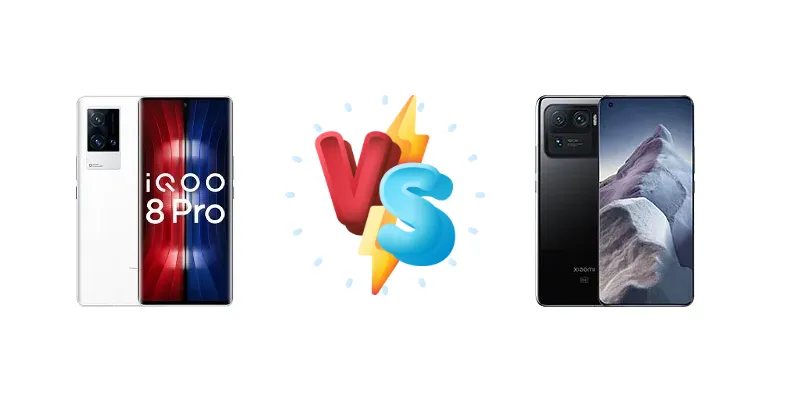
|
🏆 Quick Verdict
For users prioritizing ultimate charging speed and a slight performance edge, the iQOO 8 Pro is the winner. Its 120W charging is unmatched, and the Snapdragon 888+ offers a marginal CPU boost. However, the Mi 11 Ultra’s excellent battery endurance and refined camera system make it a strong contender for photography enthusiasts.
| PHONES | ||
|---|---|---|
| Phone Names | vivo iQOO 8 Pro | Xiaomi Mi 11 Ultra |
| Network | ||
|---|---|---|
| 2G bands | GSM 850 / 900 / 1800 / 1900 | GSM 850 / 900 / 1800 / 1900 |
| 3G bands | HSDPA 850 / 900 / 2100 | HSDPA 850 / 900 / 1700(AWS) / 1900 / 2100 |
| 4G bands | 1, 2, 3, 4, 5, 7, 8, 12, 17, 18, 19, 20, 26, 28, 34, 38, 39, 40, 41 | 1, 2, 3, 4, 5, 7, 8, 12, 17, 20, 28, 32, 38, 40, 41, 42, 66 - International |
| 5G bands | 1, 3, 5, 8, 28, 38, 41, 77, 78, 79 SA/NSA | 1, 3, 5, 7, 8, 20, 28, 38, 40, 41, 77, 78, 79 SA/NSA - International |
| Speed | HSPA, LTE, 5G | HSPA, LTE, 5G |
| Technology | GSM / HSPA / LTE / 5G | GSM / CDMA / HSPA / EVDO / LTE / 5G |
| - | 1, 3, 28, 41, 77, 78, 79 SA/NSA - China | |
| Launch | ||
|---|---|---|
| Announced | 2021, August 17 | 2021, March 29 |
| Status | Available. Released 2021, August 26 | Available. Released 2021, April 02 |
| Body | ||
|---|---|---|
| Build | - | Glass front (Gorilla Glass Victus), ceramic back, aluminum frame |
| Dimensions | 165 x 75.2 x 9.2 mm (6.50 x 2.96 x 0.36 in) | 164.3 x 74.6 x 8.4 mm (6.47 x 2.94 x 0.33 in) |
| SIM | Nano-SIM + Nano-SIM | Nano-SIM + Nano-SIM |
| Weight | 205 g (7.23 oz) | 234 g (8.25 oz) |
| - | IP68 dust/water resistant (up to 1.5m for 30 min) | |
| Display | ||
|---|---|---|
| Protection | - | Corning Gorilla Glass Victus |
| Resolution | 1440 x 3200 pixels, 20:9 ratio (~518 ppi density) | 1440 x 3200 pixels, 20:9 ratio (~515 ppi density) |
| Size | 6.78 inches, 111.0 cm2 (~89.4% screen-to-body ratio) | 6.81 inches, 112.0 cm2 (~91.4% screen-to-body ratio) |
| Type | LTPO AMOLED, 120Hz, HDR10+, Dolby Vision, 1500 nits (peak) | AMOLED, 1B colors, 120Hz, HDR10+, Dolby Vision, 900 nits (HBM), 1700 nits (peak) |
| Platform | ||
|---|---|---|
| CPU | Octa-core (1x2.99 GHz Cortex-X1 & 3x2.42 GHz Cortex-A78 & 4x1.80 GHz Cortex-A55) | Octa-core (1x2.84 GHz Cortex-X1 & 3x2.42 GHz Cortex-A78 & 4x1.80 GHz Cortex-A55) |
| Chipset | Qualcomm SM8350 Snapdragon 888+ 5G (5 nm) | Qualcomm SM8350 Snapdragon 888 5G (5 nm) |
| GPU | Adreno 660 | Adreno 660 |
| OS | Android 11, OriginOS 1.0 | Android 11, upgradable to Android 13, MIUI 14 |
| Memory | ||
|---|---|---|
| Card slot | No | No |
| Internal | 256GB 8GB RAM, 256GB 12GB RAM, 512GB 12GB RAM | 256GB 8GB RAM, 256GB 12GB RAM, 512GB 12GB RAM |
| UFS 3.1 | UFS 3.1 | |
| Main Camera | ||
|---|---|---|
| Features | Dual-LED dual-tone flash, HDR, panorama | Laser AF, color spectrum sensor, Dual-LED flash, HDR, panorama, 1.1” AMOLED selfie display |
| Single | 16 MP, f/2.4, (wide) | 20 MP, f/2.2, 27mm (wide), 1/3.4", 0.8µm |
| Triple | 50 MP, f/1.8, 23mm (wide), 1/1.56", 1.0µm, PDAF, gimbal OIS 16 MP, f/2.2, 60mm (telephoto), 1/3.1", 1.0µm, PDAF, OIS, 2.5x optical zoom 48 MP, f/2.2, 14mm, 114˚ (ultrawide), 0.8µm, AF | 50 MP, f/2.0, 24mm (wide), 1/1.12", 1.4µm, dual pixel PDAF, OIS 48 MP, f/4.1, 120mm (periscope telephoto), 1/2.0", 0.8µm, PDAF, OIS, 5x optical zoom 48 MP, f/2.2, 12mm, 128˚ (ultrawide), 1/2.0", 0.8µm, PDAF |
| Video | 8K@30fps, 1080p@30fps, gyro-EIS | 8K@24fps, 4K@30/60fps, 1080p@30/60/120/240/960/1920fps, gyro-EIS, HDR10+ rec. |
| Selfie camera | ||
|---|---|---|
| Features | HDR | HDR, panorama |
| Single | 16 MP, f/2.4, (wide) | 20 MP, f/2.2, 27mm (wide), 1/3.4", 0.8µm |
| Video | 1080p@30fps, gyro-EIS | 1080p@30/60fps, 720p@120fps, gyro-EIS |
| Sound | ||
|---|---|---|
| 3.5mm jack | No | No |
| 35mm jack | No | No |
| Loudspeaker | Yes, with dual speakers | Yes, with stereo speakers |
| 24-bit/192kHz audio | 24-bit/192kHz audio Tuned by Harman Kardon | |
| Comms | ||
|---|---|---|
| Bluetooth | 5.2, A2DP, LE, aptX HD, aptX Adaptive | 5.2, A2DP, LE, aptX HD, aptX Adaptive |
| Infrared port | - | Yes |
| NFC | Yes | Yes |
| Positioning | GPS, GLONASS, GALILEO, BDS | GPS (L1+L5), GLONASS (L1), BDS (B1I+B1c+B2a), GALILEO (E1+E5a), QZSS (L1+L5), NavIC (L5) |
| Radio | Yes | No |
| USB | USB Type-C 2.0 | USB Type-C 2.0, OTG |
| WLAN | Wi-Fi 802.11 a/b/g/n/ac, dual-band, Wi-Fi Direct | Wi-Fi 802.11 a/b/g/n/ac/6e, dual-band, Wi-Fi Direct, DLNA |
| Features | ||
|---|---|---|
| Sensors | Fingerprint (under display, ultrasonic), accelerometer, gyro, proximity, compass | Fingerprint (under display, optical), accelerometer, gyro, compass |
| - | Virtual proximity sensing | |
| Battery | ||
|---|---|---|
| Charging | 120W wired, 100% in 18 min 50W wireless 10W reverse wireless | 67W wired, PD3.0, QC4, 100% in 36 min 67W wireless, 100% in 39 min 10W reverse wireless |
| Type | 4500 mAh | Li-Po 5000 mAh |
| Misc | ||
|---|---|---|
| Colors | White (BMW M branding), Black, Pilot Edition | Ceramic White (Cosmic White), Ceramic Black (Cosmic Black) |
| Models | V2141A, I2017 | M2102K1G, M2102K1C |
| Price | About 660 EUR | About 1500 EUR |
| SAR | - | 1.08 W/kg (head) 0.81 W/kg (body) |
| SAR EU | - | 0.55 W/kg (head) 0.99 W/kg (body) |
| Tests | ||
|---|---|---|
| Battery life | - | Endurance rating 95h |
| Camera | - | Photo / Video |
| Display | - | Contrast ratio: Infinite (nominal) |
| Loudspeaker | - | -24.3 LUFS (Very good) |
| Performance | - | AnTuTu: 688720 (v8) GeekBench: 3191 (v5.1) GFXBench: 33fps (ES 3.1 onscreen) |
vivo iQOO 8 Pro
- Blazing-fast 120W wired charging
- Slightly more powerful Snapdragon 888+ chipset
- Potentially superior thermal management for gaming
- Camera specifications are less detailed
- Less information available on display technology
Xiaomi Mi 11 Ultra
- Excellent battery endurance (95h)
- Highly-regarded camera system with large sensor
- High peak display brightness (943 nits)
- Slower 67W wired charging
- Snapdragon 888 chipset is slightly less powerful
Display Comparison
The Xiaomi Mi 11 Ultra boasts a measured peak brightness of 943 nits, providing excellent outdoor visibility. While the iQOO 8 Pro’s peak brightness isn’t specified, both likely utilize AMOLED panels for vibrant colors. The Mi 11 Ultra’s ‘Infinite’ contrast ratio (nominal) is typical for AMOLED technology. The iQOO 8 Pro’s display specifications are less detailed, but its focus on gaming suggests a high refresh rate, potentially with LTPO technology for variable refresh rate and power efficiency. The Mi 11 Ultra’s larger display size and higher peak brightness give it a slight edge for media consumption.
Camera Comparison
The Mi 11 Ultra’s camera system is its standout feature, though specific details beyond 'Photo / Video' are missing. It’s widely known for its large 1/1.12” main sensor, offering exceptional low-light performance and dynamic range. The iQOO 8 Pro’s camera specifications are similarly vague. While both phones likely offer versatile camera setups, the Mi 11 Ultra’s reputation and sensor size suggest a superior overall photography experience. The absence of detailed camera specs for the iQOO 8 Pro makes a direct comparison difficult, but the Mi 11 Ultra’s established prowess gives it a clear advantage.
Performance
Both phones are equipped with the Qualcomm Snapdragon 888 series, but the iQOO 8 Pro steps up to the Snapdragon 888+ 5G (5nm). This represents a modest clock speed increase – 2.99 GHz Cortex-X1 in the iQOO 8 Pro versus 2.84 GHz in the Mi 11 Ultra – potentially translating to a few percentage points faster CPU performance. Both utilize the same Adreno 660 GPU. However, thermal management is crucial; the iQOO 8 Pro’s gaming-focused design likely incorporates more aggressive cooling solutions to mitigate throttling under sustained load. Both devices feature LPDDR5 RAM, but the iQOO 8 Pro’s faster chipset could provide a slight advantage in multitasking and app loading speeds.
Battery Life
Both devices achieve an impressive endurance rating of 95 hours, indicating excellent battery life. However, their charging approaches differ dramatically. The iQOO 8 Pro’s 120W wired charging can replenish the battery to 100% in just 18 minutes, a game-changer for users who need a quick top-up. The Mi 11 Ultra’s 67W wired charging takes 36 minutes, significantly slower. Wireless charging also favors the iQOO 8 Pro with 50W versus the Mi 11 Ultra’s 67W, but the faster wired charging of the iQOO 8 Pro is the more impactful difference. Both offer 10W reverse wireless charging.
Buying Guide
Buy the vivo iQOO 8 Pro if you need the absolute fastest charging available, frequently game on your phone, and value a slightly more aggressive performance profile. Buy the Xiaomi Mi 11 Ultra if you prioritize camera versatility, all-day battery life, and a more balanced, refined user experience, even if it means slower charging speeds.