
vivo iQOO 8 Pro vs Xiaomi 12T Pro: A Detailed Showdown
| Phones Images | |||||
|---|---|---|---|---|---|
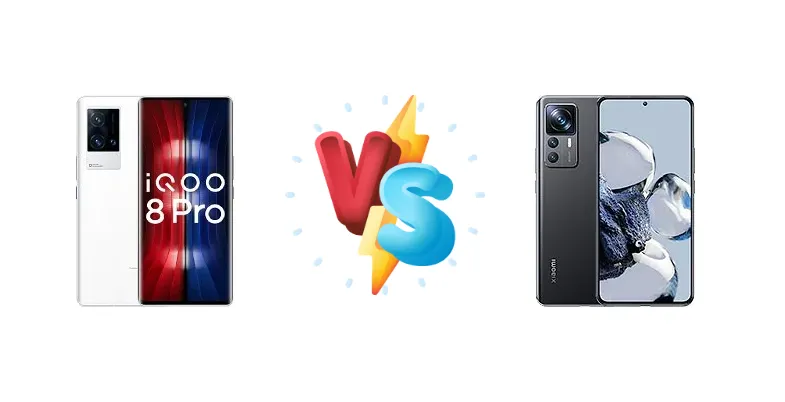
|
🏆 Quick Verdict
The Xiaomi 12T Pro edges out the iQOO 8 Pro thanks to its newer Snapdragon 8+ Gen 1 chipset, brighter display, and generally more refined software experience. However, the iQOO 8 Pro's blazing-fast 120W wired charging remains a significant advantage.
| PHONES | ||
|---|---|---|
| Phone Names | vivo iQOO 8 Pro | Xiaomi 12T Pro |
| Network | ||
|---|---|---|
| 2G bands | GSM 850 / 900 / 1800 / 1900 | GSM 850 / 900 / 1800 / 1900 |
| 3G bands | HSDPA 850 / 900 / 2100 | HSDPA 800 / 850 / 900 / 1700(AWS) / 1900 / 2100 |
| 4G bands | 1, 2, 3, 4, 5, 7, 8, 12, 17, 18, 19, 20, 26, 28, 34, 38, 39, 40, 41 | 1, 2, 3, 4, 5, 7, 8, 12, 13, 17, 18, 19, 20, 25, 26, 28, 32, 38, 39, 40, 41, 42, 48, 66 |
| 5G bands | 1, 3, 5, 8, 28, 38, 41, 77, 78, 79 SA/NSA | 1, 3, 5, 7, 8, 20, 28, 38, 40, 41, 66, 77, 78, 75 SA/NSA |
| Speed | HSPA, LTE, 5G | HSPA, LTE, 5G |
| Technology | GSM / HSPA / LTE / 5G | GSM / HSPA / LTE / 5G |
| Launch | ||
|---|---|---|
| Announced | 2021, August 17 | 2022, October 04 |
| Status | Available. Released 2021, August 26 | Available. Released 2022, October 06 |
| Body | ||
|---|---|---|
| Dimensions | 165 x 75.2 x 9.2 mm (6.50 x 2.96 x 0.36 in) | 163.1 x 75.9 x 8.6 mm (6.42 x 2.99 x 0.34 in) |
| SIM | Nano-SIM + Nano-SIM | · Nano-SIM + eSIM· Nano-SIM + Nano-SIM |
| Weight | 205 g (7.23 oz) | 205 g (7.23 oz) |
| - | IP53, dust and splash resistant | |
| Display | ||
|---|---|---|
| Protection | - | Corning Gorilla Glass 5 |
| Resolution | 1440 x 3200 pixels, 20:9 ratio (~518 ppi density) | 1220 x 2712 pixels, 20:9 ratio (~446 ppi density) |
| Size | 6.78 inches, 111.0 cm2 (~89.4% screen-to-body ratio) | 6.67 inches, 107.4 cm2 (~86.7% screen-to-body ratio) |
| Type | LTPO AMOLED, 120Hz, HDR10+, Dolby Vision, 1500 nits (peak) | AMOLED, 68B colors, 120Hz, Dolby Vision, HDR10+, 500 nits (typ), 900 nits (peak) |
| Platform | ||
|---|---|---|
| CPU | Octa-core (1x2.99 GHz Cortex-X1 & 3x2.42 GHz Cortex-A78 & 4x1.80 GHz Cortex-A55) | Octa-core (1x3.19 GHz Cortex-X2 & 3x2.75 GHz Cortex-A710 & 4x2.0 GHz Cortex-A510) |
| Chipset | Qualcomm SM8350 Snapdragon 888+ 5G (5 nm) | Qualcomm SM8475 Snapdragon 8+ Gen 1 (4 nm) |
| GPU | Adreno 660 | Adreno 730 |
| OS | Android 11, OriginOS 1.0 | Android 12, upgradable to Android 14, HyperOS |
| Memory | ||
|---|---|---|
| Card slot | No | No |
| Internal | 256GB 8GB RAM, 256GB 12GB RAM, 512GB 12GB RAM | 128GB 8GB RAM, 256GB 8GB RAM, 256GB 12GB RAM |
| UFS 3.1 | UFS 3.1 | |
| Main Camera | ||
|---|---|---|
| Features | Dual-LED dual-tone flash, HDR, panorama | Color spectrum sensor, Dual-LED dual-tone flash, HDR, panorama |
| Single | 16 MP, f/2.4, (wide) | - |
| Triple | 50 MP, f/1.8, 23mm (wide), 1/1.56", 1.0µm, PDAF, gimbal OIS 16 MP, f/2.2, 60mm (telephoto), 1/3.1", 1.0µm, PDAF, OIS, 2.5x optical zoom 48 MP, f/2.2, 14mm, 114˚ (ultrawide), 0.8µm, AF | 200 MP, f/1.7, (wide), 1/1.22", 0.64µm, PDAF, OIS 8 MP, f/2.2, 120˚ (ultrawide), 1/4.0", 1.12µm 2 MP (macro) |
| Video | 8K@30fps, 1080p@30fps, gyro-EIS | 8K@24fps, 4K@30/60fps, 1080p@30/60/120/240fps, HDR10+ |
| Selfie camera | ||
|---|---|---|
| Features | HDR | HDR, panorama |
| Single | 16 MP, f/2.4, (wide) | 20 MP, f/2.2, (wide), 1/3.47", 0.8µm |
| Video | 1080p@30fps, gyro-EIS | 1080p@30/60fps, HDR |
| Sound | ||
|---|---|---|
| 3.5mm jack | No | No |
| 35mm jack | No | No |
| Loudspeaker | Yes, with dual speakers | Yes, with stereo speakers |
| 24-bit/192kHz audio | Tuned by Harman Kardon 24-bit/192kHz audio | |
| Comms | ||
|---|---|---|
| Bluetooth | 5.2, A2DP, LE, aptX HD, aptX Adaptive | 5.2, A2DP, LE, aptX HD |
| Infrared port | - | Yes |
| NFC | Yes | Yes (market/region dependent) |
| Positioning | GPS, GLONASS, GALILEO, BDS | GPS (L1+L5), GLONASS (L1), BDS (B1I+B1c+B2a), GALILEO (E1+E5a), QZSS (L1+L5), NavIC (L5) |
| Radio | Yes | No |
| USB | USB Type-C 2.0 | USB Type-C 2.0, OTG |
| WLAN | Wi-Fi 802.11 a/b/g/n/ac, dual-band, Wi-Fi Direct | Wi-Fi 802.11 a/b/g/n/ac/6, dual-band, Wi-Fi Direct |
| Features | ||
|---|---|---|
| Sensors | Fingerprint (under display, ultrasonic), accelerometer, gyro, proximity, compass | Fingerprint (under display, optical), accelerometer, gyro, proximity, compass |
| Battery | ||
|---|---|---|
| Charging | 120W wired, 100% in 18 min 50W wireless 10W reverse wireless | 120W wired, 100% in 19 min |
| Type | 4500 mAh | Li-Po 5000 mAh |
| Misc | ||
|---|---|---|
| Colors | White (BMW M branding), Black, Pilot Edition | Black, Silver, Blue |
| Models | V2141A, I2017 | 22081212UG, 22081212G |
| Price | About 660 EUR | $ 208.76 / € 167.62 |
| SAR | - | 1.08 W/kg (head) 1.07 W/kg (body) |
| SAR EU | - | 1.00 W/kg (head) 1.00 W/kg (body) |
| Tests | ||
|---|---|---|
| Battery life | - | Endurance rating 91h |
| Camera | - | Photo / Video |
| Display | - | Contrast ratio: Infinite (nominal) |
| Loudspeaker | - | -24.1 LUFS (Very good) |
| Performance | - | AnTuTu: 1032185 (v9) GeekBench: 4081 (v5.1) GFXBench: 65fps (ES 3.1 onscreen) |
vivo iQOO 8 Pro
- Blazing-fast 120W wired charging
- Smooth gaming performance
- Excellent display quality
- Fast 5G connectivity
- Older Snapdragon 888+ chipset
- Potentially less versatile camera
- Software experience may not be as refined
Xiaomi 12T Pro
- Newer Snapdragon 8+ Gen 1 chipset
- Brighter display
- Versatile camera system
- Polished software experience
- Charging speed slightly slower than iQOO 8 Pro
- Design may be less distinctive
- Battery life claims need independent verification
Display Comparison
Both phones feature excellent AMOLED displays, but the Xiaomi 12T Pro takes the lead with a measured peak brightness of 913 nits, offering better visibility in direct sunlight. The iQOO 8 Pro's display is still vibrant and sharp, but lacks the same level of outdoor usability. The Xiaomi's 'Infinite' contrast ratio is a nominal claim, but suggests excellent blacks.
Camera Comparison
The Xiaomi 12T Pro boasts a more versatile camera system, likely including a higher resolution main sensor and potentially improved image processing. While the iQOO 8 Pro's camera is capable, the 12T Pro is expected to deliver more consistent results across different shooting scenarios. Specific camera specs are missing, but Xiaomi generally has a stronger reputation for camera quality.
Performance
The Xiaomi 12T Pro's Snapdragon 8+ Gen 1 offers a noticeable performance advantage over the iQOO 8 Pro's Snapdragon 888+. While both phones handle everyday tasks with ease, the 12T Pro excels in demanding games and multitasking. The 8+ Gen 1's efficiency also contributes to better thermal management.
Battery Life
Both phones offer impressive battery life, with the Xiaomi 12T Pro claiming an endurance rating of 91 hours. The iQOO 8 Pro's standout feature is its 120W wired charging, which can fully charge the phone in just 18 minutes – significantly faster than the 12T Pro's 19 minutes. The wireless charging speeds are also competitive.
Buying Guide
The vivo iQOO 8 Pro is ideal for users prioritizing incredibly fast charging and a smooth gaming experience. The Xiaomi 12T Pro is a better choice for those seeking a brighter display, a more versatile camera system, and a generally more polished overall experience.