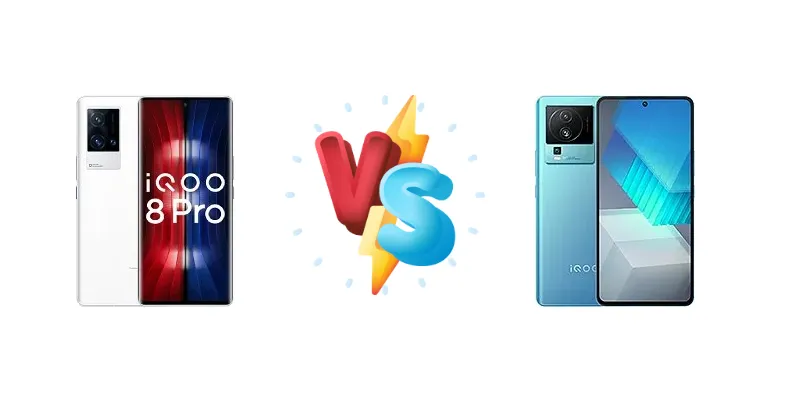
vivo's iQOO series is known for delivering high-performance smartphones at competitive prices. The iQOO 8 Pro and iQOO Neo 7 are two compelling options, each targeting gamers and power users. But which one offers the best overall experience? Let's dive into a comprehensive comparison.
🏆 Quick Verdict
The iQOO 8 Pro boasts a flagship Snapdragon 888+ and faster wireless charging, while the Neo 7 features the efficient Dimensity 8200 and slightly quicker wired charging. For ultimate performance and premium features, the 8 Pro wins, but the Neo 7 offers excellent value.
| Network |
|---|
| 2G bands | GSM 850 / 900 / 1800 / 1900 | GSM 850 / 900 / 1800 / 1900 |
| 3G bands | HSDPA 850 / 900 / 2100 | HSDPA 850 / 900 / 2100 - India |
| 4G bands | 1, 2, 3, 4, 5, 7, 8, 12, 17, 18, 19, 20, 26, 28, 34, 38, 39, 40, 41 | 1, 3, 5, 8, 28, 38, 40, 41 - India |
| 5G bands | 1, 3, 5, 8, 28, 38, 41, 77, 78, 79 SA/NSA | 1, 3, 5, 8, 28, 41, 77, 78 SA/NSA - India |
| Speed | HSPA, LTE, 5G | HSPA, LTE, 5G |
| Technology | GSM / HSPA / LTE / 5G | GSM / HSPA / LTE / 5G |
| Launch |
|---|
| Announced | 2021, August 17 | 2023, February 16 |
| Status | Available. Released 2021, August 26 | Available. Released 2023, February 16 |
| Body |
|---|
| Build | - | Glass front, plastic frame, plastic back |
| Dimensions | 165 x 75.2 x 9.2 mm (6.50 x 2.96 x 0.36 in) | 164.8 x 76.9 x 8.6 mm (6.49 x 3.03 x 0.34 in) |
| SIM | Nano-SIM + Nano-SIM | Nano-SIM + Nano-SIM |
| Weight | 205 g (7.23 oz) | 193 g (6.81 oz) |
| Display |
|---|
| Resolution | 1440 x 3200 pixels, 20:9 ratio (~518 ppi density) | 1080 x 2400 pixels, 20:9 ratio (~388 ppi density) |
| Size | 6.78 inches, 111.0 cm2 (~89.4% screen-to-body ratio) | 6.78 inches, 111.0 cm2 (~87.6% screen-to-body ratio) |
| Type | LTPO AMOLED, 120Hz, HDR10+, Dolby Vision, 1500 nits (peak) | AMOLED, 120Hz, HDR10+, 500 nits (typ), 1000 nits (HBM), 1300 nits (peak) |
| | - | Always-on display |
| Platform |
|---|
| CPU | Octa-core (1x2.99 GHz Cortex-X1 & 3x2.42 GHz Cortex-A78 & 4x1.80 GHz Cortex-A55) | Octa-core (1x3.1 GHz Cortex-A78 & 3x3.0 GHz Cortex-A78 & 4x2.0 GHz Cortex-A55) |
| Chipset | Qualcomm SM8350 Snapdragon 888+ 5G (5 nm) | Mediatek Dimensity 8200 (4 nm) |
| GPU | Adreno 660 | Mali-G610 MC6 |
| OS | Android 11, OriginOS 1.0 | Android 13, Funtouch 13 |
| Memory |
|---|
| Card slot | No | No |
| Internal | 256GB 8GB RAM, 256GB 12GB RAM, 512GB 12GB RAM | 128GB 8GB RAM, 256GB 12GB RAM |
| | UFS 3.1 | UFS 3.1 |
| Main Camera |
|---|
| Features | Dual-LED dual-tone flash, HDR, panorama | LED flash, HDR, panorama |
| Single | 16 MP, f/2.4, (wide) | 16 MP, f/2.5, (wide) |
| Triple | 50 MP, f/1.8, 23mm (wide), 1/1.56", 1.0µm, PDAF, gimbal OIS
16 MP, f/2.2, 60mm (telephoto), 1/3.1", 1.0µm, PDAF, OIS, 2.5x optical zoom
48 MP, f/2.2, 14mm, 114˚ (ultrawide), 0.8µm, AF | 64 MP, f/1.8, 24mm (wide), 1/1.97", 0.7µm, PDAF, OIS
2 MP (macro)
Auxiliary lens |
| Video | 8K@30fps, 1080p@30fps, gyro-EIS | 4K@30fps, 1080p@30fps |
| Selfie camera |
|---|
| Features | HDR | HDR |
| Single | 16 MP, f/2.4, (wide) | 16 MP, f/2.5, (wide) |
| Video | 1080p@30fps, gyro-EIS | 1080p@30fps |
| Sound |
|---|
| 3.5mm jack | No | No |
| 35mm jack | No | No |
| Loudspeaker | Yes, with dual speakers | Yes, with stereo speakers |
| | 24-bit/192kHz audio | 24-bit/192kHz audio |
| Comms |
|---|
| Bluetooth | 5.2, A2DP, LE, aptX HD, aptX Adaptive | 5.3, A2DP, LE |
| Infrared port | - | Yes |
| NFC | Yes | Yes (market/region dependent) |
| Positioning | GPS, GLONASS, GALILEO, BDS | GPS, GLONASS, GALILEO, BDS, QZSS, NavIC |
| Radio | Yes | No |
| USB | USB Type-C 2.0 | USB Type-C 2.0, OTG |
| WLAN | Wi-Fi 802.11 a/b/g/n/ac, dual-band, Wi-Fi Direct | Wi-Fi 802.11 a/b/g/n/ac, dual-band |
| Features |
|---|
| Sensors | Fingerprint (under display, ultrasonic), accelerometer, gyro, proximity, compass | Fingerprint (under display, optical), accelerometer, gyro, proximity, compass |
| Battery |
|---|
| Charging | 120W wired, 100% in 18 min
50W wireless
10W reverse wireless | 120W wired, 50% in 10 min, 100% in 25 min |
| Type | 4500 mAh | 5000 mAh |
| Misc |
|---|
| Colors | White (BMW M branding), Black, Pilot Edition | Interstellar Black, Frost Blue |
| Models | V2141A, I2017 | I2214 |
| Price | About 660 EUR | About 440 EUR |
vivo iQOO 8 Pro
- Flagship Snapdragon 888+ chipset
- Faster wireless charging (50W)
- Likely superior display quality
- Reverse wireless charging
- Potentially higher price
- Wired charging slightly slower than Neo 7
- Design may be less modern than Neo 7
vivo iQOO Neo 7
- Efficient Dimensity 8200 chipset
- Faster wired charging (50% in 10 min)
- Excellent value for money
- Modern design
- No wireless charging
- Likely slightly less impressive camera
- Potentially lower display quality compared to 8 Pro
Display Comparison
Both phones feature AMOLED displays with high refresh rates (likely 120Hz). The iQOO 8 Pro likely has a slightly better display panel with potentially higher peak brightness and color accuracy due to its Pro designation. The Neo 7's display is still excellent, offering smooth visuals and vibrant colors. Expect similar viewing experiences overall, but the 8 Pro might edge out slightly.
Camera Comparison
While specific camera specs are not fully detailed, the iQOO 8 Pro likely has a more advanced camera system, potentially including a larger primary sensor and improved image processing. The iQOO Neo 7 will still deliver capable photos and videos, but the 8 Pro is expected to offer better low-light performance and overall image quality. Both likely feature a main sensor around 50MP.
Performance
The iQOO 8 Pro's Snapdragon 888+ is a proven flagship chipset, offering excellent performance for demanding games and applications. However, the iQOO Neo 7's Dimensity 8200 is a very competitive chip, often matching or exceeding the 888+ in certain benchmarks and real-world usage, especially in sustained performance. The Dimensity 8200's efficiency also contributes to better thermal management.
Battery Life
Both phones offer 120W wired charging, a significant advantage. The iQOO 8 Pro also includes 50W wireless charging and reverse wireless charging, adding versatility. While the Neo 7 charges slightly faster wired (50% in 10 min vs 18 min for the 8 Pro), both offer incredibly fast charging times, minimizing downtime.
Buying Guide
The vivo iQOO 8 Pro is ideal for users who prioritize top-tier performance, faster wireless charging, and a slightly more premium feel. The iQOO Neo 7 is a fantastic choice for gamers and those seeking a powerful phone with excellent value, prioritizing wired charging speed and a modern chipset.
Frequently Asked Questions
❓ Which phone is better for gaming?
Both are excellent for gaming. The iQOO Neo 7's Dimensity 8200 offers competitive performance and better thermal management, while the iQOO 8 Pro's Snapdragon 888+ is a proven flagship. It depends on your preference and budget.
❓ Does the iQOO 8 Pro have wireless charging?
Yes, the iQOO 8 Pro supports 50W wireless charging and reverse wireless charging. The iQOO Neo 7 does not offer wireless charging.