
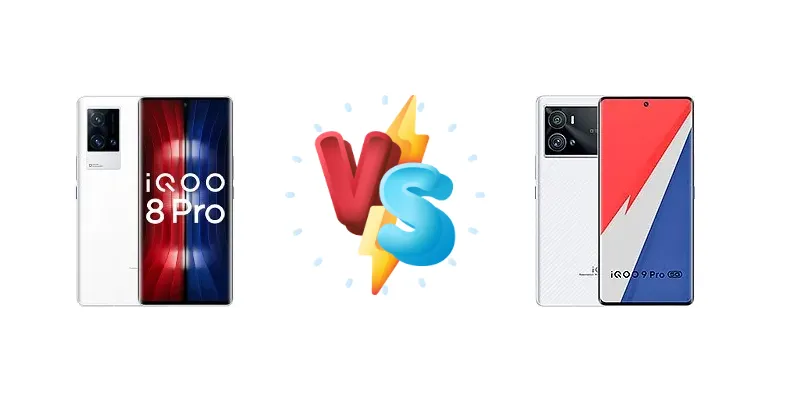
vivo iQOO 8 Pro vs iQOO 9 Pro: A Detailed Showdown
| Phones Images | |||||
|---|---|---|---|---|---|
|
🏆 Quick Verdict
The iQOO 9 Pro edges out the 8 Pro thanks to its newer Snapdragon 8 Gen 1 chipset, brighter display, and slightly faster charging. While the 8 Pro remains a strong performer, the 9 Pro’s advancements make it the superior choice for most users seeking top-tier performance.
| PHONES | ||
|---|---|---|
| Phone Names | vivo iQOO 8 Pro | vivo iQOO 9 Pro |
| Network | ||
|---|---|---|
| 2G bands | GSM 850 / 900 / 1800 / 1900 | GSM 850 / 900 / 1800 / 1900 |
| 3G bands | HSDPA 850 / 900 / 2100 | HSDPA 850 / 900 / 1700(AWS) / 1900 / 2100 |
| 4G bands | 1, 2, 3, 4, 5, 7, 8, 12, 17, 18, 19, 20, 26, 28, 34, 38, 39, 40, 41 | 1, 2, 3, 4, 5, 7, 8, 12, 17, 18, 19, 20, 25, 26, 28, 32, 34, 38, 39, 40, 41, 42, 66 |
| 5G bands | 1, 3, 5, 8, 28, 38, 41, 77, 78, 79 SA/NSA | 1, 3, 5, 7, 8, 20, 28, 38, 40, 41, 66, 77, 78, 79 SA/NSA |
| Speed | HSPA, LTE, 5G | HSPA, LTE, 5G |
| Technology | GSM / HSPA / LTE / 5G | GSM / CDMA / HSPA / CDMA2000 / LTE / 5G |
| - | CDMA2000 1x | |
| Launch | ||
|---|---|---|
| Announced | 2021, August 17 | 2022, January 05 |
| Status | Available. Released 2021, August 26 | Available. Released 2022, January 12 |
| Body | ||
|---|---|---|
| Build | - | Glass front (Panda Glass), aluminum frame, glass back or aramid fiber back |
| Dimensions | 165 x 75.2 x 9.2 mm (6.50 x 2.96 x 0.36 in) | 164.8 x 75.2 x 8.8 mm |
| SIM | Nano-SIM + Nano-SIM | Nano-SIM + Nano-SIM |
| Weight | 205 g (7.23 oz) | 204 g or 210 g (7.20 oz) |
| - | Splash and dust resistant | |
| Display | ||
|---|---|---|
| Protection | - | Panda Glass |
| Resolution | 1440 x 3200 pixels, 20:9 ratio (~518 ppi density) | 1440 x 3200 pixels, 20:9 ratio (~518 ppi density) |
| Size | 6.78 inches, 111.0 cm2 (~89.4% screen-to-body ratio) | 6.78 inches, 111.0 cm2 (~89.6% screen-to-body ratio) |
| Type | LTPO AMOLED, 120Hz, HDR10+, Dolby Vision, 1500 nits (peak) | LTPO2 AMOLED, 1B colors, 120Hz, HDR10+, Dolby Vision, 500 nits (typ), 1000 nits (HBM), 1500 nits (peak) |
| Platform | ||
|---|---|---|
| CPU | Octa-core (1x2.99 GHz Cortex-X1 & 3x2.42 GHz Cortex-A78 & 4x1.80 GHz Cortex-A55) | Octa-core (1x3.00 GHz Cortex-X2 & 3x2.50 GHz Cortex-A710 & 4x1.80 GHz Cortex-A510) |
| Chipset | Qualcomm SM8350 Snapdragon 888+ 5G (5 nm) | Qualcomm SM8450 Snapdragon 8 Gen 1 (4 nm) |
| GPU | Adreno 660 | Adreno 730 |
| OS | Android 11, OriginOS 1.0 | Android 12, Funtouch 12 (International), OriginOS Ocean (China) |
| Memory | ||
|---|---|---|
| Card slot | No | No |
| Internal | 256GB 8GB RAM, 256GB 12GB RAM, 512GB 12GB RAM | 256GB 8GB RAM, 256GB 12GB RAM, 512GB 12GB RAM |
| UFS 3.1 | UFS 3.1 (V6) | |
| Main Camera | ||
|---|---|---|
| Features | Dual-LED dual-tone flash, HDR, panorama | Dual-LED lash, HDR, panorama |
| Single | 16 MP, f/2.4, (wide) | 16 MP, f/2.5, (wide), 1/3.1", 1.0µm |
| Triple | 50 MP, f/1.8, 23mm (wide), 1/1.56", 1.0µm, PDAF, gimbal OIS 16 MP, f/2.2, 60mm (telephoto), 1/3.1", 1.0µm, PDAF, OIS, 2.5x optical zoom 48 MP, f/2.2, 14mm, 114˚ (ultrawide), 0.8µm, AF | 50 MP, f/1.8, (wide), 1/1.57", 1.0µm, PDAF, gimbal OIS 16 MP, f/2.2, 60mm (telephoto), 1/3.1", 1.0µm, PDAF, OIS, 2.5x optical zoom 50 MP, f/2.3, 15mm, 150˚ (ultrawide), 1/2.76", 0.64µm, AF |
| Video | 8K@30fps, 1080p@30fps, gyro-EIS | 8K@30fps, 4K@24/30/60fps, 1080p@30/60fps, gyro-EIS |
| Selfie camera | ||
|---|---|---|
| Features | HDR | HDR |
| Single | 16 MP, f/2.4, (wide) | 16 MP, f/2.5, (wide), 1/3.1", 1.0µm |
| Video | 1080p@30fps, gyro-EIS | 1080p@30fps, gyro-EIS |
| Sound | ||
|---|---|---|
| 3.5mm jack | No | No |
| 35mm jack | No | No |
| Loudspeaker | Yes, with dual speakers | Yes, with dual speakers |
| 24-bit/192kHz audio | 32-bit/384kHz audio | |
| Comms | ||
|---|---|---|
| Bluetooth | 5.2, A2DP, LE, aptX HD, aptX Adaptive | 5.2, A2DP, LE, aptX HD, aptX Adaptive, aptX Lossless |
| Infrared port | - | Yes |
| NFC | Yes | Yes |
| Positioning | GPS, GLONASS, GALILEO, BDS | GPS, GLONASS, GALILEO, BDS, QZSS |
| Radio | Yes | No |
| USB | USB Type-C 2.0 | USB Type-C 2.0, OTG |
| WLAN | Wi-Fi 802.11 a/b/g/n/ac, dual-band, Wi-Fi Direct | Wi-Fi 802.11 a/b/g/n/ac/6, dual-band, Wi-Fi Direct |
| Features | ||
|---|---|---|
| Sensors | Fingerprint (under display, ultrasonic), accelerometer, gyro, proximity, compass | Fingerprint (under display, ultrasonic), accelerometer, gyro, proximity, compass |
| Battery | ||
|---|---|---|
| Charging | 120W wired, 100% in 18 min 50W wireless 10W reverse wireless | 120W wired, 50% in 8 min, 100% in 20 min 50W wireless 10W reverse wireless |
| Type | 4500 mAh | 4700 mAh |
| Misc | ||
|---|---|---|
| Colors | White (BMW M branding), Black, Pilot Edition | Legend (White w/ BMW M branding), Dark Cruise, Orange |
| Models | V2141A, I2017 | V2172A, I2022 |
| Price | About 660 EUR | About 630 EUR |
| Tests | ||
|---|---|---|
| Battery life | - | Endurance rating 97h |
| Camera | - | Photo / Video |
| Display | - | Contrast ratio: Infinite (nominal) |
| Loudspeaker | - | -24.8 LUFS (Very good) |
| Performance | - | AnTuTu: 862324 (v8), 997948 (v9) GeekBench: 3708 (v5.1) GFXBench: 46fps (ES 3.1 onscreen) |
vivo iQOO 8 Pro
- Incredibly fast 120W wired charging
- Excellent performance for the price
- Smooth display with high refresh rate
- Good battery life
- Older chipset compared to the iQOO 9 Pro
- Display brightness not as high as the iQOO 9 Pro
- Camera details are limited
vivo iQOO 9 Pro
- Newer Snapdragon 8 Gen 1 chipset
- Brighter and more vibrant display
- Slightly faster charging
- Excellent performance for gaming
- Potentially higher price
- Camera details are limited
- May experience some thermal throttling under sustained load
Display Comparison
The iQOO 9 Pro boasts a significant advantage with its measured 1000 nits peak brightness, offering better visibility in direct sunlight. While the iQOO 8 Pro's display is still excellent, the 9 Pro's contrast ratio (nominally infinite) and higher brightness provide a more immersive and vibrant viewing experience. Both feature high refresh rates for smooth scrolling and gaming.
Camera Comparison
Both phones offer capable camera systems, but detailed camera specifications are missing. Generally, the iQOO 9 Pro is expected to have improvements in image processing and low-light performance due to the newer chipset and potentially updated sensors. Both likely offer excellent video recording capabilities.
Performance
The iQOO 9 Pro’s Snapdragon 8 Gen 1 (4nm) is a generational leap over the iQOO 8 Pro’s Snapdragon 888+ (5nm). The 8 Gen 1 offers improved CPU and GPU performance, resulting in faster app loading times, smoother multitasking, and enhanced gaming performance. Both phones handle demanding games well, but the 9 Pro has more headroom for future titles.
Battery Life
Both devices offer impressive battery life, with an endurance rating of 97 hours. The iQOO 9 Pro demonstrates slightly faster wired charging (50% in 8 min vs 18 min for the 8 Pro), although both support 120W wired charging and 50W wireless charging.
Buying Guide
Who should buy the vivo iQOO 8 Pro? Those looking for a slightly more budget-friendly option with excellent performance and incredibly fast charging. Who should buy the vivo iQOO 9 Pro? Gamers and power users who demand the absolute latest technology, a brighter display, and the fastest possible processing speeds.