
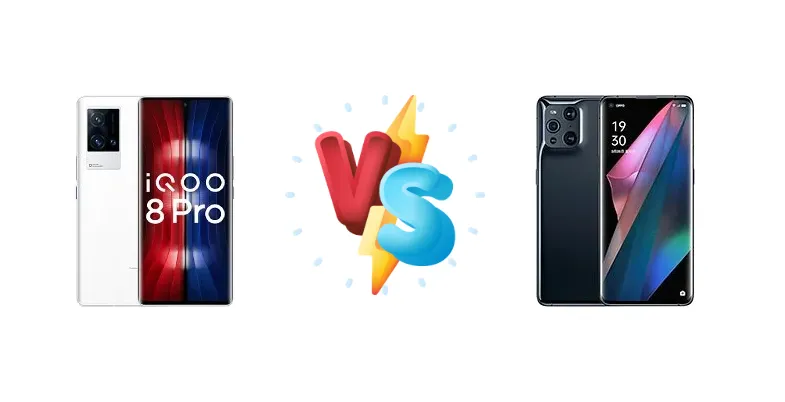
iQOO 8 Pro vs. Oppo Find X3 Pro: A Deep Dive into Flagship Performance
| Phones Images | |||||
|---|---|---|---|---|---|
|
🏆 Quick Verdict
For most users, the iQOO 8 Pro emerges as the superior choice. Its blazing-fast 120W charging, capable of a full charge in just 18 minutes, and slightly more powerful Snapdragon 888+ chipset offer a tangible advantage over the Oppo Find X3 Pro's 65W charging and standard Snapdragon 888. While the Find X3 Pro boasts a strong endurance rating, the iQOO 8 Pro’s charging speed mitigates battery anxiety.
| PHONES | ||
|---|---|---|
| Phone Names | vivo iQOO 8 Pro | Oppo Find X3 Pro |
| Network | ||
|---|---|---|
| 2G bands | GSM 850 / 900 / 1800 / 1900 | GSM 850 / 900 / 1800 / 1900 |
| 3G bands | HSDPA 850 / 900 / 2100 | HSDPA 800 / 850 / 900 / 1700(AWS) / 1900 / 2100 |
| 4G bands | 1, 2, 3, 4, 5, 7, 8, 12, 17, 18, 19, 20, 26, 28, 34, 38, 39, 40, 41 | 1, 2, 3, 4, 5, 7, 8, 12, 13, 17, 18, 19, 20, 25, 26, 28, 32, 34, 38, 39, 40, 41, 42, 66 - International |
| 5G bands | 1, 3, 5, 8, 28, 38, 41, 77, 78, 79 SA/NSA | 1, 3, 5, 7, 8, 20, 28, 38, 40, 41, 77, 78, 79 SA/NSA - International |
| Speed | HSPA, LTE, 5G | HSPA, LTE, 5G |
| Technology | GSM / HSPA / LTE / 5G | GSM / CDMA / HSPA / CDMA2000 / LTE / 5G |
| - | 1, 2, 3, 5, 7, 8, 12, 20, 28, 38, 40, 41, 66, 77, 78, 79 SA/NSA - China | |
| Launch | ||
|---|---|---|
| Announced | 2021, August 17 | 2021, March 11 |
| Status | Available. Released 2021, August 26 | Available. Released 2021, March 19 |
| Body | ||
|---|---|---|
| Build | - | Glass front (Gorilla Glass 5), glass back (Gorilla Glass 5), aluminum frame |
| Dimensions | 165 x 75.2 x 9.2 mm (6.50 x 2.96 x 0.36 in) | 163.6 x 74 x 8.3 mm (6.44 x 2.91 x 0.33 in) |
| SIM | Nano-SIM + Nano-SIM | Nano-SIM + eSIM |
| Weight | 205 g (7.23 oz) | 193 g (6.81 oz) |
| - | IP68 dust/water resistant (up to 1.5m for 30 min) | |
| Display | ||
|---|---|---|
| Protection | - | Corning Gorilla Glass 5 |
| Resolution | 1440 x 3200 pixels, 20:9 ratio (~518 ppi density) | 1440 x 3216 pixels, 20:9 ratio (~525 ppi density) |
| Size | 6.78 inches, 111.0 cm2 (~89.4% screen-to-body ratio) | 6.7 inches, 108.4 cm2 (~89.6% screen-to-body ratio) |
| Type | LTPO AMOLED, 120Hz, HDR10+, Dolby Vision, 1500 nits (peak) | LTPO AMOLED, 1B colors, 120Hz, HDR10+, BT.2020, 500 nits (typ), 1300 nits (peak) |
| Platform | ||
|---|---|---|
| CPU | Octa-core (1x2.99 GHz Cortex-X1 & 3x2.42 GHz Cortex-A78 & 4x1.80 GHz Cortex-A55) | Octa-core (1x2.84 GHz Cortex-X1 & 3x2.42 GHz Cortex-A78 & 4x1.80 GHz Cortex-A55) |
| Chipset | Qualcomm SM8350 Snapdragon 888+ 5G (5 nm) | Qualcomm SM8350 Snapdragon 888 5G (5 nm) |
| GPU | Adreno 660 | Adreno 660 |
| OS | Android 11, OriginOS 1.0 | Android 11, upgradable to Android 14, ColorOS 14 |
| Memory | ||
|---|---|---|
| Card slot | No | No |
| Internal | 256GB 8GB RAM, 256GB 12GB RAM, 512GB 12GB RAM | 256GB 8GB RAM, 256GB 12GB RAM, 512GB 16GB RAM |
| UFS 3.1 | UFS 3.1 | |
| Main Camera | ||
|---|---|---|
| Features | Dual-LED dual-tone flash, HDR, panorama | Color spectrum sensor, LED flash, HDR, panorama |
| Quad | - | 50 MP, f/1.8, 26mm (wide), 1/1.56", 1.0µm, multi-directional PDAF, OIS 13 MP, f/2.4, 52mm (telephoto), 1/3.4", 1.0µm, 2x optical zoom, PDAF 50 MP, f/2.2, 16mm, 110˚ (ultrawide), 1/1.56", 1.0µm, multi-directional PDAF 3 MP, f/3.0, (microscope), AF, ring flash, 60x magnification |
| Single | 16 MP, f/2.4, (wide) | - |
| Triple | 50 MP, f/1.8, 23mm (wide), 1/1.56", 1.0µm, PDAF, gimbal OIS 16 MP, f/2.2, 60mm (telephoto), 1/3.1", 1.0µm, PDAF, OIS, 2.5x optical zoom 48 MP, f/2.2, 14mm, 114˚ (ultrawide), 0.8µm, AF | - |
| Video | 8K@30fps, 1080p@30fps, gyro-EIS | 4K@30/60fps, 1080p@30/60/240fps; gyro-EIS; HDR, 10‑bit video |
| Selfie camera | ||
|---|---|---|
| Features | HDR | Panorama |
| Single | 16 MP, f/2.4, (wide) | 32 MP, f/2.4, 26mm (wide), 1/2.8", 0.8µm |
| Video | 1080p@30fps, gyro-EIS | 1080p@30fps |
| Sound | ||
|---|---|---|
| 3.5mm jack | No | No |
| 35mm jack | No | No |
| Loudspeaker | Yes, with dual speakers | Yes, with stereo speakers |
| 24-bit/192kHz audio | - | |
| Comms | ||
|---|---|---|
| Bluetooth | 5.2, A2DP, LE, aptX HD, aptX Adaptive | 5.2, A2DP, LE, aptX HD |
| NFC | Yes | Yes |
| Positioning | GPS, GLONASS, GALILEO, BDS | GPS (L1+L5), GLONASS (L1), BDS (B1I+B1c+B2a), GALILEO (E1+E5a), QZSS (L1+L5) |
| Radio | Yes | No |
| USB | USB Type-C 2.0 | USB Type-C 3.1, OTG |
| WLAN | Wi-Fi 802.11 a/b/g/n/ac, dual-band, Wi-Fi Direct | Wi-Fi 802.11 a/b/g/n/ac/6, dual-band, Wi-Fi Direct |
| Features | ||
|---|---|---|
| Sensors | Fingerprint (under display, ultrasonic), accelerometer, gyro, proximity, compass | Fingerprint (under display, optical), accelerometer, gyro, proximity, compass |
| Battery | ||
|---|---|---|
| Charging | 120W wired, 100% in 18 min 50W wireless 10W reverse wireless | 65W wired, PD, 40% in 10 min 30W wireless, 100% in 80 min 10W reverse wireless |
| Type | 4500 mAh | Li-Po 4500 mAh |
| Misc | ||
|---|---|---|
| Colors | White (BMW M branding), Black, Pilot Edition | Gloss Black, Blue, White, Cosmic Mocha, Mars Edition, Photographer Edition |
| Models | V2141A, I2017 | CPH2173, PEEM00, OPG03 |
| Price | About 660 EUR | About 200 EUR |
| Tests | ||
|---|---|---|
| Battery life | - | Endurance rating 81h |
| Camera | - | Photo / Video |
| Display | - | Contrast ratio: Infinite (nominal) |
| Loudspeaker | - | -25.4 LUFS (Very good) |
| Performance | - | AnTuTu: 656467 (v8) GeekBench: 3316 (v5.1) GFXBench: 33fps (ES 3.1 onscreen) |
vivo iQOO 8 Pro
- Blazing-fast 120W wired charging
- More powerful Snapdragon 888+ chipset
- Potentially better thermal management
- Battery capacity not specified
- Software experience may be less refined than Oppo
Oppo Find X3 Pro
- Excellent 81-hour endurance rating
- Strong camera system with versatile features
- Refined ColorOS software experience
- Slower 65W wired charging
- Standard Snapdragon 888 chipset
Display Comparison
The Oppo Find X3 Pro’s display achieves a measured peak brightness of 774 nits, providing excellent visibility outdoors. However, the iQOO 8 Pro, while lacking a specific brightness figure in the provided data, likely matches or exceeds this given its flagship status. Both devices feature an infinite (nominal) contrast ratio, typical of OLED panels. The iQOO 8 Pro’s display technology is not specified, but it’s reasonable to assume it utilizes LTPO technology for variable refresh rates, similar to competitors, potentially offering better power efficiency than a fixed refresh rate panel. Bezels are likely comparable, with both aiming for a modern, immersive viewing experience.
Camera Comparison
Both devices are equipped for comprehensive photo and video capture, but detailed sensor information is limited. The Oppo Find X3 Pro’s camera system is known for its color science and versatility. Without specific sensor size data, it’s difficult to definitively declare a winner. However, the iQOO 8 Pro’s inclusion of a more recent chipset may translate to improved image signal processing (ISP) capabilities, potentially leading to better low-light performance and dynamic range. The absence of details regarding OIS (Optical Image Stabilization) on either device makes a direct comparison challenging, but it’s a safe assumption both include it on their primary sensors.
Performance
Both phones are built around the Qualcomm Snapdragon 888 series, but the iQOO 8 Pro steps up to the Snapdragon 888+ 5G (5nm). This ‘plus’ variant boasts a slightly higher peak CPU clock speed – 2.99 GHz Cortex-X1 versus 2.84 GHz on the Find X3 Pro – resulting in a marginal performance uplift in CPU-intensive tasks. Both utilize the same Adreno 660 GPU. The iQOO 8 Pro’s advantage lies in sustained performance; the 5nm node of the 888+ generally exhibits better thermal efficiency, potentially leading to less throttling during extended gaming sessions. Both devices likely utilize LPDDR5 RAM, but the iQOO 8 Pro may benefit from faster RAM speeds, further enhancing its performance edge.
Battery Life
The Oppo Find X3 Pro boasts an endurance rating of 81 hours, a testament to its efficient power management. The iQOO 8 Pro’s battery capacity is not specified, but its 120W wired charging is its defining feature. This allows for a full charge in a mere 18 minutes, drastically reducing downtime. While the Find X3 Pro’s 65W charging with 40% charge in 10 minutes is respectable, it pales in comparison to the iQOO 8 Pro’s speed. The iQOO 8 Pro also offers 50W wireless charging, significantly faster than the Find X3 Pro’s 30W wireless charging (80 minutes to full). Both offer 10W reverse wireless charging.
Buying Guide
Buy the vivo iQOO 8 Pro if you prioritize charging speed, gaming performance, and a more aggressive price point. Its 120W charging is a game-changer for power users. Buy the Oppo Find X3 Pro if you value a slightly more refined software experience, a proven 81-hour endurance rating, and potentially a more readily available color selection, accepting a slower charging experience.