
iQOO 8 Pro vs OnePlus 9 Pro: A Deep Dive into Flagship Performance
| Phones Images | |||||
|---|---|---|---|---|---|
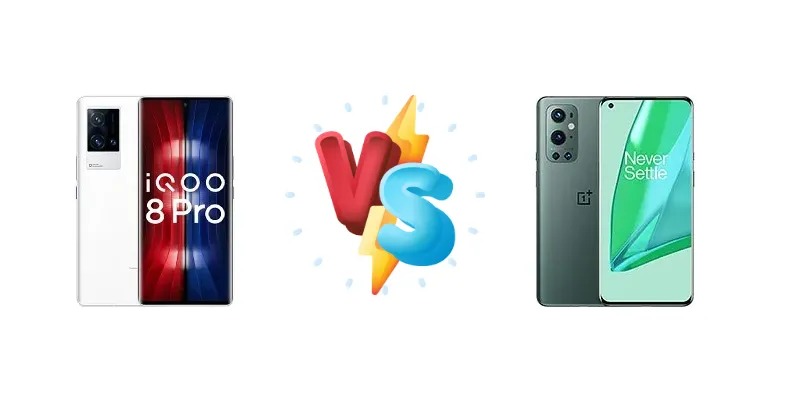
|
🏆 Quick Verdict
For users prioritizing raw speed and charging convenience, the iQOO 8 Pro emerges as the winner. Its Snapdragon 888+ and 120W charging drastically outperform the OnePlus 9 Pro’s Snapdragon 888 and 65W charging. However, the OnePlus 9 Pro remains a strong contender for those valuing a more polished software experience and established brand reputation.
| PHONES | ||
|---|---|---|
| Phone Names | vivo iQOO 8 Pro | OnePlus 9 Pro |
| Network | ||
|---|---|---|
| 2G bands | GSM 850 / 900 / 1800 / 1900 | GSM 850 / 900 / 1800 / 1900 |
| 3G bands | HSDPA 850 / 900 / 2100 | HSDPA 800 / 850 / 900 / 1700(AWS) / 1800 / 1900 / 2100 |
| 4G bands | 1, 2, 3, 4, 5, 7, 8, 12, 17, 18, 19, 20, 26, 28, 34, 38, 39, 40, 41 | 1, 2, 3, 4, 5, 7, 8, 12, 13, 17, 18, 19, 20, 25, 26, 28, 32, 38, 39, 40, 41, 66 - EU |
| 5G bands | 1, 3, 5, 8, 28, 38, 41, 77, 78, 79 SA/NSA | 1, 3, 5, 7, 8, 20, 28, 38, 40, 41, 66, 78 SA/NSA - EU |
| Speed | HSPA, LTE, 5G | HSPA 42.2/5.76 Mbps, LTE Cat20 2000/200 Mbps, 5G |
| Technology | GSM / HSPA / LTE / 5G | GSM / CDMA / HSPA / LTE / 5G |
| - | 1, 3, 28, 41, 78, 79 SA/NSA - CN | |
| Launch | ||
|---|---|---|
| Announced | 2021, August 17 | 2021, March 23 |
| Status | Available. Released 2021, August 26 | Available. Released 2021, March 30 |
| Body | ||
|---|---|---|
| Build | - | Glass front (Gorilla Glass 5), glass back (Gorilla Glass 5), aluminum frame |
| Dimensions | 165 x 75.2 x 9.2 mm (6.50 x 2.96 x 0.36 in) | 163.2 x 73.6 x 8.7 mm (6.43 x 2.90 x 0.34 in) |
| SIM | Nano-SIM + Nano-SIM | · Nano-SIM· Nano-SIM + Nano-SIM |
| Weight | 205 g (7.23 oz) | 197 g (6.95 oz) |
| - | IP68 dust/water resistant (up to 1.5m for 30 min) | |
| Display | ||
|---|---|---|
| Protection | - | Corning Gorilla Glass 5 |
| Resolution | 1440 x 3200 pixels, 20:9 ratio (~518 ppi density) | 1440 x 3216 pixels, 20:9 ratio (~525 ppi density) |
| Size | 6.78 inches, 111.0 cm2 (~89.4% screen-to-body ratio) | 6.7 inches, 108.4 cm2 (~90.3% screen-to-body ratio) |
| Type | LTPO AMOLED, 120Hz, HDR10+, Dolby Vision, 1500 nits (peak) | LTPO Fluid2 AMOLED, 1B colors, 120Hz, HDR10+, 1300 nits (peak) |
| - | Always-on display | |
| Platform | ||
|---|---|---|
| CPU | Octa-core (1x2.99 GHz Cortex-X1 & 3x2.42 GHz Cortex-A78 & 4x1.80 GHz Cortex-A55) | Octa-core (1x2.84 GHz Cortex-X1 & 3x2.42 GHz Cortex-A78 & 4x1.80 GHz Cortex-A55 |
| Chipset | Qualcomm SM8350 Snapdragon 888+ 5G (5 nm) | Qualcomm SM8350 Snapdragon 888 5G (5 nm) |
| GPU | Adreno 660 | Adreno 660 |
| OS | Android 11, OriginOS 1.0 | Android 11, upgradable to Android 14, OxygenOS 14 |
| Memory | ||
|---|---|---|
| Card slot | No | No |
| Internal | 256GB 8GB RAM, 256GB 12GB RAM, 512GB 12GB RAM | 128GB 8GB RAM, 256GB 8GB RAM, 256GB 12GB RAM |
| UFS 3.1 | UFS 3.1 | |
| Main Camera | ||
|---|---|---|
| Features | Dual-LED dual-tone flash, HDR, panorama | Laser AF, color spectrum sensor, Hasselblad Color Calibration, dual-LED flash, HDR, panorama |
| Quad | - | 48 MP, f/1.8, 23mm (wide), 1/1.43", 1.12µm, multi-directional PDAF, OIS 8 MP, f/2.4, 77mm (telephoto), 1.0µm, PDAF, OIS, 3.3x optical zoom 50 MP, f/2.2, 14mm (ultrawide), 1/1.56", 1.0µm, AF 2 MP, f/2.4, (monochrome) |
| Single | 16 MP, f/2.4, (wide) | 16 MP, f/2.4, (wide), 1/3.06", 1.0µm |
| Triple | 50 MP, f/1.8, 23mm (wide), 1/1.56", 1.0µm, PDAF, gimbal OIS 16 MP, f/2.2, 60mm (telephoto), 1/3.1", 1.0µm, PDAF, OIS, 2.5x optical zoom 48 MP, f/2.2, 14mm, 114˚ (ultrawide), 0.8µm, AF | - |
| Video | 8K@30fps, 1080p@30fps, gyro-EIS | 8K@30fps, 4K@30/60/120fps, 1080p@30/60/240fps, Auto HDR, gyro-EIS |
| Selfie camera | ||
|---|---|---|
| Features | HDR | HDR |
| Single | 16 MP, f/2.4, (wide) | 16 MP, f/2.4, (wide), 1/3.06", 1.0µm |
| Video | 1080p@30fps, gyro-EIS | 1080p@30fps, gyro-EIS |
| Sound | ||
|---|---|---|
| 3.5mm jack | No | No |
| 35mm jack | No | No |
| Loudspeaker | Yes, with dual speakers | Yes, with stereo speakers |
| 24-bit/192kHz audio | 24-bit/192kHz audio | |
| Comms | ||
|---|---|---|
| Bluetooth | 5.2, A2DP, LE, aptX HD, aptX Adaptive | 5.2, A2DP, LE, aptX HD |
| NFC | Yes | Yes |
| Positioning | GPS, GLONASS, GALILEO, BDS | GPS (L1+L5), GLONASS (G1), BDS (B1), GALILEO (E1+E5a) |
| Radio | Yes | No |
| USB | USB Type-C 2.0 | USB Type-C 3.1, OTG |
| WLAN | Wi-Fi 802.11 a/b/g/n/ac, dual-band, Wi-Fi Direct | Wi-Fi 802.11 a/b/g/n/ac/6, dual-band, Wi-Fi Direct, DLNA |
| Features | ||
|---|---|---|
| Sensors | Fingerprint (under display, ultrasonic), accelerometer, gyro, proximity, compass | Fingerprint (under display, optical), accelerometer, gyro, proximity, compass |
| Battery | ||
|---|---|---|
| Charging | 120W wired, 100% in 18 min 50W wireless 10W reverse wireless | 65W wired, PD, 100% in 29 min 50W wireless, 100% in 43 min 5W reverse wireless |
| Type | 4500 mAh | Li-Po 4500 mAh |
| Misc | ||
|---|---|---|
| Colors | White (BMW M branding), Black, Pilot Edition | Morning Mist, Forest Green, Stellar Black |
| Models | V2141A, I2017 | LE2121, LE2125, LE2123, LE2120, LE2127 |
| Price | About 660 EUR | € 246.17 / $ 264.95 / £ 287.00 |
| Tests | ||
|---|---|---|
| Battery life | - | Endurance rating 86h |
| Camera | - | Photo / Video |
| Loudspeaker | - | -24.1 LUFS (Very good) |
vivo iQOO 8 Pro
- Blazing-fast 120W wired charging
- More powerful Snapdragon 888+ chipset
- Faster wireless charging (50W)
- Funtouch OS may not appeal to all users
- Limited camera information available
OnePlus 9 Pro
- Refined OxygenOS software experience
- Well-regarded Hasselblad-tuned camera
- Strong brand reputation and support
- Slower charging speeds (65W wired, 50W wireless)
- Less powerful Snapdragon 888 chipset
Display Comparison
The OnePlus 9 Pro features a display capable of reaching 859 nits of peak brightness, providing excellent visibility in direct sunlight. While the iQOO 8 Pro’s display specifications aren’t provided, both devices likely utilize LTPO technology for adaptive refresh rates, conserving battery life. The OnePlus 9 Pro’s display is known for its color accuracy, but without comparable data for the iQOO 8 Pro, it’s difficult to definitively declare a winner in this category. Bezels are expected to be minimal on both devices, reflecting flagship design standards.
Camera Comparison
Both the iQOO 8 Pro and OnePlus 9 Pro are equipped with capable camera systems, but detailed sensor information is limited for the iQOO 8 Pro. The OnePlus 9 Pro’s camera is known for its Hasselblad color calibration, aiming for natural and accurate image reproduction. Both phones offer photo and video capabilities, but without specific details on sensor size, aperture, and OIS implementation on the iQOO 8 Pro, it’s difficult to assess its comparative image quality. The OnePlus 9 Pro’s camera system is generally considered more refined and consistently delivers high-quality results.
Performance
The iQOO 8 Pro’s Snapdragon 888+ 5G chipset, clocked at 2.99 GHz, offers a tangible performance advantage over the OnePlus 9 Pro’s Snapdragon 888 (2.84 GHz). While both utilize the same CPU core configuration (1x Cortex-X1, 3x Cortex-A78, 4x Cortex-A55), the higher clock speed of the iQOO 8 Pro translates to faster processing in demanding tasks. Both devices utilize LPDDR5 RAM, but the iQOO 8 Pro’s superior chipset is more likely to sustain peak performance for longer periods, potentially mitigating thermal throttling. The 5nm fabrication process is common to both, but the ‘+’ variant in the iQOO 8 Pro suggests minor optimizations.
Battery Life
The OnePlus 9 Pro boasts an endurance rating of 86 hours, indicating solid battery life. However, the iQOO 8 Pro’s 120W wired charging is a game-changer, achieving a full charge in just 18 minutes. In contrast, the OnePlus 9 Pro takes 29 minutes to reach 100% with its 65W charging. The iQOO 8 Pro also offers 50W wireless charging (vs. 50W on the OnePlus 9 Pro) and 10W reverse wireless charging (vs. 5W on the OnePlus 9 Pro). While battery capacity isn’t specified for the iQOO 8 Pro, the significantly faster charging speeds effectively mitigate concerns about battery life, allowing for quick top-ups throughout the day.
Buying Guide
Buy the vivo iQOO 8 Pro if you demand the fastest possible charging speeds, prioritize peak performance for gaming, and are comfortable with vivo’s Funtouch OS. Buy the OnePlus 9 Pro if you prefer a cleaner, more streamlined software experience with OxygenOS, value a well-tuned camera system, and prioritize established brand support and a wider ecosystem of accessories.