
iQOO 7 vs Redmi K40 Pro+: A Deep Dive into Performance and Charging Speed
| Phones Images | |||||
|---|---|---|---|---|---|
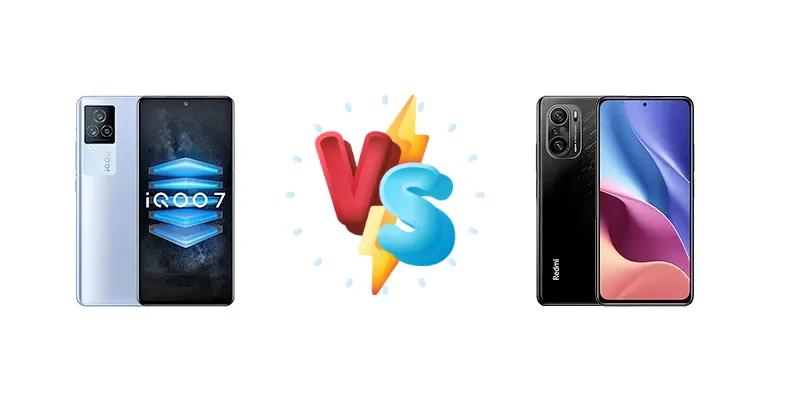
|
🏆 Quick Verdict
For the average user prioritizing speed and convenience, the iQOO 7 emerges as the winner. Its 120W charging, capable of a full charge in just 15 minutes (in China, 66W internationally), dramatically reduces downtime. While the Redmi K40 Pro+ offers a solid experience, its 33W charging feels comparatively slow in today's market.
| PHONES | ||
|---|---|---|
| Phone Names | vivo iQOO 7 | Xiaomi Redmi K40 Pro+ |
| Network | ||
|---|---|---|
| 2G bands | GSM 850 / 900 / 1800 / 1900 | GSM 850 / 900 / 1800 / 1900 - SIM 1 & SIM 2 |
| 3G bands | HSDPA 850 / 900 / 1700(AWS) / 1900 / 2100 | HSDPA 850 / 900 / 1700(AWS) / 1900 / 2100 |
| 4G bands | 1, 2, 3, 4, 5, 7, 8, 12, 17, 18, 19, 20, 25, 26, 28, 34, 38, 39, 40, 41 | 1, 2, 3, 4, 5, 7, 8, 12, 17, 18, 19, 20, 26, 28, 34, 38, 39, 40, 41, 42 |
| 5G bands | 1, 3, 28, 41, 78 SA/NSA - India | 1, 3, 28, 41, 77, 78 SA/NSA/Sub6 |
| Speed | HSPA, LTE, 5G | HSPA, LTE-A, 5G |
| Technology | GSM / CDMA / HSPA / EVDO / LTE / 5G | GSM / CDMA / HSPA / CDMA2000 / LTE / 5G |
| 1, 3, 28, 38, 41, 77, 78, 79 SA/NSA - China | CDMA2000 1x | |
| Launch | ||
|---|---|---|
| Announced | 2021, January 11 | 2021, February 25 |
| Status | Available. Released 2021, January 15 | Available. Released 2021, March 04 |
| Body | ||
|---|---|---|
| Dimensions | 162.2 x 75.8 x 8.7 mm (6.39 x 2.98 x 0.34 in) | 163.7 x 76.4 x 7.8 mm (6.44 x 3.01 x 0.31 in) |
| SIM | Nano-SIM + Nano-SIM | Dual SIM (Nano-SIM, dual stand-by) |
| Weight | 209.5 g (7.41 oz) | 196 g (6.91 oz) |
| - | IP53, dust and splash resistant | |
| Display | ||
|---|---|---|
| Protection | - | Corning Gorilla Glass 5 |
| Resolution | 1080 x 2400 pixels (~394 ppi density) | 1080 x 2400 pixels, 20:9 ratio (~395 ppi density) |
| Size | 6.62 inches, 106.5 cm2 (~86.6% screen-to-body ratio) | 6.67 inches, 107.4 cm2 (~85.9% screen-to-body ratio) |
| Type | AMOLED, 120Hz, HDR10+, 1300 nits (peak) | Super AMOLED, 120Hz, HDR10+, 1300 nits (peak) |
| Always-on display | - | |
| Platform | ||
|---|---|---|
| CPU | Octa-core (1x2.84 GHz Cortex-X1 & 3x2.42 GHz Cortex-A78 & 4x1.80 GHz Cortex-A55 | Octa-core (1x2.84 GHz Cortex-X1 & 3x2.42 GHz Cortex-A78 & 4x1.80 GHz Cortex-A55) |
| Chipset | Qualcomm SM8350 Snapdragon 888 5G (5 nm) | Qualcomm SM8350 Snapdragon 888 5G (5 nm) |
| GPU | Adreno 660 | Adreno 660 |
| OS | Android 11, Funtouch 11.1 (International), OriginOS 1.0 (China) | Android 11, MIUI 12 |
| Memory | ||
|---|---|---|
| Card slot | No | No |
| Internal | 128GB 8GB RAM, 256GB 8GB RAM, 256GB 12GB RAM | 256GB 12GB RAM |
| UFS 3.1 | UFS 3.1 | |
| Main Camera | ||
|---|---|---|
| Features | Color spectrum sensor, Dual-LED dual-tone flash, HDR, panorama | LED flash, HDR, panorama |
| Quad | 48 MP, f/1.8, 26mm (wide), 1/2.0", 0.8µm, PDAF, OIS 13 MP, f/2.5, 50mm (telephoto), 1/2.8", 0.8µm, PDAF, 2x optical zoom 13 MP, f/2.2, 120˚, 16mm (ultrawide) | - |
| Single | - | 20 MP, f/2.5, (wide), 1/3.4", 0.8µm |
| Triple | - | 108 MP, f/1.8, 26mm (wide), 1/1.52", 0.7µm, PDAF 8 MP, f/2.2, 119˚ (ultrawide) 5 MP, f/2.4, 50mm (macro), 1/5.0", 1.12µm |
| Video | 4K@30/60fps, 1080p@30/60fps, gyro-EIS | 8K@30fps, 4K@30/60fps, 1080p@30/60/120/240/960fps, gyro-EIS, HDR10+ |
| Selfie camera | ||
|---|---|---|
| Features | HDR | HDR |
| Single | 16 MP, f/2.0, (wide) | 20 MP, f/2.5, (wide), 1/3.4", 0.8µm |
| Video | 1080p@30fps | 1080p@30fps, 720p@120fps |
| Sound | ||
|---|---|---|
| 3.5mm jack | No | No |
| 35mm jack | No | - |
| Loudspeaker | Yes, with stereo speakers | Yes, with stereo speakers |
| 24-bit/192kHz audio | 24-bit/192kHz audio | |
| Comms | ||
|---|---|---|
| Bluetooth | 5.2, A2DP, LE, aptX HD | 5.2, A2DP, LE |
| Infrared port | - | Yes |
| NFC | Yes | Yes |
| Positioning | GPS (L1+L5), GLONASS, BDS, GALILEO, QZSS, NavIC | GPS (L1+L5), GLONASS (G1), BDS (B1I+B1c+B2a), GALILEO (E1+E5a), QZSS (L1+L5), NavIC (L5) |
| Radio | No | No |
| USB | USB Type-C 2.0, OTG | USB Type-C 2.0, OTG |
| WLAN | Wi-Fi 802.11 a/b/g/n/ac/6, dual-band, Wi-Fi Direct | Wi-Fi 802.11 a/b/g/n/ac/6e, dual-band, Wi-Fi Direct |
| Features | ||
|---|---|---|
| Sensors | Fingerprint (under display, optical), accelerometer, gyro, proximity, compass | Fingerprint (side-mounted), accelerometer, gyro, proximity, compass, color spectrum, barometer |
| Battery | ||
|---|---|---|
| Charging | 120W wired, 100% in 15 min (China) 66W wired (International) | 33W wired, PD3.0, QC3, 100% in 52 min (advertised) |
| Type | 4000 mAh | Li-Po 4520 mAh, non-removable |
| Misc | ||
|---|---|---|
| Colors | Gray, Blue, White, Legend | Black, White, Aurora |
| Models | V2049A, I2009 | - |
| Price | About 480 EUR | About 470 EUR |
vivo iQOO 7
- Blazing-fast 120W (China) / 66W (International) charging
- Identical Snapdragon 888 performance
- Likely optimized for gaming
- Charging speed reduced in international markets
- Battery capacity unspecified
Xiaomi Redmi K40 Pro+
- Solid Snapdragon 888 performance
- Potentially more refined software experience (based on Xiaomi's reputation)
- Balanced feature set
- Significantly slower 33W charging
- May prioritize battery life over peak performance
Display Comparison
Both devices utilize the Qualcomm SM8350 Snapdragon 888 5G (5 nm) chipset, meaning display performance will be largely dictated by panel quality and optimization. While specific display specs aren't provided, the iQOO 7's marketing often emphasizes gaming, suggesting a high refresh rate panel. The Redmi K40 Pro+ likely features a high-quality AMOLED display, typical of Xiaomi's flagship offerings. The absence of LTPO information suggests neither phone dynamically adjusts refresh rates for power saving, potentially impacting battery life during less demanding tasks.
Camera Comparison
Without detailed camera specifications, a direct comparison is limited. Both phones likely feature capable camera systems leveraging the Snapdragon 888's ISP. The Redmi K40 Pro+’s ‘Pro+’ designation suggests a potentially more advanced camera setup, possibly with a larger sensor or additional features. However, the absence of information regarding sensor size, OIS, or lens apertures prevents a definitive assessment. It’s reasonable to assume both phones will offer competitive image quality in good lighting conditions, but low-light performance will depend heavily on sensor capabilities and image processing algorithms.
Performance
The core performance is identical: both phones are powered by the Snapdragon 888 5G (5 nm) with the same CPU configuration – an octa-core setup featuring 1x2.84 GHz Cortex-X1, 3x2.42 GHz Cortex-A78, and 4x1.80 GHz Cortex-A55 cores. This means raw processing power will be nearly indistinguishable. However, thermal management, which isn't detailed here, will be crucial. The Snapdragon 888 is known to generate heat under sustained load, and the effectiveness of each phone's cooling solution will determine how well it maintains peak performance during extended gaming sessions. RAM speed (LPDDR5 or LPDDR5x) is also unspecified, but faster RAM can contribute to smoother multitasking.
Battery Life
This is where the iQOO 7 truly shines. Its 120W wired charging (66W internationally) is a game-changer, promising a full charge in a mere 15 minutes (China) or a still-impressive timeframe internationally. The Redmi K40 Pro+, with its 33W wired charging, takes significantly longer – advertised at 52 minutes for a full charge. While the battery capacity isn't specified for either device, the iQOO 7's charging speed effectively mitigates any potential disadvantage from a smaller battery. The faster charging allows for quick top-ups throughout the day, minimizing range anxiety.
Buying Guide
Buy the vivo iQOO 7 if you absolutely need the fastest possible charging speeds and frequently find yourself needing to top up your battery quickly. It’s ideal for gamers and power users who can’t afford to be tethered to a charger for long. Buy the Xiaomi Redmi K40 Pro+ if you prioritize a more balanced approach, potentially valuing other features (not detailed in provided data) and are less concerned with achieving the absolute fastest charging times. It’s a strong contender for users who prefer a more conservative charging profile.