
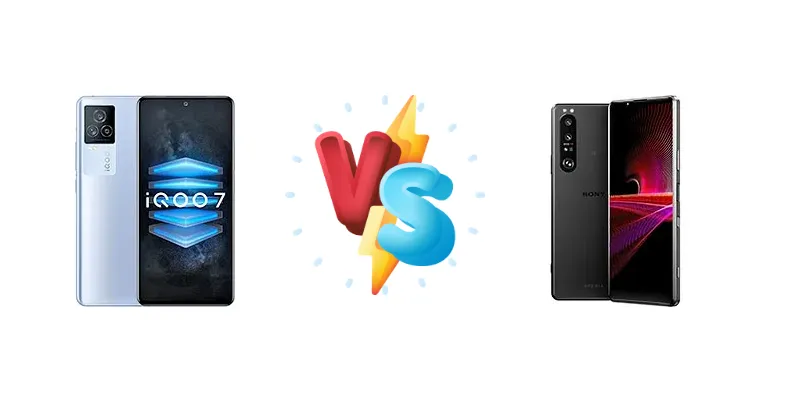
iQOO 7 vs Sony Xperia 1 III: A Deep Dive into Performance and Endurance
| Phones Images | |||||
|---|---|---|---|---|---|
|
🏆 Quick Verdict
For the average user prioritizing all-day battery and a refined multimedia experience, the Sony Xperia 1 III is the better choice. Its 82-hour endurance rating and feature-rich camera outweigh the iQOO 7’s faster charging, especially given the similar performance profiles. However, gamers and those needing rapid top-ups will find the iQOO 7’s 120W charging a compelling advantage.
| PHONES | ||
|---|---|---|
| Phone Names | vivo iQOO 7 | Sony Xperia 1 III |
| Network | ||
|---|---|---|
| 2G bands | GSM 850 / 900 / 1800 / 1900 | GSM 850 / 900 / 1800 / 1900 |
| 3G bands | HSDPA 850 / 900 / 1700(AWS) / 1900 / 2100 | HSDPA 800 / 850 / 900 / 1700(AWS) / 1900 / 2100 |
| 4G bands | 1, 2, 3, 4, 5, 7, 8, 12, 17, 18, 19, 20, 25, 26, 28, 34, 38, 39, 40, 41 | 1, 2, 3, 4, 5, 7, 8, 12, 13, 17, 19, 20, 25, 26, 28, 29, 32, 34, 38, 39, 40, 41, 46, 66 - Europe |
| 5G bands | 1, 3, 28, 41, 78 SA/NSA - India | 1, 3, 5, 7, 8, 20, 28, 38, 40, 41, 77, 78 SA/NSA/Sub6 - Europe |
| Speed | HSPA, LTE, 5G | HSPA, LTE, 5G |
| Technology | GSM / CDMA / HSPA / EVDO / LTE / 5G | GSM / HSPA / LTE / 5G |
| 1, 3, 28, 38, 41, 77, 78, 79 SA/NSA - China | SA/NSA/Sub6/mmWave - USA (specific) | |
| Launch | ||
|---|---|---|
| Announced | 2021, January 11 | 2021, April 14 |
| Status | Available. Released 2021, January 15 | Available. Released 2021, August 25 |
| Body | ||
|---|---|---|
| Build | - | Glass front (Gorilla Glass Victus), glass back (Gorilla Glass 6), aluminum frame |
| Dimensions | 162.2 x 75.8 x 8.7 mm (6.39 x 2.98 x 0.34 in) | 165 x 71 x 8.2 mm (6.50 x 2.80 x 0.32 in) |
| SIM | Nano-SIM + Nano-SIM | Nano-SIM + Nano-SIM |
| Weight | 209.5 g (7.41 oz) | 186 g / 187.1 g (mmWave) (6.56 oz) |
| - | IP65/IP68 dust/water resistant (up to 1.5m for 30 min) | |
| Display | ||
|---|---|---|
| Protection | - | Corning Gorilla Glass Victus |
| Resolution | 1080 x 2400 pixels (~394 ppi density) | 1644 x 3840 pixels, 21:9 ratio (~643 ppi density) |
| Size | 6.62 inches, 106.5 cm2 (~86.6% screen-to-body ratio) | 6.5 inches, 98.6 cm2 (~84.2% screen-to-body ratio) |
| Type | AMOLED, 120Hz, HDR10+, 1300 nits (peak) | OLED, 1B colors, 120Hz, HDR BT.2020 |
| Always-on display | Runs at 1096 x 2560 pixels except for select use cases | |
| Platform | ||
|---|---|---|
| CPU | Octa-core (1x2.84 GHz Cortex-X1 & 3x2.42 GHz Cortex-A78 & 4x1.80 GHz Cortex-A55 | Octa-core (1x2.84 GHz Cortex-X1 & 3x2.42 GHz Cortex-A78 & 4x1.80 GHz Cortex-A55) |
| Chipset | Qualcomm SM8350 Snapdragon 888 5G (5 nm) | Qualcomm SM8350 Snapdragon 888 5G (5 nm) |
| GPU | Adreno 660 | Adreno 660 |
| OS | Android 11, Funtouch 11.1 (International), OriginOS 1.0 (China) | Android 11, upgradable to Android 13 |
| Memory | ||
|---|---|---|
| Card slot | No | microSDXC (uses shared SIM slot) |
| Internal | 128GB 8GB RAM, 256GB 8GB RAM, 256GB 12GB RAM | 256GB 12GB RAM, 512GB 12GB RAM |
| UFS 3.1 | UFS 3.X | |
| Main Camera | ||
|---|---|---|
| Features | Color spectrum sensor, Dual-LED dual-tone flash, HDR, panorama | Zeiss optics, Zeiss T* lens coating, color spectrum sensor, LED flash, panorama, HDR, eye tracking |
| Quad | 48 MP, f/1.8, 26mm (wide), 1/2.0", 0.8µm, PDAF, OIS 13 MP, f/2.5, 50mm (telephoto), 1/2.8", 0.8µm, PDAF, 2x optical zoom 13 MP, f/2.2, 120˚, 16mm (ultrawide) | - |
| Single | - | 8 MP, f/2.0, 24mm (wide), 1/4", 1.12µm |
| Triple | - | 12 MP, f/1.7, 24mm (wide), 1/1.7", 1.8µm, dual pixel PDAF, OIS 12 MP, f/2.3, 70mm (telephoto), f/2.8, 105mm (telephoto), 1/2.9", dual pixel PDAF, 3x/4.4x optical zoom, OIS 12 MP, f/2.2, 124˚, 16mm (ultrawide), 1/2.6", dual pixel PDAF 0.3 MP, TOF 3D, (depth) |
| Video | 4K@30/60fps, 1080p@30/60fps, gyro-EIS | 4K@24/25/30/60/120fps HDR, 1080p@30/60/120fps; 5-axis gyro-EIS, OIS |
| Selfie camera | ||
|---|---|---|
| Features | HDR | HDR |
| Single | 16 MP, f/2.0, (wide) | 8 MP, f/2.0, 24mm (wide), 1/4.0", 1.12µm |
| Video | 1080p@30fps | 1080p@30fps, 5-axis gyro-EIS |
| Sound | ||
|---|---|---|
| 3.5mm jack | No | Yes |
| 35mm jack | No | Yes |
| Loudspeaker | Yes, with stereo speakers | Yes, with stereo speakers |
| 24-bit/192kHz audio | 24-bit/192kHz audio Dynamic vibration system | |
| Comms | ||
|---|---|---|
| Bluetooth | 5.2, A2DP, LE, aptX HD | 5.2, A2DP, LE, aptX HD, aptX Adaptive |
| NFC | Yes | Yes |
| Positioning | GPS (L1+L5), GLONASS, BDS, GALILEO, QZSS, NavIC | GPS, GLONASS, BDS, GALILEO, QZSS |
| Radio | No | No |
| USB | USB Type-C 2.0, OTG | USB Type-C 3.1, OTG, video output |
| WLAN | Wi-Fi 802.11 a/b/g/n/ac/6, dual-band, Wi-Fi Direct | Wi-Fi 802.11 a/b/g/n/ac/6, dual-band, Wi-Fi Direct, DLNA |
| Features | ||
|---|---|---|
| Sensors | Fingerprint (under display, optical), accelerometer, gyro, proximity, compass | Fingerprint (side-mounted), accelerometer, gyro, proximity, barometer, compass |
| - | Native Sony Alpha camera support | |
| Battery | ||
|---|---|---|
| Charging | 120W wired, 100% in 15 min (China) 66W wired (International) | 30W wired, PD, 50% in 30 min Wireless Reverse wireless |
| Type | 4000 mAh | Li-Po 4500 mAh |
| Misc | ||
|---|---|---|
| Colors | Gray, Blue, White, Legend | Frosted Black, Frosted Gray, Frosted Purple |
| Models | V2049A, I2009 | XQBC62/V, XQBC52V.UKCX, SO-51B, SOG03, A101SO, XQ-BC62, XQ-BC72, XQ-BC52, XQ-BC01, XQ-BC11, XQ-BC21, XQ-BC72 |
| Price | About 480 EUR | € 505.26 / $ 903.43 |
| Tests | ||
|---|---|---|
| Battery life | - | Endurance rating 82h |
| Camera | - | Photo / Video |
| Display | - | Contrast ratio: Infinite (nominal) |
| Loudspeaker | - | -26.5 LUFS (Good) |
| Performance | - | AnTuTu: 607423 (v8) GeekBench: 3515 (v5.1) GFXBench: 54fps (ES 3.1 onscreen) |
vivo iQOO 7
- Blazing-fast 120W charging (China) / 66W (International)
- Optimized for gaming performance
- Potentially aggressive thermal management
- Battery life likely shorter than Xperia 1 III
- Limited details on camera specifications
Sony Xperia 1 III
- Exceptional 82-hour battery endurance
- Wireless and reverse wireless charging
- Likely superior camera features for content creators
- Slower 30W wired charging
- May throttle under sustained gaming load
Display Comparison
Both the iQOO 7 and Xperia 1 III utilize the Qualcomm Snapdragon 888 5G (5 nm) chipset, meaning CPU performance will be nearly identical, both featuring an Octa-core setup with 1x2.84 GHz Cortex-X1, 3x2.42 GHz Cortex-A78, and 4x1.80 GHz Cortex-A55 cores. The Xperia 1 III boasts a measured peak brightness of 620 nits, suggesting a brighter outdoor viewing experience, though the iQOO 7’s display specifications are not provided. The Xperia 1 III’s infinite (nominal) contrast ratio indicates a true black level, likely due to an OLED panel, which is expected for a flagship. Without display specs for the iQOO 7, it's difficult to assess color accuracy or refresh rate differences.
Camera Comparison
Both phones are described as having Photo/Video capabilities, but detailed sensor information is lacking. The Xperia 1 III, historically, emphasizes natural color reproduction and manual control options, appealing to photography enthusiasts. The iQOO 7, while likely offering a versatile camera system, may lean towards more processed images optimized for social media sharing. Without specifics on sensor size, aperture, or OIS, a direct comparison is impossible. The absence of any mention of a telephoto lens on either device suggests a reliance on digital zoom.
Performance
The shared Snapdragon 888 5G chipset ensures similar raw processing power in both devices. However, the iQOO 7’s focus on gaming suggests potential optimizations in thermal management and software to sustain peak performance for longer durations. The Xperia 1 III, while capable, prioritizes a broader range of features, potentially leading to more conservative thermal throttling under sustained load. RAM specifications are not provided for either device, but both likely utilize LPDDR5 for fast memory access. The iQOO 7’s aggressive cooling solutions (not detailed in the provided data) could be a key differentiator for demanding users.
Battery Life
The Xperia 1 III’s 82-hour endurance rating is a significant advantage, indicating superior battery life compared to the iQOO 7. While the iQOO 7 offers incredibly fast 120W wired charging (fully charging in 15 minutes in China, 66W internationally), the Xperia 1 III’s 30W charging, while slower, is still respectable, reaching 50% in 30 minutes. The Xperia 1 III also includes wireless and reverse wireless charging, adding to its versatility. The iQOO 7’s faster charging is ideal for users who frequently need a quick top-up, but the Xperia 1 III’s longer endurance reduces the need for frequent charging.
Buying Guide
Buy the vivo iQOO 7 if you need the absolute fastest charging speeds available and prioritize gaming performance above all else. Its 120W charging is unmatched, and the Snapdragon 888 is well-suited for demanding titles. Buy the Sony Xperia 1 III if you prefer a more balanced flagship experience with a focus on photography, videography, and long-lasting battery life. Its 82-hour endurance and professional-grade camera features cater to content creators and users who value a premium, all-day experience.