
Realme GT 8 Pro vs. vivo iQOO 7: A Head-to-Head Battle of Snapdragon Power
| Phones Images | |||||
|---|---|---|---|---|---|
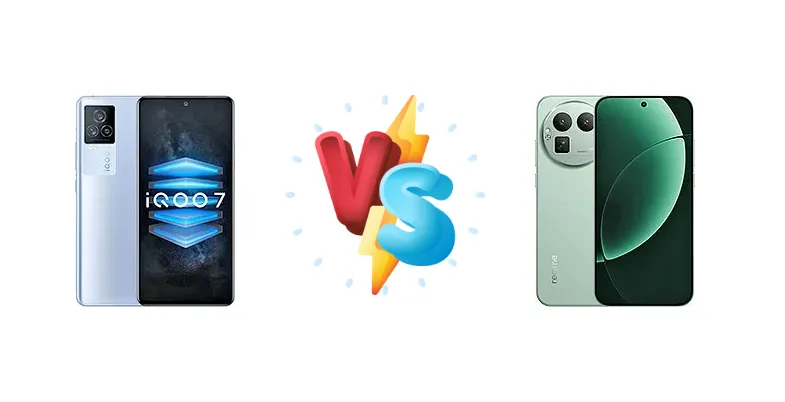
|
🏆 Quick Verdict
For the power user prioritizing raw performance and future-proofing, the Realme GT 8 Pro is the clear winner. Its Snapdragon 8 Elite Gen 5 offers a substantial performance advantage, coupled with impressive battery endurance and charging capabilities. However, the iQOO 7 remains a strong contender, particularly for those seeking a more established platform with incredibly fast charging.
| PHONES | ||
|---|---|---|
| Phone Names | vivo iQOO 7 | Realme GT 8 Pro |
| Network | ||
|---|---|---|
| 2G bands | GSM 850 / 900 / 1800 / 1900 | GSM 850 / 900 / 1800 / 1900 |
| 3G bands | HSDPA 850 / 900 / 1700(AWS) / 1900 / 2100 | HSDPA 800 / 850 / 900 / 1700(AWS) / 1900 / 2100 |
| 4G bands | 1, 2, 3, 4, 5, 7, 8, 12, 17, 18, 19, 20, 25, 26, 28, 34, 38, 39, 40, 41 | 1, 2, 3, 4, 5, 7, 8, 12, 13, 17, 18, 19, 20, 26, 28, 38, 39, 40, 41, 42, 48, 66, 71 - International |
| 5G bands | 1, 3, 28, 41, 78 SA/NSA - India | 1, 2, 3, 5, 7, 8, 20, 28, 38, 40, 41, 48, 66, 71, 77, 78, 79 SA/NSA - International |
| Speed | HSPA, LTE, 5G | HSPA, LTE, 5G |
| Technology | GSM / CDMA / HSPA / EVDO / LTE / 5G | GSM / HSPA / LTE / 5G |
| 1, 3, 28, 38, 41, 77, 78, 79 SA/NSA - China | - | |
| Launch | ||
|---|---|---|
| Announced | 2021, January 11 | 2025, October 21 |
| Status | Available. Released 2021, January 15 | Available. Released 2025, October 21 |
| Body | ||
|---|---|---|
| Build | - | Glass front (Gorilla Glass 7i), aluminum alloy frame, fiber-reinforced plastic back or silicone polymer (eco leather) back |
| Dimensions | 162.2 x 75.8 x 8.7 mm (6.39 x 2.98 x 0.34 in) | 161.8 x 76.9 x 8.2 mm (6.37 x 3.03 x 0.32 in) |
| SIM | Nano-SIM + Nano-SIM | · Nano-SIM + Nano-SIM + eSIM (max 2 at a time) - International· Nano-SIM + Nano-SIM - China |
| Weight | 209.5 g (7.41 oz) | 214 g or 218 g (7.69 oz) |
| Display | ||
|---|---|---|
| Protection | - | Corning Gorilla Glass 7i, Mohs level 4 |
| Resolution | 1080 x 2400 pixels (~394 ppi density) | 1440 x 3136 pixels, 19.5:9 ratio (~508 ppi density) |
| Size | 6.62 inches, 106.5 cm2 (~86.6% screen-to-body ratio) | 6.79 inches, 112.8 cm2 (~90.7% screen-to-body ratio) |
| Type | AMOLED, 120Hz, HDR10+, 1300 nits (peak) | AMOLED, 1B colors, 144Hz, HDR10+, HDR Vivid, Dolby Vision, 1000 nits (typ), 2000 nits (HBM), 7000 nits (peak) |
| Always-on display | - | |
| Platform | ||
|---|---|---|
| CPU | Octa-core (1x2.84 GHz Cortex-X1 & 3x2.42 GHz Cortex-A78 & 4x1.80 GHz Cortex-A55 | Octa-core (2x4.6 GHz Oryon V3 Phoenix L + 6x3.62 GHz Oryon V3 Phoenix M) |
| Chipset | Qualcomm SM8350 Snapdragon 888 5G (5 nm) | Qualcomm SM8850-AC Snapdragon 8 Elite Gen 5 (3 nm) |
| GPU | Adreno 660 | Adreno 840 |
| OS | Android 11, Funtouch 11.1 (International), OriginOS 1.0 (China) | Android 16, up to 4 major Android upgrades, Realme UI 7.0 |
| Memory | ||
|---|---|---|
| Card slot | No | No |
| Internal | 128GB 8GB RAM, 256GB 8GB RAM, 256GB 12GB RAM | 256GB 12GB RAM, 256GB 16GB RAM, 512GB 12GB RAM, 512GB 16GB RAM, 1TB 16GB RAM |
| UFS 3.1 | - | |
| Main Camera | ||
|---|---|---|
| Features | Color spectrum sensor, Dual-LED dual-tone flash, HDR, panorama | Ricoh lens, Color spectrum sensor, LED flash, HDR, panorama, switchable camera bump |
| Quad | 48 MP, f/1.8, 26mm (wide), 1/2.0", 0.8µm, PDAF, OIS 13 MP, f/2.5, 50mm (telephoto), 1/2.8", 0.8µm, PDAF, 2x optical zoom 13 MP, f/2.2, 120˚, 16mm (ultrawide) | - |
| Triple | - | 50 MP, f/1.8, 22mm (wide), 1/1.56", 1.0µm, multi-directional PDAF, OIS 200 MP, f/2.6, 65mm, (periscope telephoto), 1/1.56", 0.5µm, multi-directional PDAF, OIS, 3x optical zoom 50 MP, f/2.0, 16mm, 116˚ (ultrawide), 1/2.88", 0.64µm |
| Video | 4K@30/60fps, 1080p@30/60fps, gyro-EIS | 8K@30fps, 4K@30/60/120fps, 1080p@30/60/120/240fps, gyro-EIS, HDR, Dolby Vision, 10-bit LOG |
| Selfie camera | ||
|---|---|---|
| Features | HDR | Panorama |
| Single | 16 MP, f/2.0, (wide) | 32 MP, f/2.4, 24mm (wide), 1/3.1", 0.7µm |
| Video | 1080p@30fps | 4K@30/60fps, 1080p@30/60fps; gyro-EIS, HDR, Dolby Vision |
| Sound | ||
|---|---|---|
| 3.5mm jack | No | - |
| 35mm jack | No | No |
| Loudspeaker | Yes, with stereo speakers | Yes, with stereo speakers |
| 24-bit/192kHz audio | - | |
| Comms | ||
|---|---|---|
| Bluetooth | 5.2, A2DP, LE, aptX HD | 6.0, A2DP, LE, aptX HD, LHDC 5 |
| Infrared port | - | Yes |
| NFC | Yes | Yes, 360˚ |
| Positioning | GPS (L1+L5), GLONASS, BDS, GALILEO, QZSS, NavIC | GPS (L1+L5), BDS (B1I+B1c+B2a), GALILEO (E1+E5a), QZSS (L1+L5), GLONASS, NavIC (L5) |
| Radio | No | No |
| USB | USB Type-C 2.0, OTG | USB Type-C 2.0, OTG |
| WLAN | Wi-Fi 802.11 a/b/g/n/ac/6, dual-band, Wi-Fi Direct | Wi-Fi 802.11 a/b/g/n/ac/6/7, dual-band |
| Features | ||
|---|---|---|
| Sensors | Fingerprint (under display, optical), accelerometer, gyro, proximity, compass | Fingerprint (under display, ultrasonic), accelerometer, gyro, proximity, compass |
| Battery | ||
|---|---|---|
| Charging | 120W wired, 100% in 15 min (China) 66W wired (International) | 120W wired, 120W UFCS, 14.4W PD, 55W PPS, 14.4W QC, 15 min to 50%, 43 min to 100% 50W wireless, 79 min to 100% 10W wireless reverse 5W reverse wired |
| Type | 4000 mAh | Si/C Li-Ion 7000 mAh |
| Misc | ||
|---|---|---|
| Colors | Gray, Blue, White, Legend | Diary White, Urban Blue, Green, Aston Martin Green |
| Models | V2049A, I2009 | RMX5210 |
| Price | About 480 EUR | € 899.99 |
| SAR | - | 0.99 W/kg (head) 1.27 W/kg (body) |
| EU LABEL | ||
|---|---|---|
| Battery | - | 60:32h endurance, 1100 cycles |
| Energy | - | Class B |
| Free fall | - | Class D (60 falls) |
| Repairability | - | Class C |
vivo iQOO 7
- Incredibly fast 120W wired charging (China)
- Proven Snapdragon 888 performance
- Established software ecosystem
- Potentially lower battery life than GT 8 Pro
- Chipset is a generation behind
Realme GT 8 Pro
- Cutting-edge Snapdragon 8 Elite Gen 5 performance
- Exceptional battery life and endurance
- Versatile charging options (wired, wireless, reverse)
- Software may be less mature than iQOO 7
- 120W charging takes 43 minutes to full
Display Comparison
The Realme GT 8 Pro boasts a significantly brighter display, reaching a measured peak of 2262 nits. This translates to superior visibility in direct sunlight, a crucial advantage for outdoor users. While the iQOO 7’s display specifications aren’t provided, it’s likely to be a high-quality panel, but it won’t match the GT 8 Pro’s peak brightness. The GT 8 Pro’s brightness also suggests a more advanced panel technology, potentially LTPO, enabling variable refresh rates for improved power efficiency. Bezels are likely comparable, given both phones target a premium aesthetic.
Camera Comparison
Without detailed camera specifications for the iQOO 7, a direct comparison is limited. However, the Realme GT 8 Pro’s camera system is expected to be a strong performer, leveraging the Snapdragon 8 Elite Gen 5’s advanced ISP. The focus should be on the main sensor resolution and aperture. Larger sensors and wider apertures capture more light, resulting in better low-light performance. Image processing algorithms will also play a key role, and Realme’s software typically emphasizes vibrant, social media-ready images. The iQOO 7 will likely offer a competent camera experience, but the GT 8 Pro’s chipset advantage suggests superior image processing capabilities.
Performance
The core difference lies in the chipsets. The Realme GT 8 Pro’s Snapdragon 8 Elite Gen 5 (3nm) represents a generational leap over the iQOO 7’s Snapdragon 888 (5nm). The 3nm process node inherently offers better thermal efficiency, meaning the GT 8 Pro is likely to sustain peak performance for longer periods without throttling. The CPU architecture also favors the GT 8 Pro; its Oryon V3 Phoenix cores (2x4.6 GHz + 6x3.62 GHz) are demonstrably faster than the Snapdragon 888’s Cortex-X1 and A78 configuration (2.84 GHz + 2.42 GHz). While both phones likely utilize LPDDR5X RAM, the GT 8 Pro’s superior chipset will maximize its potential.
Battery Life
The Realme GT 8 Pro showcases impressive battery endurance, with a measured 60:32h endurance and 20:24h of active use. This is likely due to the efficient 3nm Snapdragon 8 Elite Gen 5. The iQOO 7, while offering incredibly fast 120W wired charging (15 minutes to 100% in China, 66W internationally), may not match the GT 8 Pro’s overall battery life. The GT 8 Pro’s charging is also versatile, supporting 120W UFCS, 50W wireless, and various PD/PPS standards. The iQOO 7’s charging speed is a significant advantage for quick top-ups, but the GT 8 Pro offers a more complete charging ecosystem and longer runtimes.
Buying Guide
Buy the vivo iQOO 7 if you need blazing-fast charging (especially in China) and a proven, reliable platform with a strong gaming focus. It's ideal for users who frequently top up their phones and value a mature software experience. Buy the Realme GT 8 Pro if you prioritize cutting-edge performance, exceptional battery life, and the latest Snapdragon technology. This phone is geared towards enthusiasts who demand the best possible specs and are willing to embrace a slightly newer, potentially evolving software ecosystem.