
iQOO 5 Pro vs Xiaomi Mi 10 Ultra: A Deep Dive into Speed and Endurance
| Phones Images | |||||
|---|---|---|---|---|---|
|
🏆 Quick Verdict
For the average user prioritizing the absolute fastest wired charging and a slightly more streamlined experience, the iQOO 5 Pro emerges as the winner. It achieves a full charge in just 15 minutes. However, the Mi 10 Ultra’s 50W wireless charging and slightly better overall battery endurance make it a compelling alternative for those who value convenience.
| PHONES | ||
|---|---|---|
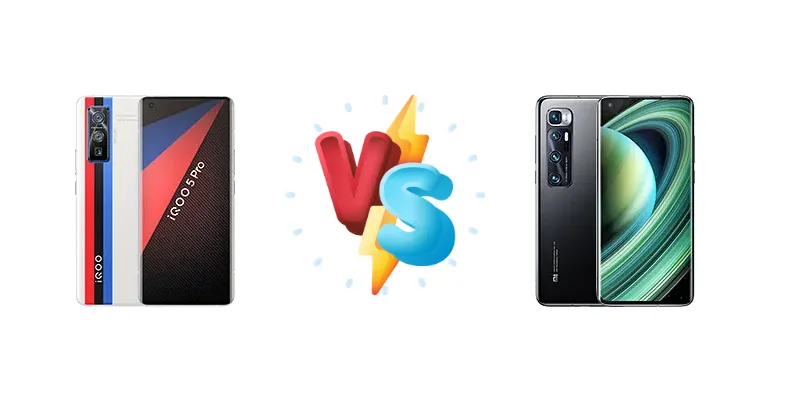
| Phone Names | vivo iQOO 5 Pro 5G | Xiaomi Mi 10 Ultra |
| Network | ||
|---|---|---|
| 2G bands | GSM 850 / 900 / 1800 / 1900 | GSM 850 / 900 / 1800 / 1900 |
| 3G bands | HSDPA 850 / 900 / 1700(AWS) / 1900 / 2100 | HSDPA 850 / 900 / 1700(AWS) / 1900 / 2100 |
| 4G bands | 1, 2, 3, 4, 5, 7, 8, 12, 17, 18, 19, 20, 25, 26, 28, 34, 38, 39, 40, 41 | 1, 2, 3, 4, 5, 7, 8, 12, 17, 34, 38, 39, 40, 41 |
| 5G bands | 1, 3, 28, 38, 41, 77, 78, 79 SA/NSA | 1, 3, 41, 78, 79 SA/NSA |
| Speed | HSPA, LTE, 5G | HSPA, LTE, 5G |
| Technology | GSM / CDMA / HSPA / LTE / 5G | GSM / CDMA / HSPA / EVDO / LTE / 5G |
| CDMA 800 & TD-SCDMA | CDMA2000 1xEV-DO | |
| Launch | ||
|---|---|---|
| Announced | 2020, August 17. Released 2020, August 24 | 2020, August 11. Released 2020, August 16 |
| Status | Discontinued | Discontinued |
| Body | ||
|---|---|---|
| Build | - | Glass front (Gorilla Glass 5), glass back (Gorilla Glass 6), aluminum frame |
| Dimensions | 159.6 x 73.3 x 8.9 mm (6.28 x 2.89 x 0.35 in) | 162.4 x 75.1 x 9.5 mm (6.39 x 2.96 x 0.37 in) |
| SIM | Nano-SIM + Nano-SIM | Nano-SIM + Nano-SIM |
| Weight | 198 g (6.98 oz) | 221.8 g (7.83 oz) |
| Display | ||
|---|---|---|
| Protection | - | Corning Gorilla Glass 5 |
| Resolution | 1080 x 2376 pixels (~398 ppi density) | 1080 x 2340 pixels, 19.5:9 ratio (~386 ppi density) |
| Size | 6.56 inches, 104.6 cm2 (~89.4% screen-to-body ratio) | 6.67 inches, 109.2 cm2 (~89.5% screen-to-body ratio) |
| Type | AMOLED, 120Hz, HDR10+ | OLED, 1B colors, 120Hz, HDR10+, 800 nits (HBM), 1120 nits (peak) |
| Platform | ||
|---|---|---|
| CPU | Octa-core (1x2.84 GHz Cortex-A77 & 3x2.42 GHz Cortex-A77 & 4x1.80 GHz Cortex-A55) | Octa-core (1x2.84 GHz Cortex-A77 & 3x2.42 GHz Cortex-A77 & 4x1.80 GHz Cortex-A55) |
| Chipset | Qualcomm SM8250 Snapdragon 865 5G (7 nm+) | Qualcomm SM8250 Snapdragon 865 5G (7 nm+) |
| GPU | Adreno 650 | Adreno 650 |
| OS | Android 10, IQOO UI 1.5 | Android 10, MIUI 12.5 |
| Memory | ||
|---|---|---|
| Card slot | No | No |
| Internal | 256GB 8GB RAM, 256GB 12GB RAM | 128GB 8GB RAM, 256GB 8GB RAM, 256GB 12GB RAM, 512GB 16GB RAM |
| UFS 3.1 | UFS 3.1 | |
| Main Camera | ||
|---|---|---|
| Features | Dual-LED flash, HDR, panorama | Laser AF, color spectrum sensor, Dual-LED flash, HDR, panorama |
| Quad | - | 48 MP, f/1.9, 25mm (wide), 1/1.32", 1.2µm, PDAF, OIS 48 MP, f/4.1, 120mm (periscope telephoto), 1/2.0", 0.8µm, PDAF, OIS, 5x optical zoom 12 MP, f/2.0, 50mm (telephoto), 1/2.55", 1.4µm, dual pixel PDAF, 2x optical zoom 20 MP, f/2.2, 128˚, 12mm (ultrawide), 1/2.8", 1.0µm, PDAF |
| Triple | 50 MP, f/1.9, (wide), 1/1.31", 1.2µm, dual pixel PDAF, OIS 8 MP, f/3.4, 135mm (periscope telephoto), 1/4.0", PDAF, OIS, 5x optical zoom 13 MP, f/2.2, 120˚, 16mm (ultrawide), 1/4.0", 1.12µm | - |
| Video | 8K, 4K@30fps, 1080p@30fps, gyro-EIS | 8K@24fps, 4K@30/60fps, 1080p@30/60/120/240/960fps, gyro-EIS, HDR10 rec. |
| Selfie camera | ||
|---|---|---|
| Features | Panorama | HDR |
| Single | 16 MP, f/2.5, (wide) | 20 MP, f/2.3, (wide), 1/3.4", 0.8µm |
| Video | 1080p@30fps | 1080p@30fps, 720p@120fps, gyro-EIS |
| Sound | ||
|---|---|---|
| 3.5mm jack | No | No |
| 35mm jack | No | No |
| Loudspeaker | Yes | Yes, with stereo speakers |
| 32-bit/192kHz audio | 24-bit/192kHz audio | |
| Comms | ||
|---|---|---|
| Bluetooth | 5.1, A2DP, LE, aptX HD | 5.1, A2DP, LE, aptX HD |
| Infrared port | - | Yes |
| NFC | Yes | Yes |
| Positioning | GPS (L1+L5), GLONASS, BDS, GALILEO | GPS (L1+L5), GLONASS (G1), BDS (B1I+B2a), GALILEO (E1+E5a), QZSS (L1+L5) |
| Radio | No | No |
| USB | USB Type-C, OTG | USB Type-C 2.0, OTG |
| WLAN | Wi-Fi 802.11 a/b/g/n/ac/6, dual-band, Wi-Fi Direct | Wi-Fi 802.11 a/b/g/n/ac/6, dual-band, Wi-Fi Direct, DLNA |
| Features | ||
|---|---|---|
| Sensors | Fingerprint (under display, optical), accelerometer, gyro, proximity, compass | Fingerprint (under display, optical), accelerometer, gyro, proximity, compass, barometer |
| Battery | ||
|---|---|---|
| Charging | 120W wired, 50% in 5 min, 100% in 15 min Reverse wired | 120W wired, PD3.0, QC5, 41% in 5 min, 100% in 23 min 50W wireless, 100% in 40 min 10W reverse wireless |
| Type | 4000 mAh | Li-Ion 4500 mAh, graphene-enhanced |
| Misc | ||
|---|---|---|
| Colors | White, Black | Obsidian Black, Mercury Silver, Transparent Edition |
| Models | v2025a | M2007J1SC |
| Price | About 610 EUR | About 650 EUR |
| Tests | ||
|---|---|---|
| Battery life | - | Endurance rating 85h |
| Camera | - | Photo / Video |
| Display | - | Contrast ratio: Infinite (nominal) |
| Loudspeaker | - | -24.6 LUFS (Very good) |
| Performance | - | AnTuTu: 638497 (v8) GeekBench: 3248 (v5.1) GFXBench: 46fps (ES 3.1 onscreen) |
vivo iQOO 5 Pro 5G
- Blazing-fast 120W wired charging (15 minutes to full)
- Potentially superior thermal management for gaming
- Streamlined user experience (typical of iQOO)
- No wireless charging
- Limited camera details in provided data
Xiaomi Mi 10 Ultra
- 50W wireless charging for added convenience
- Potentially more versatile camera system (based on market reports)
- Slightly better overall battery endurance
- Slower 120W wired charging (23 minutes to full)
- Higher price point (likely, given 'Ultra' branding)
Display Comparison
Both the iQOO 5 Pro and Mi 10 Ultra share an 'Infinite' (nominal) contrast ratio, suggesting both utilize AMOLED panels. However, specific details like peak brightness, color gamut coverage, and refresh rate are missing. Given the Mi 10 Ultra’s positioning as an ‘Ultra’ device, it likely boasts a slightly more refined display experience, potentially with higher peak brightness for HDR content. Without further data, it’s difficult to definitively declare a winner, but the Mi 10 Ultra’s premium branding suggests a more advanced panel.
Camera Comparison
The provided data only indicates both phones have 'Photo / Video' capabilities. The Mi 10 Ultra is known for its advanced camera system, including a large 108MP main sensor and periscope zoom lens (based on market knowledge). The iQOO 5 Pro’s camera specs are less publicized. While both likely deliver excellent image quality, the Mi 10 Ultra’s hardware suggests a more versatile and capable camera system, particularly in low-light conditions and zoom photography. The absence of sensor size details for the iQOO 5 Pro hinders a direct comparison.
Performance
Both devices are powered by the Qualcomm SM8250 Snapdragon 865 5G (7 nm+), featuring the same Octa-core CPU configuration (1x2.84 GHz Cortex-A77, 3x2.42 GHz Cortex-A77, 4x1.80 GHz Cortex-A55). Therefore, raw CPU performance will be nearly identical. The key differentiator will be thermal management and sustained performance. The iQOO brand historically focuses on gaming, suggesting a more robust cooling solution to prevent throttling under sustained load. RAM speed (LPDDR5x) is not specified, but is a critical factor in overall system responsiveness. Without this data, it's difficult to assess a performance advantage.
Battery Life
Both phones feature 120W wired charging, but the implementation differs. The iQOO 5 Pro reaches 100% in 15 minutes, while the Mi 10 Ultra takes 23 minutes. This 8-minute difference is significant for users prioritizing speed. The Mi 10 Ultra also offers 50W wireless charging (100% in 40 minutes) and 10W reverse wireless charging, features absent in the iQOO 5 Pro. Both have an endurance rating of 85h, suggesting similar real-world battery life despite potential differences in battery capacity (not specified). The Mi 10 Ultra’s wireless charging capabilities provide a clear advantage for convenience.
Buying Guide
Buy the vivo iQOO 5 Pro if you need the absolute fastest wired charging speeds available and prioritize a gaming-focused experience. Buy the Xiaomi Mi 10 Ultra if you prefer the convenience of fast wireless charging, a more versatile camera system (based on market reports, though not detailed in provided data), and a slightly longer-lasting battery between charges.