
iQOO 5 Pro vs Realme X50 Pro Player: A Deep Dive into Snapdragon 865 Flagships
| Phones Images | |||||
|---|---|---|---|---|---|
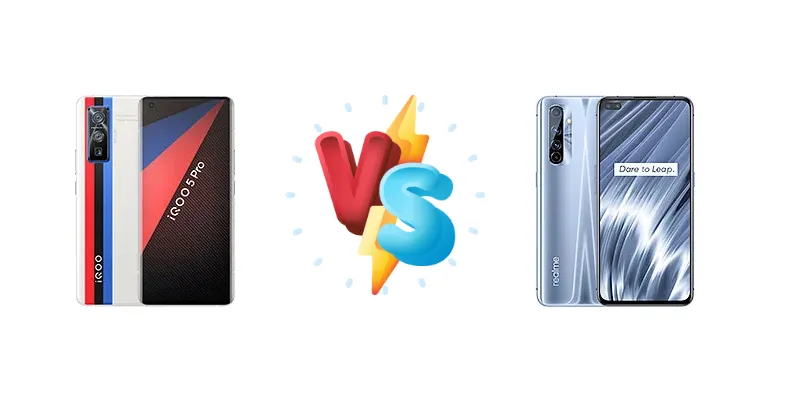
|
🏆 Quick Verdict
For the average user prioritizing speed and convenience, the iQOO 5 Pro 5G is the clear winner. Its groundbreaking 120W charging capability dramatically reduces downtime, offsetting the slightly slower charging speed of the Realme X50 Pro Player. While both phones offer similar performance, the iQOO 5 Pro’s charging advantage is a game-changer.
| PHONES | ||
|---|---|---|
| Phone Names | vivo iQOO 5 Pro 5G | Realme X50 Pro Player |
| Network | ||
|---|---|---|
| 2G bands | GSM 850 / 900 / 1800 / 1900 | GSM 850 / 900 / 1800 / 1900 |
| 3G bands | HSDPA 850 / 900 / 1700(AWS) / 1900 / 2100 | HSDPA 800 / 850 / 900 / 1700(AWS) / 1900 / 2100 |
| 4G bands | 1, 2, 3, 4, 5, 7, 8, 12, 17, 18, 19, 20, 25, 26, 28, 34, 38, 39, 40, 41 | 1, 2, 3, 4, 5, 7, 8, 12, 17, 20, 34, 38, 39, 40, 41 |
| 5G bands | 1, 3, 28, 38, 41, 77, 78, 79 SA/NSA | 1, 3, 41, 77, 78, 79 SA/NSA |
| Speed | HSPA, LTE, 5G | HSPA, LTE, 5G |
| Technology | GSM / CDMA / HSPA / LTE / 5G | GSM / CDMA / HSPA / EVDO / LTE / 5G |
| CDMA 800 & TD-SCDMA | CDMA2000 1xEV-DO | |
| Launch | ||
|---|---|---|
| Announced | 2020, August 17. Released 2020, August 24 | 2020, May 25. Released 2020, June 01 |
| Status | Discontinued | Discontinued |
| Body | ||
|---|---|---|
| Build | - | Glass front (Unspecified), glass back (Unspecified), aluminum frame |
| Dimensions | 159.6 x 73.3 x 8.9 mm (6.28 x 2.89 x 0.35 in) | 159 x 74.2 x 8.9 mm (6.26 x 2.92 x 0.35 in) |
| SIM | Nano-SIM + Nano-SIM | Nano-SIM + Nano-SIM |
| Weight | 198 g (6.98 oz) | 209 g (7.37 oz) |
| Display | ||
|---|---|---|
| Protection | - | Unspecified |
| Resolution | 1080 x 2376 pixels (~398 ppi density) | 1080 x 2400 pixels, 20:9 ratio (~409 ppi density) |
| Size | 6.56 inches, 104.6 cm2 (~89.4% screen-to-body ratio) | 6.44 inches, 100.1 cm2 (~84.9% screen-to-body ratio) |
| Type | AMOLED, 120Hz, HDR10+ | Super AMOLED, 90Hz, HDR10+ |
| Platform | ||
|---|---|---|
| CPU | Octa-core (1x2.84 GHz Cortex-A77 & 3x2.42 GHz Cortex-A77 & 4x1.80 GHz Cortex-A55) | Octa-core (1x2.84 GHz Cortex-A77 & 3x2.42 GHz Cortex-A77 & 4x1.80 GHz Cortex-A55) |
| Chipset | Qualcomm SM8250 Snapdragon 865 5G (7 nm+) | Qualcomm SM8250 Snapdragon 865 5G (7 nm+) |
| GPU | Adreno 650 | Adreno 650 |
| OS | Android 10, IQOO UI 1.5 | Android 10, Realme UI |
| Memory | ||
|---|---|---|
| Card slot | No | No |
| Internal | 256GB 8GB RAM, 256GB 12GB RAM | 128GB 6GB RAM, 128GB 8GB RAM, 128GB 12GB RAM |
| UFS 3.1 | UFS 3.1 | |
| Main Camera | ||
|---|---|---|
| Features | Dual-LED flash, HDR, panorama | LED flash, HDR, panorama |
| Quad | - | 48 MP, f/1.8, 26mm (wide), 1/2.0", 0.8µm, PDAF 8 MP, f/2.3, 119˚, 16mm (ultrawide) 2 MP (macro) Auxiliary lens |
| Triple | 50 MP, f/1.9, (wide), 1/1.31", 1.2µm, dual pixel PDAF, OIS 8 MP, f/3.4, 135mm (periscope telephoto), 1/4.0", PDAF, OIS, 5x optical zoom 13 MP, f/2.2, 120˚, 16mm (ultrawide), 1/4.0", 1.12µm | - |
| Video | 8K, 4K@30fps, 1080p@30fps, gyro-EIS | 4K@30/60fps, 1080p@30/60/240/960fps; gyro-EIS |
| Selfie camera | ||
|---|---|---|
| Dual | - | 16 MP, f/2.5, 29mm (standard), 1/3.06", 1.0µm 2 MP, f/2.4, (depth) |
| Features | Panorama | HDR |
| Single | 16 MP, f/2.5, (wide) | - |
| Video | 1080p@30fps | 1080p@30/120fps, gyro-EIS |
| Sound | ||
|---|---|---|
| 3.5mm jack | No | No |
| 35mm jack | No | No |
| Loudspeaker | Yes | Yes, with dual speakers |
| 32-bit/192kHz audio | 24-bit/192kHz audio | |
| Comms | ||
|---|---|---|
| Bluetooth | 5.1, A2DP, LE, aptX HD | 5.1, A2DP, LE, aptX HD |
| NFC | Yes | Yes |
| Positioning | GPS (L1+L5), GLONASS, BDS, GALILEO | GPS, GLONASS, BDS, NavIC |
| Radio | No | No |
| USB | USB Type-C, OTG | USB Type-C 2.0 |
| WLAN | Wi-Fi 802.11 a/b/g/n/ac/6, dual-band, Wi-Fi Direct | Wi-Fi 802.11 a/b/g/n/ac/6, dual-band, Wi-Fi Direct |
| Features | ||
|---|---|---|
| Sensors | Fingerprint (under display, optical), accelerometer, gyro, proximity, compass | Fingerprint (under display, optical), accelerometer, gyro, proximity, compass |
| Battery | ||
|---|---|---|
| Charging | 120W wired, 50% in 5 min, 100% in 15 min Reverse wired | 65W wired, PD, 100% in 35 min |
| Type | 4000 mAh | 4200 mAh |
| Misc | ||
|---|---|---|
| Colors | White, Black | Light Speed Silver, Phantom Black |
| Models | v2025a | RMX2072 |
| Price | About 610 EUR | About 350 EUR |
vivo iQOO 5 Pro 5G
- Blazing-fast 120W charging
- Potential for superior sustained performance due to iQOO's focus on gaming
- Reverse wired charging for topping up accessories
- May be more expensive than the Realme X50 Pro Player
- Specific display details (resolution, refresh rate) are unknown
Realme X50 Pro Player
- Competitive Snapdragon 865 performance
- 65W fast charging with PD support
- Potentially more affordable price point
- Significantly slower charging compared to the iQOO 5 Pro
- Less emphasis on sustained gaming performance
Display Comparison
Both devices utilize the Qualcomm Snapdragon 865 chipset fabricated on a 7nm+ process, meaning display differences will be key. While specific display specs (resolution, refresh rate, panel type) are not provided, both likely feature high refresh rate AMOLED panels common in this price bracket. The absence of LTPO technology in either device suggests potential for slightly higher power consumption compared to newer displays. Bezels are likely comparable, given the focus on maximizing screen real estate in flagship devices. Color accuracy will depend on calibration, but both brands typically offer vibrant and customizable color profiles.
Camera Comparison
Without detailed camera specifications, a direct comparison is limited. Both phones likely feature multi-camera setups, but the quality will depend on sensor size, lens apertures, and image processing algorithms. The absence of information regarding OIS (Optical Image Stabilization) is a significant omission; its presence would be a major advantage for video recording and low-light photography. We can assume both phones will offer standard modes like portrait, night mode, and potentially a macro mode, but the quality of these modes will vary significantly based on the underlying hardware and software.
Performance
The core performance is virtually identical, as both the iQOO 5 Pro and Realme X50 Pro Player are powered by the Qualcomm SM8250 Snapdragon 865 5G. The CPU configuration – Octa-core (1x2.84 GHz Cortex-A77 & 3x2.42 GHz Cortex-A77 & 4x1.80 GHz Cortex-A55) – is the same across both devices. Performance differences will likely stem from RAM configuration (LPDDR5 is expected on both) and thermal management. The iQOO brand often prioritizes sustained performance, potentially incorporating more aggressive cooling solutions to mitigate throttling during extended gaming sessions. However, without specific thermal testing data, this remains speculative.
Battery Life
The most significant differentiator is charging speed. The iQOO 5 Pro boasts a remarkable 120W wired charging capability, capable of reaching 50% charge in just 5 minutes and 100% in 15 minutes. This is a substantial advantage over the Realme X50 Pro Player’s 65W wired charging, which takes 35 minutes to reach a full charge. While the Realme X50 Pro Player supports PD (Power Delivery), the iQOO 5 Pro’s sheer speed is unmatched. The actual battery capacity (mAh) isn't specified, but the faster charging of the iQOO 5 Pro effectively mitigates any potential disadvantage from a slightly smaller battery size.
Buying Guide
Buy the vivo iQOO 5 Pro 5G if you absolutely need the fastest possible charging and value minimizing downtime. Its 120W charging is unmatched in this generation. Buy the Realme X50 Pro Player if you prioritize a slightly more balanced approach, potentially finding it at a lower price point, and don't mind a 35-minute full charge cycle. It's a strong performer, but doesn't offer the same charging revolution.