
iQOO 5 Pro vs Asus ROG Phone 3: A Deep Dive into Gaming and Charging Champions
| Phones Images | |||||
|---|---|---|---|---|---|
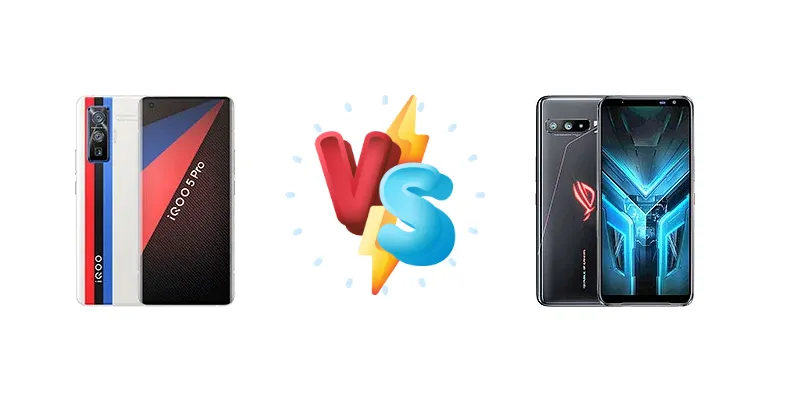
|
🏆 Quick Verdict
For the average user prioritizing rapid charging and a balanced experience, the iQOO 5 Pro emerges as the winner. Its 120W charging is a game-changer, replenishing the battery in just 15 minutes. However, dedicated gamers who value sustained performance and a feature-rich gaming ecosystem will find the ROG Phone 3 more compelling.
| PHONES | ||
|---|---|---|
| Phone Names | vivo iQOO 5 Pro 5G | Asus ROG Phone 3 |
| Network | ||
|---|---|---|
| 2G bands | GSM 850 / 900 / 1800 / 1900 | GSM 850 / 900 / 1800 / 1900 |
| 3G bands | HSDPA 850 / 900 / 1700(AWS) / 1900 / 2100 | HSDPA 800 / 850 / 900 / 1700(AWS) / 1800 / 1900 / 2100 - A version |
| 4G bands | 1, 2, 3, 4, 5, 7, 8, 12, 17, 18, 19, 20, 25, 26, 28, 34, 38, 39, 40, 41 | 1, 2, 3, 4, 5, 7, 8, 12, 13, 17, 18, 19, 20, 25, 26, 28, 29, 30, 32, 34, 38, 39, 40, 41, 42, 48, 66, 71 - A version |
| 5G bands | 1, 3, 28, 38, 41, 77, 78, 79 SA/NSA | 1, 2, 3, 5, 28, 41, 66, 71, 77, 78, 79 SA/NSA - A version |
| Speed | HSPA, LTE, 5G | HSPA 42.2/5.76 Mbps, LTE (6CA) Cat20 2000/150 Mbps, 5G 4.4 Gbps DL |
| Technology | GSM / CDMA / HSPA / LTE / 5G | GSM / CDMA / HSPA / LTE / 5G |
| CDMA 800 & TD-SCDMA | - | |
| Launch | ||
|---|---|---|
| Announced | 2020, August 17. Released 2020, August 24 | 2020, July 22. Released 2020, July 23 |
| Status | Discontinued | Discontinued |
| Body | ||
|---|---|---|
| Build | - | Glass front (Gorilla Glass 6), glass back (Gorilla Glass 3), aluminum frame |
| Dimensions | 159.6 x 73.3 x 8.9 mm (6.28 x 2.89 x 0.35 in) | 171 x 78 x 9.9 mm (6.73 x 3.07 x 0.39 in) |
| SIM | Nano-SIM + Nano-SIM | Nano-SIM + Nano-SIM |
| Weight | 198 g (6.98 oz) | 240 g (8.47 oz) |
| Display | ||
|---|---|---|
| Protection | - | Corning Gorilla Glass 6 |
| Resolution | 1080 x 2376 pixels (~398 ppi density) | 1080 x 2340 pixels, 19.5:9 ratio (~391 ppi density) |
| Size | 6.56 inches, 104.6 cm2 (~89.4% screen-to-body ratio) | 6.59 inches, 106.6 cm2 (~79.9% screen-to-body ratio) |
| Type | AMOLED, 120Hz, HDR10+ | AMOLED, 1B colors, 144Hz, HDR10+, 650 nits (typ) |
| Platform | ||
|---|---|---|
| CPU | Octa-core (1x2.84 GHz Cortex-A77 & 3x2.42 GHz Cortex-A77 & 4x1.80 GHz Cortex-A55) | Octa-core (1x3.10 GHz Cortex-A77 & 3x2.42 GHz Cortex-A77 & 4x1.80 GHz Cortex-A55) |
| Chipset | Qualcomm SM8250 Snapdragon 865 5G (7 nm+) | Qualcomm SM8250 Snapdragon 865 5G+ (7 nm+) |
| GPU | Adreno 650 | Adreno 650 |
| OS | Android 10, IQOO UI 1.5 | Android 10, upgradable to Android 12, ROG UI |
| Memory | ||
|---|---|---|
| Card slot | No | No |
| Internal | 256GB 8GB RAM, 256GB 12GB RAM | 128GB 8GB RAM, 128GB 12GB RAM, 256GB 12GB RAM, 512GB 12GB RAM, 512GB 16GB RAM |
| UFS 3.1 | - | |
| Main Camera | ||
|---|---|---|
| Features | Dual-LED flash, HDR, panorama | LED flash, HDR, panorama |
| Triple | 50 MP, f/1.9, (wide), 1/1.31", 1.2µm, dual pixel PDAF, OIS 8 MP, f/3.4, 135mm (periscope telephoto), 1/4.0", PDAF, OIS, 5x optical zoom 13 MP, f/2.2, 120˚, 16mm (ultrawide), 1/4.0", 1.12µm | 64 MP, f/1.8, 26mm (wide), 1/1.73", 0.8µm, PDAF 13 MP, f/2.4, 11mm, 125˚ (ultrawide) 5 MP (macro) |
| Video | 8K, 4K@30fps, 1080p@30fps, gyro-EIS | 8K@30fps, 4K@30/60/120fps, 1080p@30/60/240fps, 720p@480fps; gyro-EIS |
| Selfie camera | ||
|---|---|---|
| Features | Panorama | Panorama, HDR |
| Single | 16 MP, f/2.5, (wide) | 24 MP, f/2.0, 27mm (wide), 0.9µm |
| Video | 1080p@30fps | 1080p@30fps |
| Sound | ||
|---|---|---|
| 3.5mm jack | No | No |
| 35mm jack | No | No |
| Loudspeaker | Yes | Yes, with DTS:X stereo speakers (2 dedicated amplifiers) |
| 32-bit/192kHz audio | - | |
| Comms | ||
|---|---|---|
| Bluetooth | 5.1, A2DP, LE, aptX HD | 5.1, A2DP, LE, aptX HD, aptX Adaptive |
| NFC | Yes | Yes |
| Positioning | GPS (L1+L5), GLONASS, BDS, GALILEO | GPS (L1+L5), GLONASS, BDS, GALILEO, QZSS |
| Radio | No | No |
| USB | USB Type-C, OTG | USB Type-C 3.1 (side), USB Type-C 2.0 (bottom), OTG, accessory connector |
| WLAN | Wi-Fi 802.11 a/b/g/n/ac/6, dual-band, Wi-Fi Direct | Wi-Fi 802.11 a/b/g/n/ac/6, dual-band, Wi-Fi Direct |
| Features | ||
|---|---|---|
| Sensors | Fingerprint (under display, optical), accelerometer, gyro, proximity, compass | Fingerprint (under display, optical), accelerometer, gyro, proximity, compass |
| Battery | ||
|---|---|---|
| Charging | 120W wired, 50% in 5 min, 100% in 15 min Reverse wired | 30W wired, PD3.0, QC4 10W reverse wired |
| Type | 4000 mAh | Li-Po 6000 mAh |
| Misc | ||
|---|---|---|
| Colors | White, Black | Black Glare |
| Models | v2025a | ASUS_I003D, ZS661KS, I003DD, I003D |
| Price | About 610 EUR | About 650 EUR |
| SAR | - | 0.74 W/kg (head) 1.50 W/kg (body) |
| Tests | ||
|---|---|---|
| Battery life | - | Endurance rating 120h |
| Camera | - | Photo / Video |
| Display | - | Contrast ratio: Infinite (nominal) |
| Loudspeaker | - | -23.1 LUFS (Very good) |
| Performance | - | AnTuTu: 621932 (v8) GeekBench: 13306 (v4.4), 3386 (v5.1) GFXBench: 48fps (ES 3.1 onscreen) |
vivo iQOO 5 Pro 5G
- Unrivaled 120W fast charging
- Sleek and modern design
- Competitive performance with Snapdragon 865
- Limited camera details
- Potentially less sustained performance than ROG Phone 3
Asus ROG Phone 3
- Slightly faster CPU performance (Snapdragon 865+)
- Gaming-focused features and ecosystem
- Good display brightness and contrast
- Significantly slower 30W charging
- Larger and heavier form factor
Display Comparison
Both phones utilize the Qualcomm Snapdragon 865 5G platform, but differ in display characteristics. The ROG Phone 3 boasts a measured peak brightness of 719 nits, providing good visibility outdoors. While the iQOO 5 Pro’s display specs aren’t provided, it’s reasonable to expect similar or slightly lower peak brightness given the focus on other areas. The ROG Phone 3’s infinite contrast ratio (nominal) suggests a true OLED panel, delivering deep blacks. The iQOO 5 Pro’s panel type is unknown, but its overall experience is likely optimized for color accuracy and responsiveness.
Camera Comparison
Both devices offer photo and video capabilities, but detailed camera specifications are limited. Without sensor size or aperture information, a direct comparison is difficult. The ROG Phone 3’s camera system is likely geared towards general-purpose photography, while the iQOO 5 Pro may prioritize image processing for social media sharing. The absence of detailed camera specs suggests neither phone is a primary focus for photography enthusiasts.
Performance
The Asus ROG Phone 3 edges out the iQOO 5 Pro in raw CPU performance thanks to the Snapdragon 865 5G+ chipset clocked at 3.10 GHz versus the iQOO 5 Pro’s 2.84 GHz Snapdragon 865. This difference, while not massive, will be noticeable in CPU-intensive tasks and sustained gaming loads. Both phones share the same CPU core configuration (1x Cortex-A77 at higher clock, 3x Cortex-A77, 4x Cortex-A55), but the ROG Phone 3’s higher clock speed provides a slight advantage. Both utilize LPDDR5 RAM, ensuring fast memory access, but the specific RAM speed isn’t specified. The ROG Phone 3’s larger chassis likely allows for a more sophisticated cooling system, potentially mitigating thermal throttling during extended gaming sessions.
Battery Life
Both the iQOO 5 Pro and ROG Phone 3 achieve an endurance rating of 120 hours, indicating comparable battery life under similar usage conditions. However, the iQOO 5 Pro’s 120W wired charging is a monumental advantage, achieving 50% charge in just 5 minutes and a full charge in 15 minutes. The ROG Phone 3’s 30W charging, while supporting PD3.0 and QC4, is significantly slower. The iQOO 5 Pro also offers reverse wired charging, a feature present on the ROG Phone 3 but at a lower 10W output. This charging speed disparity makes the iQOO 5 Pro ideal for users who frequently need to top up their battery quickly.
Buying Guide
Buy the vivo iQOO 5 Pro 5G if you need the absolute fastest charging speeds available, a sleek design, and a phone that excels in everyday tasks alongside gaming. Buy the Asus ROG Phone 3 if you prefer a dedicated gaming phone with a focus on long-term performance, a larger display, and a robust suite of gaming accessories and software features.