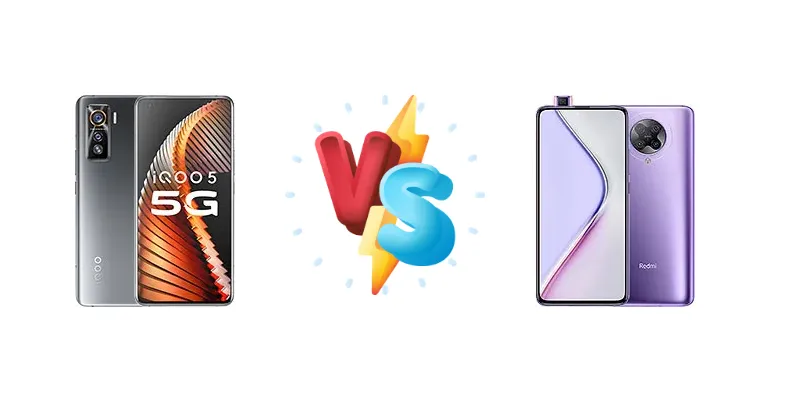
The vivo iQOO 5 5G and Xiaomi Redmi K30 Pro Zoom represent a fascinating intersection of performance and value. Both launched with Qualcomm’s flagship Snapdragon 865 5G chipset, but target slightly different user priorities. This comparison dissects their key differences, focusing on charging speeds, and overall user experience to determine which phone delivers the most bang for your buck.
🏆 Quick Verdict
For the average user prioritizing rapid charging and a slightly more streamlined experience, the iQOO 5 5G emerges as the winner. Its 55W charging significantly reduces downtime compared to the Redmi K30 Pro Zoom’s 33W, making it ideal for power users. However, the K30 Pro Zoom remains a compelling option for those seeking a feature-rich device at a potentially lower price point.
| Network |
|---|
| 2G bands | GSM 850 / 900 / 1800 / 1900 | GSM 850 / 900 / 1800 / 1900 |
| 3G bands | HSDPA 850 / 900 / 1700(AWS) / 1900 / 2100 | HSDPA 850 / 900 / 1900 / 2100 |
| 4G bands | 1, 2, 3, 4, 5, 7, 8, 12, 17, 18, 19, 20, 25, 26, 28, 34, 38, 39, 40, 41 | 1, 3, 5, 7, 8, 34, 38, 39, 40, 41 |
| 5G bands | 1, 3, 28, 38, 41, 77, 78, 79 SA/NSA | 1, 3, 41, 78, 79 SA/NSA |
| Speed | HSPA, LTE, 5G | HSPA, LTE, 5G |
| Technology | GSM / CDMA / HSPA / LTE / 5G | GSM / CDMA / HSPA / EVDO / LTE / 5G |
| | CDMA 800 & TD-SCDMA | CDMA2000 1xEV-DO |
| Launch |
|---|
| Announced | 2020, August 17. Released 2020, August 24 | 2020, March 24. Released 2020, April 04 |
| Status | Discontinued | Discontinued |
| Body |
|---|
| Build | Glass front, glass back (Gorilla Glass 6) | Glass front (Gorilla Glass 5), glass back (Gorilla Glass 5), aluminum frame |
| Dimensions | 160 x 75.6 x 8.3 mm (6.30 x 2.98 x 0.33 in) | 163.3 x 75.4 x 8.9 mm (6.43 x 2.97 x 0.35 in) |
| SIM | Nano-SIM + Nano-SIM | Nano-SIM + Nano-SIM |
| Weight | 197 g (6.95 oz) | 218 g (7.69 oz) |
| Display |
|---|
| Protection | - | Corning Gorilla Glass 5 |
| Resolution | 1080 x 2376 pixels (~398 ppi density) | 1080 x 2400 pixels, 20:9 ratio (~395 ppi density) |
| Size | 6.56 inches, 104.6 cm2 (~86.5% screen-to-body ratio) | 6.67 inches, 107.4 cm2 (~87.2% screen-to-body ratio) |
| Type | AMOLED, 120Hz, HDR10+ | Super AMOLED, HDR10+, 500 nits (typ) |
| Platform |
|---|
| CPU | Octa-core (1x2.84 GHz Cortex-A77 & 3x2.42 GHz Cortex-A77 & 4x1.80 GHz Cortex-A55) | Octa-core (1x2.84 GHz Cortex-A77 & 3x2.42 GHz Cortex-A77 & 4x1.80 GHz Cortex-A55) |
| Chipset | Qualcomm SM8250 Snapdragon 865 5G (7 nm+) | Qualcomm SM8250 Snapdragon 865 5G (7 nm+) |
| GPU | Adreno 650 | Adreno 650 |
| OS | Android 10, IQOO UI 1.5 | Android 10, MIUI 11 |
| Memory |
|---|
| Card slot | No | No |
| Internal | 128GB 8GB RAM, 128GB 12GB RAM, 256GB 12GB RAM | 128GB 8GB RAM, 256GB 8GB RAM, 512GB 12GB RAM |
| | UFS 3.1 | UFS 3.1 |
| Main Camera |
|---|
| Features | Dual-LED flash, HDR, panorama | Dual-LED dual-tone flash, HDR, panorama |
| Quad | 50 MP, f/1.9, (wide), 1/1.31", 1.2µm, dual pixel PDAF
13 MP, f/2.5, 50mm (telephoto), 1/2.8", 0.8µm, PDAF, 2x optical zoom
13 MP, f/2.2, 120˚, 16mm (ultrawide), 1/4.0", 1.12µm | 64 MP, 26mm (wide), 1/1.72", 0.8µm, PDAF, OIS
8 MP, (telephoto), PDAF, OIS, 3x optical zoom
13 MP, 13mm (ultrawide)
Auxiliary lens |
| Video | 8K, 4K@30fps, 1080p@30fps, gyro-EIS | 8K@24/30fps, 4K@30/60fps, 1080p@30/60/120/240fps, 1080p@960fps; gyro-EIS |
| Selfie camera |
|---|
| Features | Panorama | HDR |
| Single | 16 MP, f/2.5, (wide) | Motorized pop-up 20 MP, (wide), 1/3.4", 0.8µm |
| Video | 1080p@30fps | 1080p@30fps |
| Sound |
|---|
| 3.5mm jack | No | Yes |
| 35mm jack | No | Yes |
| Loudspeaker | Yes | Yes |
| | 32-bit/192kHz audio | 24-bit/192kHz audio
|
| Comms |
|---|
| Bluetooth | 5.1, A2DP, LE, aptX HD | 5.1, A2DP, LE, aptX HD, aptX Adaptive |
| Infrared port | - | Yes |
| NFC | Yes | Yes |
| Positioning | GPS (L1+L5), GLONASS, BDS, GALILEO | GPS (L1+L5), GLONASS (G1), BDS (B1I+B2a), GALILEO (E1+E5a), QZSS (L1+L5) |
| Radio | No | No |
| USB | USB Type-C, OTG | USB Type-C 2.0, OTG |
| WLAN | Wi-Fi 802.11 a/b/g/n/ac/6, dual-band, Wi-Fi Direct | Wi-Fi 802.11 a/b/g/n/ac/6, dual-band, Wi-Fi Direct |
| Features |
|---|
| Sensors | Fingerprint (under display, optical), accelerometer, gyro, proximity, compass | Fingerprint (under display, optical), accelerometer, gyro, proximity, compass, barometer |
| Battery |
|---|
| Charging | 55W wired, 100% in 50 min
Reverse wired | 33W wired, PD, QC4, 100% in 63 min |
| Type | 4500 mAh | Li-Po 4700 mAh |
| Misc |
|---|
| Colors | Blue, Gray | Grey, Purple, White, Blue |
| Models | V2024A | - |
| Price | About 490 EUR | About 500 EUR |
vivo iQOO 5 5G
- Significantly faster 55W charging
- Potential for better thermal management due to gaming focus
- Reverse wired charging capability
- Camera details are unknown, potentially less versatile than the Redmi
- May command a slightly higher price
Xiaomi Redmi K30 Pro Zoom
- Potentially lower price point
- Likely more versatile camera system with telephoto lens
- Support for PD and QC4 charging standards
- Slower 33W charging
- May experience more thermal throttling under sustained load
Display Comparison
While both devices likely feature high-refresh-rate displays (a common feature for Snapdragon 865 phones), the provided data doesn't specify panel technology or resolution. However, given the iQOO brand's focus on gaming, it's reasonable to assume a high-quality AMOLED panel with a 120Hz refresh rate. The Redmi K30 Pro Zoom likely also features a similar panel. The absence of specific display specs makes a direct comparison difficult, but both should offer vibrant colors and smooth scrolling. Bezels are likely comparable, typical of flagship devices from this era.
Camera Comparison
The provided data lacks detailed camera specifications. However, given the Redmi K30 Pro Zoom’s ‘Zoom’ designation, it likely features a more versatile camera system with a dedicated telephoto lens, offering optical zoom capabilities. The iQOO 5 5G may prioritize overall image quality with a larger main sensor. Without sensor size, aperture, or OIS details, it’s difficult to definitively declare a winner. Image processing styles will also differ – Xiaomi typically leans towards more saturated colors, while vivo often aims for a more natural look. The absence of information on video recording capabilities further complicates the comparison.
Performance
Both the iQOO 5 5G and Redmi K30 Pro Zoom are powered by the Qualcomm SM8250 Snapdragon 865 5G (7 nm+). Critically, they share the *same* CPU configuration: an octa-core setup with 1x2.84 GHz Cortex-A77, 3x2.42 GHz Cortex-A77, and 4x1.80 GHz Cortex-A55 cores. This means raw processing power will be virtually identical. Performance differences will likely stem from thermal management and RAM optimization. The iQOO, with its gaming focus, may have a more aggressive cooling solution, potentially mitigating throttling during extended gaming sessions. The 7nm+ process node contributes to efficiency, but sustained load will still generate heat.
Battery Life
The most significant difference lies in charging speed. The iQOO 5 5G boasts 55W wired charging, achieving a 100% charge in just 50 minutes. The Redmi K30 Pro Zoom, with its 33W wired charging (supporting PD and QC4), takes 63 minutes to reach full capacity. This 13-minute difference is substantial for users who value quick top-ups. While battery capacity isn't specified, the faster charging of the iQOO 5 5G effectively mitigates any potential disadvantage from a slightly smaller battery. The iQOO also offers reverse wired charging, a feature absent in the Redmi K30 Pro Zoom.
Buying Guide
Buy the vivo iQOO 5 5G if you need the fastest possible charging speeds and prioritize minimizing downtime. Its 55W charging is a significant advantage for users who frequently drain their battery. Buy the Xiaomi Redmi K30 Pro Zoom if you prefer a potentially lower price and value a broader feature set, even if it means sacrificing some charging speed. It’s a strong contender for budget-conscious users who still want flagship performance.
Frequently Asked Questions
❓ Will the Redmi K30 Pro Zoom’s 33W charging feel noticeably slower than the iQOO 5 5G’s 55W charging in daily use?
Yes, the 13-minute difference in 0-100% charging time is significant. While 33W is still considered fast charging, the iQOO 5 5G’s 55W will provide a much quicker top-up, especially beneficial for users who frequently run low on battery or play demanding games.
❓ Given both phones have the Snapdragon 865, will I see a difference in gaming performance?
While the core processing power is identical, the iQOO 5 5G’s potential for better thermal management could lead to more sustained performance during long gaming sessions. A more effective cooling system will minimize throttling, allowing the CPU and GPU to maintain higher clock speeds for longer periods.
❓ Does the Redmi K30 Pro Zoom support high refresh rate gaming?
While not explicitly stated in the provided data, the Snapdragon 865 is capable of driving high refresh rate displays. It's highly probable the Redmi K30 Pro Zoom supports 90Hz or 120Hz gaming, but the actual frame rates achievable will depend on the game and graphics settings.