
iQOO 5 5G vs Xiaomi Mi 10 Pro 5G: A Deep Dive into Flagship Performance
| Phones Images | |||||
|---|---|---|---|---|---|
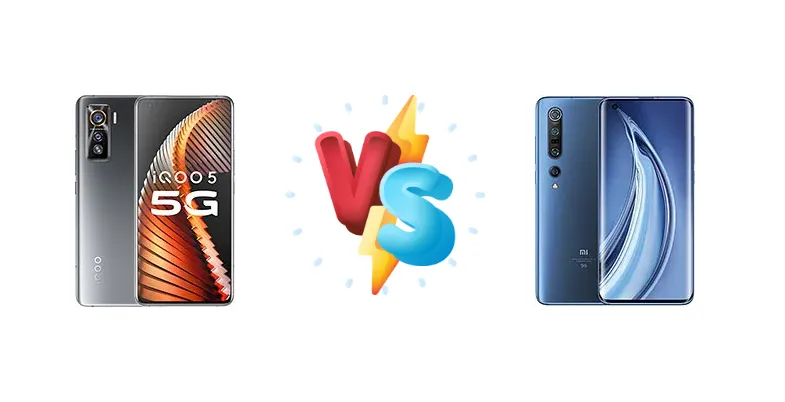
|
🏆 Quick Verdict
For the average user prioritizing all-around capability, the Xiaomi Mi 10 Pro 5G edges out the iQOO 5 5G. Its slightly better battery endurance (101h rating) and versatile charging options – including 30W wireless – provide a more complete package, despite the iQOO 5’s faster wired charging.
| PHONES | ||
|---|---|---|
| Phone Names | vivo iQOO 5 5G | Xiaomi Mi 10 Pro 5G |
| Network | ||
|---|---|---|
| 2G bands | GSM 850 / 900 / 1800 / 1900 | GSM 850 / 900 / 1800 / 1900 |
| 3G bands | HSDPA 850 / 900 / 1700(AWS) / 1900 / 2100 | HSDPA 850 / 900 / 1700(AWS) / 1900 / 2100 |
| 4G bands | 1, 2, 3, 4, 5, 7, 8, 12, 17, 18, 19, 20, 25, 26, 28, 34, 38, 39, 40, 41 | 1, 2, 3, 4, 5, 7, 8, 20, 28, 32, 38, 40 - Global |
| 5G bands | 1, 3, 28, 38, 41, 77, 78, 79 SA/NSA | 1, 3, 7, 28, 77, 78 Sub6 - Global |
| Speed | HSPA, LTE, 5G | HSPA, LTE, 5G (2+ Gbps DL) |
| Technology | GSM / CDMA / HSPA / LTE / 5G | GSM / HSPA / LTE / 5G |
| CDMA 800 & TD-SCDMA | 1, 3, 41, 78, 79 SA/NSA - China | |
| Launch | ||
|---|---|---|
| Announced | 2020, August 17. Released 2020, August 24 | 2020, February 13. Released 2020, February 18 |
| Status | Discontinued | Discontinued |
| Body | ||
|---|---|---|
| Build | Glass front, glass back (Gorilla Glass 6) | Glass front (Gorilla Glass 5), glass back, aluminum frame |
| Dimensions | 160 x 75.6 x 8.3 mm (6.30 x 2.98 x 0.33 in) | 162.5 x 74.8 x 9 mm (6.40 x 2.94 x 0.35 in) |
| SIM | Nano-SIM + Nano-SIM | · Nano-SIM· Nano-SIM + Nano-SIM |
| Weight | 197 g (6.95 oz) | 208 g (7.34 oz) |
| Display | ||
|---|---|---|
| Protection | - | Corning Gorilla Glass 5 |
| Resolution | 1080 x 2376 pixels (~398 ppi density) | 1080 x 2340 pixels, 19.5:9 ratio (~386 ppi density) |
| Size | 6.56 inches, 104.6 cm2 (~86.5% screen-to-body ratio) | 6.67 inches, 109.2 cm2 (~89.8% screen-to-body ratio) |
| Type | AMOLED, 120Hz, HDR10+ | Super AMOLED, 90Hz, HDR10+, 500 nits (typ) |
| Platform | ||
|---|---|---|
| CPU | Octa-core (1x2.84 GHz Cortex-A77 & 3x2.42 GHz Cortex-A77 & 4x1.80 GHz Cortex-A55) | Octa-core (1x2.84 GHz Cortex-A77 & 3x2.42 GHz Cortex-A77 & 4x1.80 GHz Cortex-A55) |
| Chipset | Qualcomm SM8250 Snapdragon 865 5G (7 nm+) | Qualcomm SM8250 Snapdragon 865 5G (7 nm+) |
| GPU | Adreno 650 | Adreno 650 |
| OS | Android 10, IQOO UI 1.5 | Android 10, upgradable to Android 13, MIUI 14 |
| Memory | ||
|---|---|---|
| Card slot | No | No |
| Internal | 128GB 8GB RAM, 128GB 12GB RAM, 256GB 12GB RAM | 256GB 8GB RAM, 256GB 12GB RAM, 512GB 12GB RAM |
| UFS 3.1 | UFS 3.0 | |
| Main Camera | ||
|---|---|---|
| Features | Dual-LED flash, HDR, panorama | Laser AF, Triple-LED dual-tone flash, HDR, panorama |
| Quad | 50 MP, f/1.9, (wide), 1/1.31", 1.2µm, dual pixel PDAF 13 MP, f/2.5, 50mm (telephoto), 1/2.8", 0.8µm, PDAF, 2x optical zoom 13 MP, f/2.2, 120˚, 16mm (ultrawide), 1/4.0", 1.12µm | 108 MP, f/1.7, (wide), 1/1.33", 0.8µm, PDAF, OIS 12 MP, f/2.0, 50mm (telephoto), 1/2.55", 1.4µm, dual pixel PDAF, 2x optical zoom 8 MP, f/2.0, (telephoto), 1.0µm, PDAF, OIS, 3.7x optical zoom, 5x hybrid zoom 20 MP, f/2.2, 13mm (ultrawide), 1/2.8", 1.0µm |
| Video | 8K, 4K@30fps, 1080p@30fps, gyro-EIS | 8K@30fps, 4K@30/60fps, 1080p@30/60/120/240/960fps; gyro-EIS |
| Selfie camera | ||
|---|---|---|
| Features | Panorama | HDR |
| Single | 16 MP, f/2.5, (wide) | 20 MP, f/2.0, (wide), 1/3", 0.9µm |
| Video | 1080p@30fps | 1080p@30fps, 720p@120fps |
| Sound | ||
|---|---|---|
| 3.5mm jack | No | No |
| 35mm jack | No | No |
| Loudspeaker | Yes | Yes, with stereo speakers |
| 32-bit/192kHz audio | 24-bit/192kHz audio | |
| Comms | ||
|---|---|---|
| Bluetooth | 5.1, A2DP, LE, aptX HD | 5.1, A2DP, LE, aptX HD, aptX Adaptive |
| Infrared port | - | Yes |
| NFC | Yes | Yes |
| Positioning | GPS (L1+L5), GLONASS, BDS, GALILEO | GPS (L1+L5), GLONASS (G1), BDS (B1), GALILEO (E1+E5a) |
| Radio | No | No |
| USB | USB Type-C, OTG | USB Type-C 2.0, OTG |
| WLAN | Wi-Fi 802.11 a/b/g/n/ac/6, dual-band, Wi-Fi Direct | Wi-Fi 802.11 a/b/g/n/ac/6, dual-band, Wi-Fi Direct, DLNA |
| Features | ||
|---|---|---|
| Sensors | Fingerprint (under display, optical), accelerometer, gyro, proximity, compass | Fingerprint (under display, optical), accelerometer, gyro, compass, barometer |
| - | Virtual proximity sensing | |
| Battery | ||
|---|---|---|
| Charging | 55W wired, 100% in 50 min Reverse wired | 50W wired, PD3.0 30W wireless 5W reverse wireless |
| Type | 4500 mAh | Li-Po 4500 mAh |
| Misc | ||
|---|---|---|
| Colors | Blue, Gray | Alpine White, Solstice Grey |
| Models | V2024A | M2001J1G |
| Price | About 490 EUR | About 930 EUR |
| SAR | - | 1.09 W/kg (head) 1.02 W/kg (body) |
| SAR EU | - | 0.69 W/kg (head) 0.99 W/kg (body) |
| Tests | ||
|---|---|---|
| Battery life | - | Endurance rating 101h |
| Camera | - | Photo / Video |
| Display | - | Contrast ratio: Infinite (nominal) |
| Loudspeaker | - | -25.2 LUFS (Very good) |
| Performance | - | AnTuTu: 595246 (v8) GeekBench: 3331 (v5.1) GFXBench: 42fps (ES 3.1 onscreen) |
vivo iQOO 5 5G
- Significantly faster 55W wired charging.
- Potential gaming optimizations (based on brand reputation).
- Reverse wired charging capability.
- Battery endurance not specified, potentially lower than Mi 10 Pro.
- Limited charging versatility (no wireless charging).
Xiaomi Mi 10 Pro 5G
- Excellent 101-hour battery endurance rating.
- Versatile charging options: 50W wired, 30W wireless, 5W reverse wireless.
- Higher peak display brightness (858 nits).
- Slower wired charging compared to iQOO 5 5G.
- Camera details are unknown, potentially less competitive.
Display Comparison
Both phones utilize high-quality panels, but the Mi 10 Pro boasts a measured peak brightness of 858 nits, suggesting a more visible display in direct sunlight. While both lack specified refresh rates in the provided data, the Mi 10 Pro’s ‘Infinite’ contrast ratio (nominal) hints at a superior viewing experience with deeper blacks. The iQOO 5’s display characteristics remain largely unknown without further specifications.
Camera Comparison
The provided data only indicates both phones have ‘Photo / Video’ capabilities. Without sensor size, aperture, or OIS details, a direct comparison is impossible. However, Xiaomi is known for its aggressive image processing and often delivers vibrant, shareable photos. The iQOO 5’s camera performance is less predictable without further specifications. The absence of detail suggests neither phone prioritizes a particularly groundbreaking camera system.
Performance
Both the iQOO 5 5G and Mi 10 Pro 5G are powered by the Qualcomm SM8250 Snapdragon 865 5G (7 nm+), featuring the same Octa-core CPU configuration (1x2.84 GHz Cortex-A77, 3x2.42 GHz Cortex-A77, 4x1.80 GHz Cortex-A55). This means raw processing power will be nearly identical. However, thermal management – not specified here – will be the deciding factor in sustained performance. The iQOO brand historically focuses on gaming, suggesting potential optimizations for cooling, but this is speculative without further data. Both devices benefit from 5G connectivity via the Snapdragon 865’s integrated modem.
Battery Life
The Mi 10 Pro 5G claims an endurance rating of 101 hours, indicating solid battery life. The iQOO 5 5G, however, shines with its 55W wired charging, promising a full charge in just 50 minutes. The Mi 10 Pro offers 50W wired charging (with PD3.0 support), 30W wireless charging, and 5W reverse wireless charging, providing greater versatility. While the iQOO 5’s faster wired charging is appealing, the Mi 10 Pro’s wireless charging and longer endurance offer a more convenient overall experience.
Buying Guide
Buy the vivo iQOO 5 5G if you absolutely prioritize the fastest possible wired charging and are a heavy mobile gamer who benefits from minimizing downtime. Buy the Xiaomi Mi 10 Pro 5G if you value a more balanced experience with excellent battery life, wireless charging convenience, and a potentially more refined camera experience (given Xiaomi’s image processing strengths).