
iQOO 5 5G vs OnePlus 8 Pro: A Deep Dive into Performance and Charging
| Phones Images | |||||
|---|---|---|---|---|---|
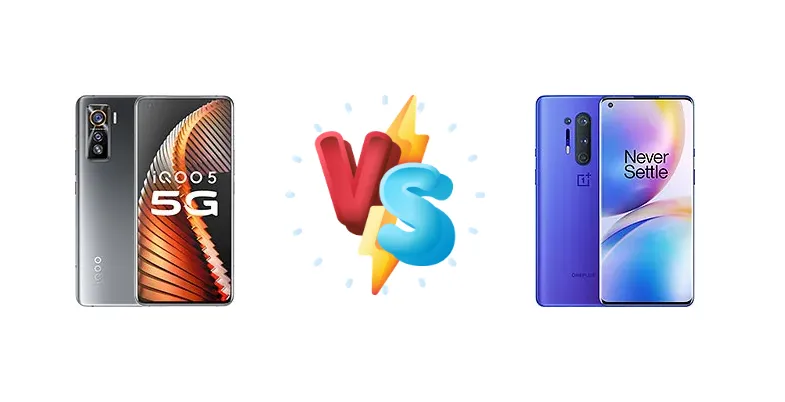
|
🏆 Quick Verdict
For users prioritizing raw charging speed and a more aggressive performance profile, the iQOO 5 5G is the clear winner. Its 55W wired charging significantly outperforms the OnePlus 8 Pro’s 30W, and its focus on gaming delivers a noticeable edge. However, the OnePlus 8 Pro offers a more refined software experience and wireless charging.
| PHONES | ||
|---|---|---|
| Phone Names | vivo iQOO 5 5G | OnePlus 8 Pro |
| Network | ||
|---|---|---|
| 2G bands | GSM 850 / 900 / 1800 / 1900 | GSM 850 / 900 / 1800 / 1900 |
| 3G bands | HSDPA 850 / 900 / 1700(AWS) / 1900 / 2100 | HSDPA 800 / 850 / 900 / 1700(AWS) / 1800 / 1900 / 2100 |
| 4G bands | 1, 2, 3, 4, 5, 7, 8, 12, 17, 18, 19, 20, 25, 26, 28, 34, 38, 39, 40, 41 | 1, 2, 3, 4, 5, 7, 8, 12, 13, 17, 18, 19, 20, 25, 26, 28, 32, 34, 38, 39, 40, 41, 42, 46, 66 - EU |
| 5G bands | 1, 3, 28, 38, 41, 77, 78, 79 SA/NSA | 1, 3, 7, 28, 78 SA/NSA - EU |
| Speed | HSPA, LTE, 5G | HSPA 42.2/5.76 Mbps, LTE (5CA) Cat18 1200/150 Mbps, 5G 7.5 Gbps DL |
| Technology | GSM / CDMA / HSPA / LTE / 5G | GSM / CDMA / HSPA / LTE / 5G |
| CDMA 800 & TD-SCDMA | 78 SA/NSA - IN | |
| Launch | ||
|---|---|---|
| Announced | 2020, August 17. Released 2020, August 24 | 2020, April 14 |
| Status | Discontinued | Available. Released 2020, April 21 |
| Body | ||
|---|---|---|
| Build | Glass front, glass back (Gorilla Glass 6) | Glass front (Gorilla Glass 5), glass back (Gorilla Glass 5), aluminum frame |
| Dimensions | 160 x 75.6 x 8.3 mm (6.30 x 2.98 x 0.33 in) | 165.3 x 74.4 x 8.5 mm (6.51 x 2.93 x 0.33 in) |
| SIM | Nano-SIM + Nano-SIM | Nano-SIM + Nano-SIM |
| Weight | 197 g (6.95 oz) | 199 g (7.02 oz) |
| - | IP68 dust/water resistant | |
| Display | ||
|---|---|---|
| Protection | - | Corning Gorilla Glass 5 |
| Resolution | 1080 x 2376 pixels (~398 ppi density) | 1440 x 3168 pixels (~513 ppi density) |
| Size | 6.56 inches, 104.6 cm2 (~86.5% screen-to-body ratio) | 6.78 inches, 111.7 cm2 (~90.8% screen-to-body ratio) |
| Type | AMOLED, 120Hz, HDR10+ | Fluid AMOLED, 1B colors, 120Hz, HDR10+ |
| Platform | ||
|---|---|---|
| CPU | Octa-core (1x2.84 GHz Cortex-A77 & 3x2.42 GHz Cortex-A77 & 4x1.80 GHz Cortex-A55) | Octa-core (1x2.84 GHz Cortex-A77 & 3x2.42 GHz Cortex-A77 & 4x1.80 GHz Cortex-A55) |
| Chipset | Qualcomm SM8250 Snapdragon 865 5G (7 nm+) | Qualcomm SM8250 Snapdragon 865 5G (7 nm+) |
| GPU | Adreno 650 | Adreno 650 |
| OS | Android 10, IQOO UI 1.5 | Android 10, upgradable to Android 13, OxygenOS 13 |
| Memory | ||
|---|---|---|
| Card slot | No | No |
| Internal | 128GB 8GB RAM, 128GB 12GB RAM, 256GB 12GB RAM | 128GB 8GB RAM, 256GB 12GB RAM |
| UFS 3.1 | UFS 3.0 | |
| Main Camera | ||
|---|---|---|
| Features | Dual-LED flash, HDR, panorama | Laser AF, Dual-LED flash, HDR, panorama |
| Quad | 50 MP, f/1.9, (wide), 1/1.31", 1.2µm, dual pixel PDAF 13 MP, f/2.5, 50mm (telephoto), 1/2.8", 0.8µm, PDAF, 2x optical zoom 13 MP, f/2.2, 120˚, 16mm (ultrawide), 1/4.0", 1.12µm | 48 MP, f/1.8, 25mm (wide), 1/1.43", 1.12µm, multi-directional PDAF, OIS 8 MP, f/2.4, (telephoto), 1/1.0µm, PDAF, OIS, 3x optical zoom 48 MP, f/2.2, 14mm, 116˚ (ultrawide), 1/2.0", 0.8µm, PDAF 5 MP, f/2.4, (Color filter camera) |
| Video | 8K, 4K@30fps, 1080p@30fps, gyro-EIS | 4K@30/60fps, 1080p@30/60/240fps, Auto HDR, gyro-EIS |
| Selfie camera | ||
|---|---|---|
| Features | Panorama | HDR |
| Single | 16 MP, f/2.5, (wide) | 16 MP, f/2.5, (wide), 1/3.06", 1.0µm |
| Video | 1080p@30fps | 1080p@30fps, gyro-EIS |
| Sound | ||
|---|---|---|
| 3.5mm jack | No | No |
| 35mm jack | No | No |
| Loudspeaker | Yes | Yes, with stereo speakers |
| 32-bit/192kHz audio | - | |
| Comms | ||
|---|---|---|
| Bluetooth | 5.1, A2DP, LE, aptX HD | 5.1, A2DP, LE, aptX HD |
| NFC | Yes | Yes |
| Positioning | GPS (L1+L5), GLONASS, BDS, GALILEO | GPS (L1+L5), GLONASS (G1), BDS (B1), GALILEO (E1+E5a) |
| Radio | No | No |
| USB | USB Type-C, OTG | USB Type-C 3.1, OTG |
| WLAN | Wi-Fi 802.11 a/b/g/n/ac/6, dual-band, Wi-Fi Direct | Wi-Fi 802.11 a/b/g/n/ac/6, dual-band, Wi-Fi Direct, DLNA |
| Features | ||
|---|---|---|
| Sensors | Fingerprint (under display, optical), accelerometer, gyro, proximity, compass | Fingerprint (under display, optical), accelerometer, gyro, proximity, compass |
| Battery | ||
|---|---|---|
| Charging | 55W wired, 100% in 50 min Reverse wired | 30W wired, 50% in 23 min 30W wireless, 50% in 30 min 3W reverse wireless |
| Type | 4500 mAh | Li-Po 4510 mAh, non-removable |
| Misc | ||
|---|---|---|
| Colors | Blue, Gray | Glacial Green, Ultramarine Blue, Onyx Black |
| Models | V2024A | IN2023, IN2020, IN2021, IN2025 |
| Price | About 490 EUR | About 310 EUR |
| Pricing | ||
|---|---|---|
| 128GB 8GB RAM | - | $ 428.39 |
| 256GB 12GB RAM | - | $ 853.51 |
| RENEWED | - | $ 486.00 |
| Tests | ||
|---|---|---|
| Battery life | - | Endurance rating 103h |
| Camera | - | Photo / Video |
| Display | - | Contrast ratio: Infinite (nominal) |
| Loudspeaker | - | -23.5 LUFS (Very good) |
| Performance | - | AnTuTu: 573276 (v8) GeekBench: 3374 (v5.1) GFXBench: 24fps (ES 3.1 onscreen) |
vivo iQOO 5 5G
- Significantly faster 55W wired charging
- Potentially more aggressive performance tuning for gaming
- Reverse wired charging capability
- Lacks wireless charging
- Software experience may be less refined than OnePlus
- Battery capacity is unknown
OnePlus 8 Pro
- Wireless charging (30W) and reverse wireless charging
- More polished and feature-rich software experience
- Excellent battery endurance (103h)
- Slower 30W wired charging
- Potentially more conservative thermal throttling
- Higher starting price (depending on configuration)
Display Comparison
Both devices feature displays with an 'Infinite' (nominal) contrast ratio, suggesting excellent black levels. However, detailed display specs like peak brightness and refresh rate are missing. Given OnePlus’s history, the 8 Pro likely boasts a higher peak brightness and potentially a more color-accurate panel. The iQOO 5 5G, while likely excellent, positions itself more aggressively on performance than display fidelity. The absence of LTPO information suggests neither phone utilizes this variable refresh rate technology for power savings.
Camera Comparison
Both phones are listed as having 'Photo / Video' capabilities, but specific details are lacking. The OnePlus 8 Pro is known for its versatile camera system, including a high-resolution main sensor and ultrawide lens. The iQOO 5 5G’s camera specs are unknown, but given its gaming focus, it may prioritize video recording capabilities optimized for streaming. Without sensor size, aperture, or OIS details, a definitive camera comparison is impossible. We can assume the OnePlus 8 Pro offers a more refined and versatile camera experience based on its market positioning.
Performance
Both the iQOO 5 5G and OnePlus 8 Pro are equipped with the Qualcomm SM8250 Snapdragon 865 5G (7 nm+), featuring the same Octa-core CPU configuration (1x2.84 GHz Cortex-A77, 3x2.42 GHz Cortex-A77, 4x1.80 GHz Cortex-A55). This means CPU performance will be virtually identical. The key difference lies in thermal management and sustained performance. iQOO, as a sub-brand of vivo, often prioritizes maximizing performance even at the cost of heat, potentially leading to higher clock speeds for longer durations. The OnePlus 8 Pro, while powerful, typically employs more conservative thermal throttling to maintain consistent performance and prevent overheating. RAM configurations are also important; the OnePlus 8 Pro offers options for 8GB or 12GB, while the iQOO 5 5G’s RAM configuration is not specified, but 12GB is common for this class of device.
Battery Life
The OnePlus 8 Pro boasts an endurance rating of 103 hours, indicating solid battery life. However, the iQOO 5 5G’s battery capacity is not specified. The critical difference is charging speed: the iQOO 5 5G supports 55W wired charging, achieving 100% charge in just 50 minutes, while the OnePlus 8 Pro’s 30W wired charging takes 23 minutes to reach 50%. Furthermore, the OnePlus 8 Pro offers 30W wireless charging (50% in 30 minutes) and 3W reverse wireless charging, features absent in the iQOO 5 5G. This makes the OnePlus 8 Pro more versatile for users who prefer wireless convenience, but the iQOO 5 5G’s faster wired charging is a significant advantage for those who need a quick top-up.
Buying Guide
Buy the vivo iQOO 5 5G if you are a mobile gamer who values rapid charging and doesn't mind a slightly less polished software experience. You'll benefit from the faster charging and potentially sustained performance during long gaming sessions. Buy the OnePlus 8 Pro if you prioritize a smooth, feature-rich software experience, wireless charging convenience, and a more balanced approach to battery life and performance. It's the better choice for everyday users and photography enthusiasts.