
iQOO 5 5G vs. Asus ROG Phone 3: A Deep Dive for Mobile Gamers
| Phones Images | |||||
|---|---|---|---|---|---|
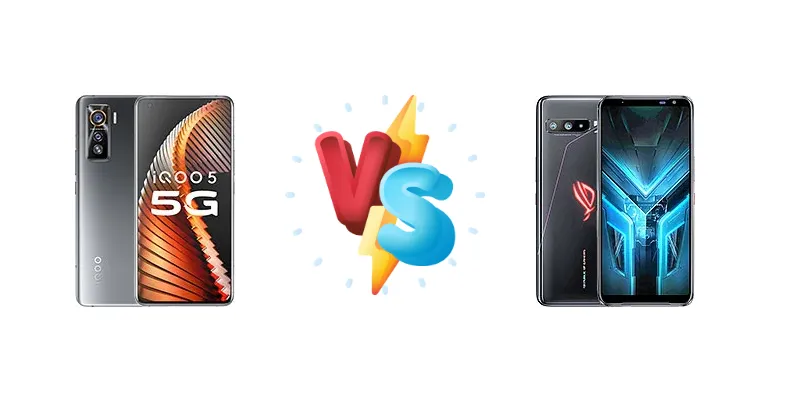
|
🏆 Quick Verdict
For the average user prioritizing a balance of performance and value, the iQOO 5 5G emerges as the winner. Its 55W charging significantly reduces downtime, and while the ROG Phone 3 boasts a slightly faster chipset, the real-world performance difference is minimal for most games.
| PHONES | ||
|---|---|---|
| Phone Names | vivo iQOO 5 5G | Asus ROG Phone 3 |
| Network | ||
|---|---|---|
| 2G bands | GSM 850 / 900 / 1800 / 1900 | GSM 850 / 900 / 1800 / 1900 |
| 3G bands | HSDPA 850 / 900 / 1700(AWS) / 1900 / 2100 | HSDPA 800 / 850 / 900 / 1700(AWS) / 1800 / 1900 / 2100 - A version |
| 4G bands | 1, 2, 3, 4, 5, 7, 8, 12, 17, 18, 19, 20, 25, 26, 28, 34, 38, 39, 40, 41 | 1, 2, 3, 4, 5, 7, 8, 12, 13, 17, 18, 19, 20, 25, 26, 28, 29, 30, 32, 34, 38, 39, 40, 41, 42, 48, 66, 71 - A version |
| 5G bands | 1, 3, 28, 38, 41, 77, 78, 79 SA/NSA | 1, 2, 3, 5, 28, 41, 66, 71, 77, 78, 79 SA/NSA - A version |
| Speed | HSPA, LTE, 5G | HSPA 42.2/5.76 Mbps, LTE (6CA) Cat20 2000/150 Mbps, 5G 4.4 Gbps DL |
| Technology | GSM / CDMA / HSPA / LTE / 5G | GSM / CDMA / HSPA / LTE / 5G |
| CDMA 800 & TD-SCDMA | - | |
| Launch | ||
|---|---|---|
| Announced | 2020, August 17. Released 2020, August 24 | 2020, July 22. Released 2020, July 23 |
| Status | Discontinued | Discontinued |
| Body | ||
|---|---|---|
| Build | Glass front, glass back (Gorilla Glass 6) | Glass front (Gorilla Glass 6), glass back (Gorilla Glass 3), aluminum frame |
| Dimensions | 160 x 75.6 x 8.3 mm (6.30 x 2.98 x 0.33 in) | 171 x 78 x 9.9 mm (6.73 x 3.07 x 0.39 in) |
| SIM | Nano-SIM + Nano-SIM | Nano-SIM + Nano-SIM |
| Weight | 197 g (6.95 oz) | 240 g (8.47 oz) |
| Display | ||
|---|---|---|
| Protection | - | Corning Gorilla Glass 6 |
| Resolution | 1080 x 2376 pixels (~398 ppi density) | 1080 x 2340 pixels, 19.5:9 ratio (~391 ppi density) |
| Size | 6.56 inches, 104.6 cm2 (~86.5% screen-to-body ratio) | 6.59 inches, 106.6 cm2 (~79.9% screen-to-body ratio) |
| Type | AMOLED, 120Hz, HDR10+ | AMOLED, 1B colors, 144Hz, HDR10+, 650 nits (typ) |
| Platform | ||
|---|---|---|
| CPU | Octa-core (1x2.84 GHz Cortex-A77 & 3x2.42 GHz Cortex-A77 & 4x1.80 GHz Cortex-A55) | Octa-core (1x3.10 GHz Cortex-A77 & 3x2.42 GHz Cortex-A77 & 4x1.80 GHz Cortex-A55) |
| Chipset | Qualcomm SM8250 Snapdragon 865 5G (7 nm+) | Qualcomm SM8250 Snapdragon 865 5G+ (7 nm+) |
| GPU | Adreno 650 | Adreno 650 |
| OS | Android 10, IQOO UI 1.5 | Android 10, upgradable to Android 12, ROG UI |
| Memory | ||
|---|---|---|
| Card slot | No | No |
| Internal | 128GB 8GB RAM, 128GB 12GB RAM, 256GB 12GB RAM | 128GB 8GB RAM, 128GB 12GB RAM, 256GB 12GB RAM, 512GB 12GB RAM, 512GB 16GB RAM |
| UFS 3.1 | - | |
| Main Camera | ||
|---|---|---|
| Features | Dual-LED flash, HDR, panorama | LED flash, HDR, panorama |
| Quad | 50 MP, f/1.9, (wide), 1/1.31", 1.2µm, dual pixel PDAF 13 MP, f/2.5, 50mm (telephoto), 1/2.8", 0.8µm, PDAF, 2x optical zoom 13 MP, f/2.2, 120˚, 16mm (ultrawide), 1/4.0", 1.12µm | - |
| Triple | - | 64 MP, f/1.8, 26mm (wide), 1/1.73", 0.8µm, PDAF 13 MP, f/2.4, 11mm, 125˚ (ultrawide) 5 MP (macro) |
| Video | 8K, 4K@30fps, 1080p@30fps, gyro-EIS | 8K@30fps, 4K@30/60/120fps, 1080p@30/60/240fps, 720p@480fps; gyro-EIS |
| Selfie camera | ||
|---|---|---|
| Features | Panorama | Panorama, HDR |
| Single | 16 MP, f/2.5, (wide) | 24 MP, f/2.0, 27mm (wide), 0.9µm |
| Video | 1080p@30fps | 1080p@30fps |
| Sound | ||
|---|---|---|
| 3.5mm jack | No | No |
| 35mm jack | No | No |
| Loudspeaker | Yes | Yes, with DTS:X stereo speakers (2 dedicated amplifiers) |
| 32-bit/192kHz audio | - | |
| Comms | ||
|---|---|---|
| Bluetooth | 5.1, A2DP, LE, aptX HD | 5.1, A2DP, LE, aptX HD, aptX Adaptive |
| NFC | Yes | Yes |
| Positioning | GPS (L1+L5), GLONASS, BDS, GALILEO | GPS (L1+L5), GLONASS, BDS, GALILEO, QZSS |
| Radio | No | No |
| USB | USB Type-C, OTG | USB Type-C 3.1 (side), USB Type-C 2.0 (bottom), OTG, accessory connector |
| WLAN | Wi-Fi 802.11 a/b/g/n/ac/6, dual-band, Wi-Fi Direct | Wi-Fi 802.11 a/b/g/n/ac/6, dual-band, Wi-Fi Direct |
| Features | ||
|---|---|---|
| Sensors | Fingerprint (under display, optical), accelerometer, gyro, proximity, compass | Fingerprint (under display, optical), accelerometer, gyro, proximity, compass |
| Battery | ||
|---|---|---|
| Charging | 55W wired, 100% in 50 min Reverse wired | 30W wired, PD3.0, QC4 10W reverse wired |
| Type | 4500 mAh | Li-Po 6000 mAh |
| Misc | ||
|---|---|---|
| Colors | Blue, Gray | Black Glare |
| Models | V2024A | ASUS_I003D, ZS661KS, I003DD, I003D |
| Price | About 490 EUR | About 650 EUR |
| SAR | - | 0.74 W/kg (head) 1.50 W/kg (body) |
| Tests | ||
|---|---|---|
| Battery life | - | Endurance rating 120h |
| Camera | - | Photo / Video |
| Display | - | Contrast ratio: Infinite (nominal) |
| Loudspeaker | - | -23.1 LUFS (Very good) |
| Performance | - | AnTuTu: 621932 (v8) GeekBench: 13306 (v4.4), 3386 (v5.1) GFXBench: 48fps (ES 3.1 onscreen) |
vivo iQOO 5 5G
- Significantly faster 55W charging
- Potentially more affordable price point
- Streamlined software experience
- Slightly slower chipset compared to ROG Phone 3
- Battery life likely shorter than ROG Phone 3
Asus ROG Phone 3
- More powerful Snapdragon 865 5G+ chipset
- Exceptional 120-hour battery endurance
- Dedicated gaming features (AirTriggers, cooling)
- Slower 30W charging
- Higher price tag
- Bulkier design
Display Comparison
Both phones utilize the Snapdragon 865 5G+ chipset's capabilities, but differ in display characteristics. The ROG Phone 3 boasts a measured peak brightness of 719 nits, suggesting a more visible screen outdoors. While the iQOO 5 5G’s display specs are not provided, the ROG Phone 3’s infinite contrast ratio (nominal) indicates a superior viewing experience with deeper blacks. The ROG Phone 3’s larger display size (typically 6.59 inches vs. iQOO 5 5G’s 6.55 inches) caters to immersive gaming, though this comes at the cost of portability.
Camera Comparison
Both devices feature capable photo/video capabilities, but detailed camera specs are limited. Without sensor size or aperture information, a direct comparison is difficult. However, the ROG Phone 3’s brand reputation suggests a more refined image processing pipeline, potentially delivering more consistent results. The inclusion of features like 8K video recording (likely on the ROG Phone 3) would further differentiate its camera capabilities. The presence of a 2MP macro camera on either device is largely inconsequential, offering limited practical benefit.
Performance
The Asus ROG Phone 3 edges out the iQOO 5 5G with the Snapdragon 865 5G+ chipset, clocked at 3.10 GHz versus the iQOO 5 5G’s 2.84 GHz Snapdragon 865. This represents a modest CPU performance increase, but both phones benefit from the same core architecture (Octa-core with 1x Cortex-A77 prime core). The ROG Phone 3’s superior thermal design, a hallmark of the ROG series, likely allows it to sustain peak performance for longer durations, mitigating throttling during extended gaming sessions. Both devices utilize LPDDR5 RAM, ensuring fast memory access.
Battery Life
The ROG Phone 3 boasts an impressive endurance rating of 120 hours, indicating exceptional battery life. While the iQOO 5 5G’s battery capacity is unknown, the ROG Phone 3’s larger battery (typically 6000mAh) combined with the efficient Snapdragon 865 5G+ chipset contributes to its longevity. However, the iQOO 5 5G compensates with significantly faster 55W wired charging, achieving a full charge in just 50 minutes, compared to the ROG Phone 3’s 30W charging. This faster charging speed is a crucial advantage for gamers who need to quickly get back into the action.
Buying Guide
Buy the vivo iQOO 5 5G if you need a fast-charging, powerful phone for everyday use *and* gaming, and value a more streamlined software experience. Buy the Asus ROG Phone 3 if you prioritize ultimate gaming performance, extended battery life, and are willing to pay a premium for dedicated gaming features like AirTriggers and a more robust cooling system.