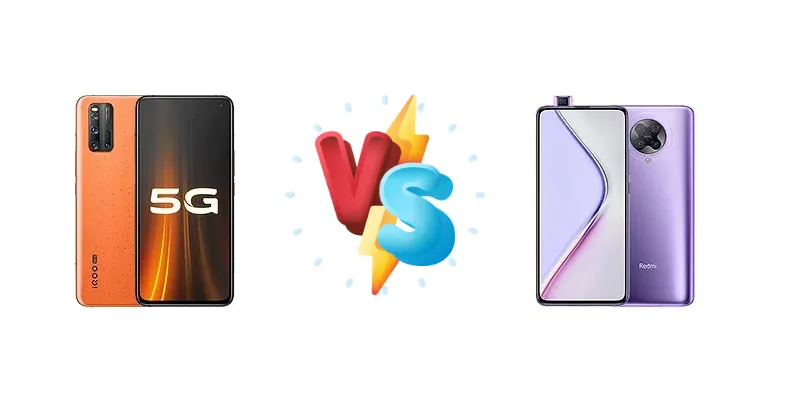
The vivo iQOO 3 5G and Xiaomi Redmi K30 Pro Zoom represent a fascinating intersection of value and performance. Both devices launched with the flagship Qualcomm Snapdragon 865 5G chipset, but diverge in their approach to battery technology and overall user experience. This comparison dissects these differences to determine which phone delivers the best experience for various user needs.
🏆 Quick Verdict
For users prioritizing the fastest possible charging speeds and a brighter display, the iQOO 3 5G is the clear winner. However, the Redmi K30 Pro Zoom offers a more balanced package with potentially longer battery life due to its more conservative charging approach, making it ideal for those who value endurance.
| Network |
|---|
| 2G bands | GSM 850 / 900 / 1800 / 1900 | GSM 850 / 900 / 1800 / 1900 |
| 3G bands | HSDPA 850 / 900 / 1700(AWS) / 1900 / 2100 | HSDPA 850 / 900 / 1900 / 2100 |
| 4G bands | 1, 2, 3, 4, 5, 7, 8, 12, 17, 18, 19, 20, 25, 26, 34, 38, 39, 40, 41 | 1, 3, 5, 7, 8, 34, 38, 39, 40, 41 |
| 5G bands | 1, 3, 41, 77, 78, 79 SA/NSA - China | 1, 3, 41, 78, 79 SA/NSA |
| Speed | HSPA, LTE, 5G (3.3 Gbps DL) | HSPA, LTE, 5G |
| Technology | GSM / CDMA / HSPA / LTE / 5G | GSM / CDMA / HSPA / EVDO / LTE / 5G |
| | 41, 77, 78 - India | CDMA2000 1xEV-DO |
| Launch |
|---|
| Announced | 2020, February 25. Released 2020, March 04 | 2020, March 24. Released 2020, April 04 |
| Status | Discontinued | Discontinued |
| Body |
|---|
| Build | Glass front (Gorilla Glass 6), glass back (Gorilla Glass 6), aluminum frame | Glass front (Gorilla Glass 5), glass back (Gorilla Glass 5), aluminum frame |
| Dimensions | 158.5 x 74.9 x 9.2 mm (6.24 x 2.95 x 0.36 in) | 163.3 x 75.4 x 8.9 mm (6.43 x 2.97 x 0.35 in) |
| SIM | Nano-SIM + Nano-SIM | Nano-SIM + Nano-SIM |
| Weight | 214.5 g (7.58 oz) | 218 g (7.69 oz) |
| Display |
|---|
| Protection | Corning Gorilla Glass 6 | Corning Gorilla Glass 5 |
| Resolution | 1080 x 2400 pixels, 20:9 ratio (~409 ppi density) | 1080 x 2400 pixels, 20:9 ratio (~395 ppi density) |
| Size | 6.44 inches, 100.1 cm2 (~84.3% screen-to-body ratio) | 6.67 inches, 107.4 cm2 (~87.2% screen-to-body ratio) |
| Type | Super AMOLED, HDR10+, 800 nits (typ) | Super AMOLED, HDR10+, 500 nits (typ) |
| Platform |
|---|
| CPU | Octa-core (1x2.84 GHz Cortex-A77 & 3x2.42 GHz Cortex-A77 & 4x1.80 GHz Cortex-A55) | Octa-core (1x2.84 GHz Cortex-A77 & 3x2.42 GHz Cortex-A77 & 4x1.80 GHz Cortex-A55) |
| Chipset | Qualcomm SM8250 Snapdragon 865 5G (7 nm+) | Qualcomm SM8250 Snapdragon 865 5G (7 nm+) |
| GPU | Adreno 650 | Adreno 650 |
| OS | Android 10, iQOO UI 1.0 | Android 10, MIUI 11 |
| Memory |
|---|
| Card slot | No | No |
| Internal | 128GB 6GB RAM, 128GB 8GB RAM, 128GB 12GB RAM, 256GB 8GB RAM, 256GB 12GB RAM | 128GB 8GB RAM, 256GB 8GB RAM, 512GB 12GB RAM |
| | UFS 3.1 | UFS 3.1 |
| Main Camera |
|---|
| Features | LED flash, HDR, panorama | Dual-LED dual-tone flash, HDR, panorama |
| Quad | 48 MP, f/1.8, (wide), 1/2.0", 0.8µm, PDAF
13 MP, f/2.5, 50mm (telephoto), PDAF, 2x optical zoom
13 MP, f/2.2, 120˚, 16mm (ultrawide), AF
Auxiliary lens | 64 MP, 26mm (wide), 1/1.72", 0.8µm, PDAF, OIS
8 MP, (telephoto), PDAF, OIS, 3x optical zoom
13 MP, 13mm (ultrawide)
Auxiliary lens |
| Video | 4K@30/60fps, 1080p@30fps; gyro-EIS | 8K@24/30fps, 4K@30/60fps, 1080p@30/60/120/240fps, 1080p@960fps; gyro-EIS |
| Selfie camera |
|---|
| Features | HDR | HDR |
| Single | 16 MP, f/2.5, (wide) | Motorized pop-up 20 MP, (wide), 1/3.4", 0.8µm |
| Video | 1080p@30fps | 1080p@30fps |
| Sound |
|---|
| 3.5mm jack | Yes | Yes |
| 35mm jack | Yes | Yes |
| Loudspeaker | Yes | Yes |
| | 32-bit/192kHz audio
| 24-bit/192kHz audio
|
| Comms |
|---|
| Bluetooth | 5.1, A2DP, LE, aptX HD | 5.1, A2DP, LE, aptX HD, aptX Adaptive |
| Infrared port | - | Yes |
| NFC | Yes (market/region dependent) | Yes |
| Positioning | GPS, GLONASS, BDS, GALILEO | GPS (L1+L5), GLONASS (G1), BDS (B1I+B2a), GALILEO (E1+E5a), QZSS (L1+L5) |
| Radio | No | No |
| USB | USB Type-C 2.0, OTG | USB Type-C 2.0, OTG |
| WLAN | Wi-Fi 802.11 a/b/g/n/ac/6, dual-band, Wi-Fi Direct | Wi-Fi 802.11 a/b/g/n/ac/6, dual-band, Wi-Fi Direct |
| Features |
|---|
| Sensors | Fingerprint (under display, optical), accelerometer, gyro, proximity, compass | Fingerprint (under display, optical), accelerometer, gyro, proximity, compass, barometer |
| Battery |
|---|
| Charging | 55W wired, 50% in 15 min | 33W wired, PD, QC4, 100% in 63 min |
| Type | 4400 mAh | Li-Po 4700 mAh |
| Misc |
|---|
| Colors | Volcano Orange, Tornado Black, Quantum Silver | Grey, Purple, White, Blue |
| Models | V1955A, I1927, I1928 | - |
| Price | About 480 EUR | About 500 EUR |
| SAR | 1.19 W/kg (head) 0.59 W/kg (body) | - |
| Tests |
|---|
| Battery life |
Endurance rating 118h
| - |
| Camera |
Photo / Video | - |
| Display |
Contrast ratio: Infinite (nominal) | - |
| Loudspeaker |
-26.3 LUFS (Good)
| - |
| Performance |
AnTuTu: 575601 (v8)
GeekBench: 13325 (v4.4), 3402 (v5.1)
GFXBench: 42fps (ES 3.1 onscreen) | - |
vivo iQOO 3 5G
- Ultra-fast 55W charging
- Brighter display for outdoor visibility
- Identical Snapdragon 865 performance
- Potentially shorter battery lifespan due to faster charging
- Limited camera information available
Xiaomi Redmi K30 Pro Zoom
- Potentially longer battery endurance
- More conservative charging for battery health
- Identical Snapdragon 865 performance
- Slower 33W charging
- Limited camera information available
Display Comparison
Both the iQOO 3 5G and Redmi K30 Pro Zoom feature displays capable of handling demanding content, but the iQOO 3 5G boasts a measured peak brightness of 848 nits. While the Redmi K30 Pro Zoom’s display specs aren’t provided, this higher brightness on the iQOO 3 5G translates to superior visibility outdoors. Both are listed with an 'Infinite' (nominal) contrast ratio, suggesting both utilize OLED panels. Without PWM frequency data for either, it's difficult to assess potential flicker-related eye strain, but the iQOO 3 5G’s brighter panel may be more comfortable for extended use in bright environments.
Camera Comparison
Both phones are listed with 'Photo / Video' capabilities, offering minimal insight into their camera systems. Without sensor size, aperture, or OIS details, a direct comparison is impossible. The absence of specific camera information suggests neither phone prioritizes camera performance as a primary selling point. It’s reasonable to assume both offer competent camera experiences for everyday use, but enthusiasts seeking top-tier image quality may need to look elsewhere. The lack of detail also prevents assessment of video recording capabilities.
Performance
At the heart of both devices lies the Qualcomm SM8250 Snapdragon 865 5G (7 nm+). Critically, both utilize the same CPU configuration: an octa-core setup with 1x2.84 GHz Cortex-A77, 3x2.42 GHz Cortex-A77, and 4x1.80 GHz Cortex-A55 cores. This means raw processing power will be nearly identical. The key differentiator will likely be thermal management, a detail not provided in the source data. However, given the identical chipset and CPU, sustained performance will depend on the effectiveness of each phone’s cooling solution. RAM specifications are missing, but both likely utilize LPDDR5 for fast memory access.
Battery Life
The iQOO 3 5G boasts 55W wired charging, capable of reaching 50% charge in just 15 minutes – a significant advantage for users needing quick top-ups. Conversely, the Redmi K30 Pro Zoom offers 33W wired charging, taking 63 minutes to reach 100%. The iQOO 3 5G has an endurance rating of 118h, while the Redmi K30 Pro Zoom’s battery life is not specified. While the iQOO 3 5G charges faster, the Redmi K30 Pro Zoom’s slower charging may contribute to better long-term battery health and potentially longer overall endurance, as faster charging can generate more heat.
Buying Guide
Buy the vivo iQOO 3 5G if you need blazing-fast 55W charging to minimize downtime and appreciate a display that remains visible even in direct sunlight. Buy the Xiaomi Redmi K30 Pro Zoom if you prefer a more measured approach to battery management, potentially resulting in longer overall usage between charges, and value a slightly more balanced feature set.
Frequently Asked Questions
❓ Does the 55W charging on the iQOO 3 5G significantly degrade the battery faster than the 33W charging on the Redmi K30 Pro Zoom?
While faster charging generates more heat, which can contribute to battery degradation over time, the difference between 33W and 55W isn't necessarily drastic. Modern battery management systems mitigate much of this impact. However, users prioritizing long-term battery health may prefer the Redmi K30 Pro Zoom’s more conservative charging speed.
❓ Given the identical Snapdragon 865 chipsets, will I notice a performance difference in demanding games like PUBG between the iQOO 3 5G and the Redmi K30 Pro Zoom?
Theoretically, performance should be nearly identical under ideal conditions. However, sustained performance will depend heavily on each phone’s thermal management system. Without specific thermal testing data, it’s impossible to say which phone will maintain higher clock speeds for longer periods during extended gaming sessions.
❓ Is the lack of detailed camera specifications a significant drawback for both phones?
Yes, it is. The absence of sensor size, aperture, and OIS information makes it difficult to assess the camera capabilities of either device. This suggests neither phone is positioned as a camera-centric flagship, and users prioritizing photography may want to consider alternatives.