
iQOO 3 5G vs. Black Shark 3 Pro: A Deep Dive into Gaming Performance and Battery Life
| Phones Images | |||||
|---|---|---|---|---|---|
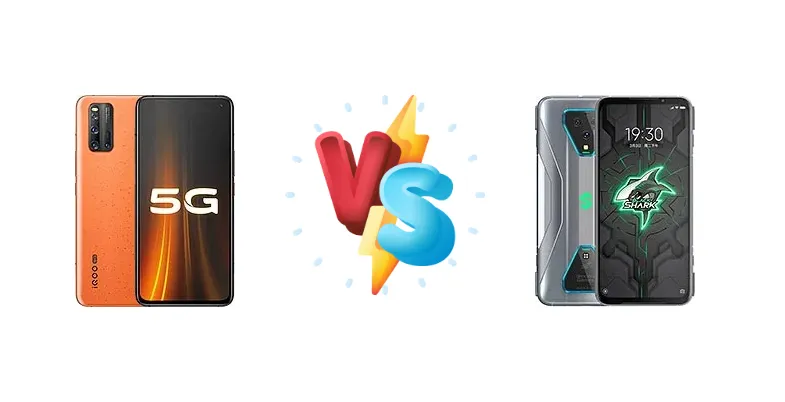
|
🏆 Quick Verdict
For the average user prioritizing a balance of gaming prowess and everyday usability, the Xiaomi Black Shark 3 Pro emerges as the slightly stronger choice. Its 65W charging, achieving a full charge in just 38 minutes, provides a significant convenience advantage over the iQOO 3 5G’s 55W system, despite both phones utilizing the same Snapdragon 865.
| PHONES | ||
|---|---|---|
| Phone Names | vivo iQOO 3 5G | Xiaomi Black Shark 3 Pro |
| Network | ||
|---|---|---|
| 2G bands | GSM 850 / 900 / 1800 / 1900 | GSM 850 / 900 / 1800 / 1900 |
| 3G bands | HSDPA 850 / 900 / 1700(AWS) / 1900 / 2100 | HSDPA 800 / 850 / 900 / 1700(AWS) / 1900 / 2100 |
| 4G bands | 1, 2, 3, 4, 5, 7, 8, 12, 17, 18, 19, 20, 25, 26, 34, 38, 39, 40, 41 | 1, 3, 4, 5, 7, 8, 12, 17, 20, 34, 38, 39, 40, 41 |
| 5G bands | 1, 3, 41, 77, 78, 79 SA/NSA - China | 41, 78, 79 SA/NSA |
| Speed | HSPA, LTE, 5G (3.3 Gbps DL) | HSPA, LTE, 5G |
| Technology | GSM / CDMA / HSPA / LTE / 5G | GSM / CDMA / HSPA / EVDO / LTE / 5G |
| 41, 77, 78 - India | CDMA2000 1xEV-DO | |
| Launch | ||
|---|---|---|
| Announced | 2020, February 25. Released 2020, March 04 | 2020, March 03. Released 2020, March 17 |
| Status | Discontinued | Discontinued |
| Body | ||
|---|---|---|
| Build | Glass front (Gorilla Glass 6), glass back (Gorilla Glass 6), aluminum frame | Glass front, aluminum back, aluminum frame |
| Dimensions | 158.5 x 74.9 x 9.2 mm (6.24 x 2.95 x 0.36 in) | 177.8 x 83.3 x 10.1 mm (7.00 x 3.28 x 0.40 in) |
| SIM | Nano-SIM + Nano-SIM | Nano-SIM + Nano-SIM |
| Weight | 214.5 g (7.58 oz) | 253 g (8.92 oz) |
| - | Physical pop-up gaming triggers | |
| Display | ||
|---|---|---|
| Protection | Corning Gorilla Glass 6 | - |
| Resolution | 1080 x 2400 pixels, 20:9 ratio (~409 ppi density) | 1440 x 3120 pixels, 19.5:9 ratio (~484 ppi density) |
| Size | 6.44 inches, 100.1 cm2 (~84.3% screen-to-body ratio) | 7.1 inches, 123.7 cm2 (~83.6% screen-to-body ratio) |
| Type | Super AMOLED, HDR10+, 800 nits (typ) | AMOLED, 90Hz, HDR10+, 500 nits (typ) |
| - | Always-on display | |
| Platform | ||
|---|---|---|
| CPU | Octa-core (1x2.84 GHz Cortex-A77 & 3x2.42 GHz Cortex-A77 & 4x1.80 GHz Cortex-A55) | Octa-core (1x2.84 GHz Cortex-A77 & 3x2.42 GHz Cortex-A77 & 4x1.80 GHz Cortex-A55) |
| Chipset | Qualcomm SM8250 Snapdragon 865 5G (7 nm+) | Qualcomm SM8250 Snapdragon 865 5G (7 nm+) |
| GPU | Adreno 650 | Adreno 650 |
| OS | Android 10, iQOO UI 1.0 | Android 10 |
| Memory | ||
|---|---|---|
| Card slot | No | No |
| Internal | 128GB 6GB RAM, 128GB 8GB RAM, 128GB 12GB RAM, 256GB 8GB RAM, 256GB 12GB RAM | 256GB 8GB RAM, 256GB 12GB RAM, 512GB 12GB RAM |
| UFS 3.1 | UFS 3.0 | |
| Main Camera | ||
|---|---|---|
| Features | LED flash, HDR, panorama | LED flash, HDR, panorama |
| Quad | 48 MP, f/1.8, (wide), 1/2.0", 0.8µm, PDAF 13 MP, f/2.5, 50mm (telephoto), PDAF, 2x optical zoom 13 MP, f/2.2, 120˚, 16mm (ultrawide), AF Auxiliary lens | - |
| Triple | - | 64 MP, f/1.8, 26mm (wide), 1/1.72", 0.8µm, PDAF 13 MP, f/2.3, (ultrawide) Auxiliary lens |
| Video | 4K@30/60fps, 1080p@30fps; gyro-EIS | 4K@30/60fps, 1080p@30/60/240fps, 720p@1920fps |
| Selfie camera | ||
|---|---|---|
| Features | HDR | HDR |
| Single | 16 MP, f/2.5, (wide) | 20 MP, f/2.2, (wide), 1/3", 0.9µm |
| Video | 1080p@30fps | 1080p@30fps |
| Sound | ||
|---|---|---|
| 3.5mm jack | Yes | Yes |
| 35mm jack | Yes | Yes |
| Loudspeaker | Yes | Yes, with stereo speakers |
| 32-bit/192kHz audio | - | |
| Comms | ||
|---|---|---|
| Bluetooth | 5.1, A2DP, LE, aptX HD | 5.0, A2DP, LE, aptX HD, aptX Adaptive |
| NFC | Yes (market/region dependent) | No |
| Positioning | GPS, GLONASS, BDS, GALILEO | GPS, GLONASS, GALILEO, QZSS, BDS |
| Radio | No | No |
| USB | USB Type-C 2.0, OTG | USB Type-C 2.0 |
| WLAN | Wi-Fi 802.11 a/b/g/n/ac/6, dual-band, Wi-Fi Direct | Wi-Fi 802.11 a/b/g/n/ac/6, dual-band, Wi-Fi Direct |
| Features | ||
|---|---|---|
| Sensors | Fingerprint (under display, optical), accelerometer, gyro, proximity, compass | Fingerprint (under display, optical), accelerometer, gyro, proximity, compass |
| Battery | ||
|---|---|---|
| Charging | 55W wired, 50% in 15 min | 65W wired, 100% in 38 min 18W magnetic wireless |
| Type | 4400 mAh | Li-Po 5000 mAh |
| Misc | ||
|---|---|---|
| Colors | Volcano Orange, Tornado Black, Quantum Silver | Phantom Black, Armor Gray |
| Models | V1955A, I1927, I1928 | SHARK MBU-A0, SHARK MBU-H0 |
| Price | About 480 EUR | About 940 EUR |
| SAR | 1.19 W/kg (head) 0.59 W/kg (body) | - |
| Tests | ||
|---|---|---|
| Battery life | Endurance rating 118h | - |
| Camera | Photo / Video | - |
| Display | Contrast ratio: Infinite (nominal) | - |
| Loudspeaker | -26.3 LUFS (Good) | - |
| Performance | AnTuTu: 575601 (v8) GeekBench: 13325 (v4.4), 3402 (v5.1) GFXBench: 42fps (ES 3.1 onscreen) | - |
vivo iQOO 3 5G
- Respectable 118-hour endurance rating.
- 55W fast charging provides a quick power boost.
- Potentially more balanced software experience.
- Slower charging compared to the Black Shark 3 Pro.
- Limited camera information suggests it's not a primary focus.
Xiaomi Black Shark 3 Pro
- 65W charging delivers a full charge in just 38 minutes.
- 18W magnetic wireless charging adds convenience.
- Likely superior thermal management for sustained gaming.
- Potentially more aggressive thermal throttling under heavy load.
- Gaming-focused design may not appeal to all users.
Display Comparison
Both devices utilize panels capable of displaying vibrant colors, but detailed display specifications beyond the iQOO 3 5G’s measured 848 nits peak brightness are unavailable. Given the Black Shark 3 Pro’s gaming focus, it likely prioritizes a high refresh rate (likely 90Hz or 120Hz, based on market trends for the time) to enhance visual fluidity. The iQOO 3 5G’s ‘Infinite’ contrast ratio is a nominal specification, common in OLED displays, and doesn’t provide a comparative advantage without further data. The absence of LTPO technology in either device suggests both will rely on traditional refresh rate switching, potentially impacting battery life during variable content.
Camera Comparison
The provided data only indicates both phones feature photo and video capabilities, lacking specifics on sensor size, aperture, or image processing. Given the Black Shark 3 Pro’s broader appeal, it may incorporate a more versatile camera system. However, without detailed specifications, it’s difficult to assess a clear advantage. The absence of information suggests neither phone prioritizes camera performance as a key selling point, focusing instead on gaming capabilities.
Performance
Both the iQOO 3 5G and Black Shark 3 Pro are powered by the Qualcomm SM8250 Snapdragon 865 5G (7 nm+), featuring an identical CPU configuration: an octa-core setup with 1x2.84 GHz Cortex-A77, 3x2.42 GHz Cortex-A77, and 4x1.80 GHz Cortex-A55 cores. This means raw processing power will be nearly identical. However, the Black Shark 3 Pro likely employs a more aggressive cooling solution – a common feature in gaming phones – to sustain peak performance for longer durations. While both benefit from 5G connectivity, sustained gaming performance will hinge on the effectiveness of their respective thermal management systems, a metric not provided in the source data.
Battery Life
The iQOO 3 5G boasts an endurance rating of 118 hours, suggesting respectable battery life. However, the Black Shark 3 Pro compensates for potentially higher power draw from its gaming-centric features with significantly faster charging: 65W wired, achieving 100% charge in 38 minutes, alongside 18W magnetic wireless charging. The iQOO 3 5G’s 55W charging, reaching 50% in 15 minutes, is still fast, but the Black Shark 3 Pro’s complete charge time is substantially quicker, offering a crucial advantage for gamers who need to quickly return to action.
Buying Guide
Buy the vivo iQOO 3 5G if you prioritize a slightly more refined software experience and a potentially more balanced daily driver. Buy the Xiaomi Black Shark 3 Pro if you are a dedicated mobile gamer who values the fastest possible charging speeds and a more overtly gaming-focused design, and are willing to accept a potentially more aggressive thermal profile under sustained load.