
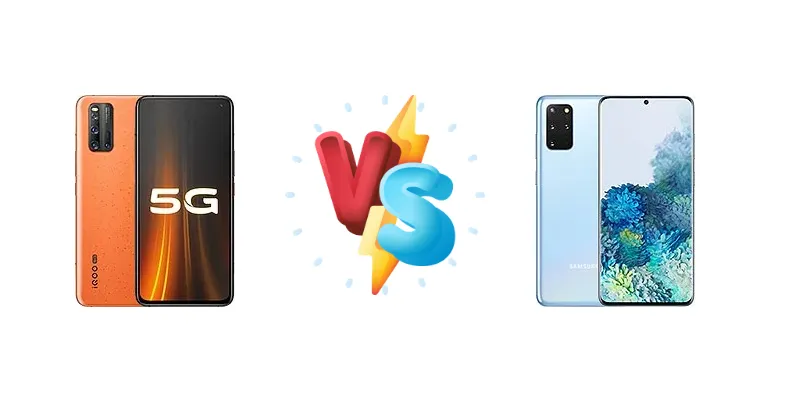
iQOO 3 5G vs Samsung Galaxy S20+ 5G: A Detailed Comparison
| Phones Images | |||||
|---|---|---|---|---|---|
|
🏆 Quick Verdict
For the average user prioritizing performance and charging speed, the iQOO 3 5G emerges as the winner. Its 55W charging and Snapdragon 865 chipset deliver a faster, more responsive experience, especially for gaming, at a potentially lower cost. The S20+ offers a more refined software experience and a versatile camera, but the iQOO 3’s value proposition is stronger.
| PHONES | ||
|---|---|---|
| Phone Names | vivo iQOO 3 5G | Samsung Galaxy S20+ 5G |
| Network | ||
|---|---|---|
| 2G bands | GSM 850 / 900 / 1800 / 1900 | GSM 850 / 900 / 1800 / 1900 |
| 3G bands | HSDPA 850 / 900 / 1700(AWS) / 1900 / 2100 | HSDPA 850 / 900 / 1700(AWS) / 1900 / 2100 |
| 4G bands | 1, 2, 3, 4, 5, 7, 8, 12, 17, 18, 19, 20, 25, 26, 34, 38, 39, 40, 41 | 1, 2, 3, 4, 5, 7, 8, 12, 13, 17, 18, 19, 20, 25, 26, 28, 32, 38, 39, 40, 41, 66 - SM-G986B |
| 5G bands | 1, 3, 41, 77, 78, 79 SA/NSA - China | 1, 3, 5, 7, 8, 28, 40, 77, 78 SA/NSA/Sub6 - SM-G986B |
| Speed | HSPA, LTE, 5G (3.3 Gbps DL) | HSPA 42.2/5.76 Mbps, LTE (7CA) Cat20 2000/200 Mbps, 5G (5+ Gbps DL) |
| Technology | GSM / CDMA / HSPA / LTE / 5G | GSM / CDMA / HSPA / EVDO / LTE / 5G |
| 41, 77, 78 - India | - | |
| Launch | ||
|---|---|---|
| Announced | 2020, February 25. Released 2020, March 04 | 2020, February 11 |
| Status | Discontinued | Available. Released 2020, March 06 |
| Body | ||
|---|---|---|
| Build | Glass front (Gorilla Glass 6), glass back (Gorilla Glass 6), aluminum frame | Glass front (Gorilla Glass 6), glass back (Gorilla Glass 6), aluminum frame |
| Dimensions | 158.5 x 74.9 x 9.2 mm (6.24 x 2.95 x 0.36 in) | 161.9 x 73.7 x 7.8 mm (6.37 x 2.90 x 0.31 in) |
| SIM | Nano-SIM + Nano-SIM | · Nano-SIM + eSIM· Nano-SIM + Nano-SIM |
| Weight | 214.5 g (7.58 oz) | 188 g (6.63 oz) |
| Display | ||
|---|---|---|
| Protection | Corning Gorilla Glass 6 | Corning Gorilla Glass 6 |
| Resolution | 1080 x 2400 pixels, 20:9 ratio (~409 ppi density) | 1440 x 3200 pixels, 20:9 ratio (~525 ppi density) |
| Size | 6.44 inches, 100.1 cm2 (~84.3% screen-to-body ratio) | 6.7 inches, 108.0 cm2 (~90.5% screen-to-body ratio) |
| Type | Super AMOLED, HDR10+, 800 nits (typ) | Dynamic AMOLED 2X, 120Hz, HDR10+, 1200 nits (peak) |
| Platform | ||
|---|---|---|
| CPU | Octa-core (1x2.84 GHz Cortex-A77 & 3x2.42 GHz Cortex-A77 & 4x1.80 GHz Cortex-A55) | Octa-core (2x2.73 GHz Mongoose M5 & 2x2.50 GHz Cortex-A76 & 4x2.0 GHz Cortex-A55) - GlobalOcta-core (1x2.84 GHz Cortex-A77 & 3x2.42 GHz Cortex-A77 & 4x1.80 GHz Cortex-A55) - USA |
| Chipset | Qualcomm SM8250 Snapdragon 865 5G (7 nm+) | Exynos 990 (7 nm+) - GlobalQualcomm SM8250 Snapdragon 865 5G (7 nm+) - USA |
| GPU | Adreno 650 | Mali-G77 MP11 - GlobalAdreno 650 - USA |
| OS | Android 10, iQOO UI 1.0 | Android 10, upgradable to Android 13, One UI 5.1 |
| Memory | ||
|---|---|---|
| Card slot | No | microSDXC (uses shared SIM slot) |
| Internal | 128GB 6GB RAM, 128GB 8GB RAM, 128GB 12GB RAM, 256GB 8GB RAM, 256GB 12GB RAM | 128GB 8GB RAM, 128GB 12GB RAM, 256GB 12GB RAM, 512GB 12GB RAM |
| UFS 3.1 | - | |
| Main Camera | ||
|---|---|---|
| Features | LED flash, HDR, panorama | LED flash, auto-HDR, panorama |
| Quad | 48 MP, f/1.8, (wide), 1/2.0", 0.8µm, PDAF 13 MP, f/2.5, 50mm (telephoto), PDAF, 2x optical zoom 13 MP, f/2.2, 120˚, 16mm (ultrawide), AF Auxiliary lens | - |
| Triple | - | 12 MP, f/1.8, 26mm (wide), 1/1.76", 1.8µm, dual pixel PDAF, OIS 64 MP, f/2.0, 29mm (telephoto), 1/1.72", 0.8µm, PDAF, OIS, 1.1x optical zoom, 3x hybrid zoom 12 MP, f/2.2, 13mm, 120˚ (ultrawide), 1/2.55" 1.4µm, Super Steady video 0.3 MP, TOF 3D, f/1.0, (depth) |
| Video | 4K@30/60fps, 1080p@30fps; gyro-EIS | 8K@24fps, 4K@30/60fps, 1080p@30/60/240fps, 720p@960fps, HDR10+, stereo sound rec., gyro-EIS & OIS |
| Selfie camera | ||
|---|---|---|
| Features | HDR | HDR |
| Single | 16 MP, f/2.5, (wide) | 10 MP, f/2.2, 26mm (wide), 1/3.24", 1.22µm, dual pixel PDAF |
| Video | 1080p@30fps | 4K@30/60fps, 1080p@30fps |
| Sound | ||
|---|---|---|
| 3.5mm jack | Yes | No |
| 35mm jack | Yes | No |
| Loudspeaker | Yes | Yes, with stereo speakers |
| 32-bit/192kHz audio | - | |
| Comms | ||
|---|---|---|
| Bluetooth | 5.1, A2DP, LE, aptX HD | 5.0, A2DP, LE |
| NFC | Yes (market/region dependent) | Yes |
| Positioning | GPS, GLONASS, BDS, GALILEO | GPS, GLONASS, BDS, GALILEO |
| Radio | No | FM radio (Snapdragon model only; market/operator dependent) |
| USB | USB Type-C 2.0, OTG | USB Type-C 3.2, OTG |
| WLAN | Wi-Fi 802.11 a/b/g/n/ac/6, dual-band, Wi-Fi Direct | Wi-Fi 802.11 a/b/g/n/ac/6, dual-band, Wi-Fi Direct |
| Features | ||
|---|---|---|
| Sensors | Fingerprint (under display, optical), accelerometer, gyro, proximity, compass | Fingerprint (under display, ultrasonic), accelerometer, gyro, proximity, compass, barometer |
| Battery | ||
|---|---|---|
| Charging | 55W wired, 50% in 15 min | 25W wired, PD3.0 15W wireless (Qi) 4.5W reverse wireless |
| Type | 4400 mAh | Li-Ion 4500 mAh |
| Misc | ||
|---|---|---|
| Colors | Volcano Orange, Tornado Black, Quantum Silver | Cosmic Black, Cosmic Grey, Cloud Blue, Cloud White, Aura Red, Aura Blue |
| Models | V1955A, I1927, I1928 | SM-G986, SM-G986F, SM-G986F/DS, SM-G986U, SM-G986U1, SM-G9860, SM-G986B/DS, SM-G986N, SM-G986B, SM-G986W, SCG02 |
| Price | About 480 EUR | $ 174.17 / C$ 684.99 / € 299.97 |
| SAR | 1.19 W/kg (head) 0.59 W/kg (body) | 1.08 W/kg (head) 1.02 W/kg (body) |
| SAR EU | - | 1.09 W/kg (head) 1.57 W/kg (body) |
| Tests | ||
|---|---|---|
| Battery life | Endurance rating 118h | - |
| Camera | Photo / Video | - |
| Display | Contrast ratio: Infinite (nominal) | - |
| Loudspeaker | -26.3 LUFS (Good) | - |
| Performance | AnTuTu: 575601 (v8) GeekBench: 13325 (v4.4), 3402 (v5.1) GFXBench: 42fps (ES 3.1 onscreen) | - |
vivo iQOO 3 5G
- Significantly faster 55W charging
- Potentially lower price point
- Snapdragon 865 offers strong performance
- Less refined software experience
- Camera likely less versatile than S20+
Samsung Galaxy S20+ 5G
- Versatile camera system with strong video
- Polished Samsung One UI software
- Wireless and reverse wireless charging
- Exynos 990 (global version) can throttle under load
- Slower 25W wired charging
Display Comparison
The iQOO 3 5G boasts a peak brightness of 848 nits, a respectable figure, but the S20+ likely surpasses this (Samsung typically achieves higher peak brightness). Both utilize 7nm+ fabrication, but the display technologies differ. While specifics on the S20+ panel aren’t provided, Samsung’s displays are known for color accuracy. The iQOO 3’s ‘infinite’ contrast ratio is a marketing term, but suggests a strong VA-type panel. The S20+ likely has a higher refresh rate option, a key advantage for smoother scrolling and gaming, though this isn't specified in the provided data.
Camera Comparison
The provided data only indicates ‘Photo / Video’ capabilities for both. Without sensor size, aperture, or megapixel counts, a detailed comparison is difficult. However, Samsung’s Galaxy S20+ is renowned for its camera versatility, particularly its video recording capabilities. The iQOO 3 likely prioritizes still photography, but lacks the brand recognition and software optimization of Samsung’s camera system. The presence of a 2MP macro camera on either device is largely irrelevant; image quality from such sensors is typically poor.
Performance
Both phones, in their respective configurations, can be equipped with the Qualcomm Snapdragon 865 5G (7nm+). However, the global S20+ shipped with the Exynos 990 (also 7nm+). The Snapdragon 865, as found in the US S20+ and the iQOO 3, generally offers superior sustained performance and thermal management compared to the Exynos 990. The iQOO 3’s CPU configuration (1x2.84 GHz Cortex-A77, 3x2.42 GHz Cortex-A77, 4x1.80 GHz Cortex-A55) is identical to the US Snapdragon S20+, suggesting similar raw CPU power. The Exynos 990’s CPU (2x2.73 GHz Mongoose M5, 2x2.50 GHz Cortex-A76, 4x2.0 GHz Cortex-A55) has a different architecture, but the real-world performance difference is often minimal. The iQOO 3’s focus on cooling likely allows it to maintain peak performance for longer.
Battery Life
The iQOO 3 5G boasts an endurance rating of 118 hours, a solid result. Crucially, it supports 55W wired charging, capable of reaching 50% charge in just 15 minutes. The S20+ offers a slower 25W wired charging with PD3.0, 15W wireless charging (Qi), and 4.5W reverse wireless charging. While the S20+ offers wireless charging convenience, the iQOO 3’s significantly faster wired charging is a major advantage for users who prioritize quick top-ups. The actual battery capacity (mAh) isn’t provided, but the iQOO 3’s charging speed effectively mitigates any potential capacity disadvantage.
Buying Guide
Buy the vivo iQOO 3 5G if you need uncompromising performance for gaming and demanding tasks, and prioritize incredibly fast charging. You’ll benefit from a more aggressive price point. Buy the Samsung Galaxy S20+ 5G if you prefer a more polished software experience, a versatile camera system with strong video capabilities, and integration with the Samsung ecosystem, and are willing to pay a premium.