
iQOO 3 5G vs Realme X50 Pro 5G: A Deep Dive into Battery, Display, and Performance
| Phones Images | |||||
|---|---|---|---|---|---|
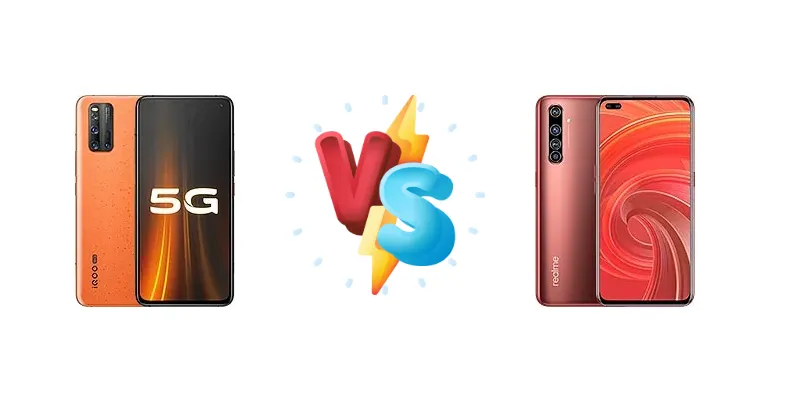
|
🏆 Quick Verdict
For the average user prioritizing longevity, the iQOO 3 5G is the better choice. Its significantly higher endurance rating of 118 hours versus the X50 Pro’s 90 hours translates to a real-world advantage. While the X50 Pro boasts faster charging, the iQOO 3’s superior battery life minimizes the need to constantly top up.
| PHONES | ||
|---|---|---|
| Phone Names | vivo iQOO 3 5G | Realme X50 Pro 5G |
| Network | ||
|---|---|---|
| 2G bands | GSM 850 / 900 / 1800 / 1900 | GSM 850 / 900 / 1800 / 1900 |
| 3G bands | HSDPA 850 / 900 / 1700(AWS) / 1900 / 2100 | HSDPA 800 / 850 / 900 / 1700(AWS) / 1900 / 2100 |
| 4G bands | 1, 2, 3, 4, 5, 7, 8, 12, 17, 18, 19, 20, 25, 26, 34, 38, 39, 40, 41 | 1, 2, 3, 4, 5, 7, 8, 12, 17, 18, 19, 20, 26, 28, 32, 38, 39, 40, 41, 42, 66 - Global |
| 5G bands | 1, 3, 41, 77, 78, 79 SA/NSA - China | 1, 3, 5, 7, 28, 38, 40, 41, 77, 78 SA/NSA - Global |
| Speed | HSPA, LTE, 5G (3.3 Gbps DL) | HSPA, LTE, 5G |
| Technology | GSM / CDMA / HSPA / LTE / 5G | GSM / HSPA / LTE / 5G |
| 41, 77, 78 - India | 41, 78, 79 SA/NSA - India | |
| Launch | ||
|---|---|---|
| Announced | 2020, February 25. Released 2020, March 04 | 2020, February 24. Released 2020, March 05 |
| Status | Discontinued | Discontinued |
| Body | ||
|---|---|---|
| Build | Glass front (Gorilla Glass 6), glass back (Gorilla Glass 6), aluminum frame | Glass front (Gorilla Glass 5), glass back (Gorilla Glass 5), aluminum frame |
| Dimensions | 158.5 x 74.9 x 9.2 mm (6.24 x 2.95 x 0.36 in) | 159 x 74.2 x 8.9 mm (6.26 x 2.92 x 0.35 in) |
| SIM | Nano-SIM + Nano-SIM | · Nano-SIM· Nano-SIM + Nano-SIM |
| Weight | 214.5 g (7.58 oz) | 205 g (7.23 oz) |
| Display | ||
|---|---|---|
| Protection | Corning Gorilla Glass 6 | Corning Gorilla Glass 5 |
| Resolution | 1080 x 2400 pixels, 20:9 ratio (~409 ppi density) | 1080 x 2400 pixels, 20:9 ratio (~409 ppi density) |
| Size | 6.44 inches, 100.1 cm2 (~84.3% screen-to-body ratio) | 6.44 inches, 100.1 cm2 (~84.9% screen-to-body ratio) |
| Type | Super AMOLED, HDR10+, 800 nits (typ) | Super AMOLED, 90Hz, HDR10+ |
| Platform | ||
|---|---|---|
| CPU | Octa-core (1x2.84 GHz Cortex-A77 & 3x2.42 GHz Cortex-A77 & 4x1.80 GHz Cortex-A55) | Octa-core (1x2.84 GHz Cortex-A77 & 3x2.42 GHz Cortex-A77 & 4x1.80 GHz Cortex-A55) |
| Chipset | Qualcomm SM8250 Snapdragon 865 5G (7 nm+) | Qualcomm SM8250 Snapdragon 865 5G (7 nm+) |
| GPU | Adreno 650 | Adreno 650 |
| OS | Android 10, iQOO UI 1.0 | Android 10, upgradable to Android 11, Realme UI 2.0 |
| Memory | ||
|---|---|---|
| Card slot | No | No |
| Internal | 128GB 6GB RAM, 128GB 8GB RAM, 128GB 12GB RAM, 256GB 8GB RAM, 256GB 12GB RAM | 128GB 6GB RAM, 128GB 8GB RAM, 256GB 8GB RAM, 256GB 12GB RAM |
| UFS 3.1 | UFS 3.0 | |
| Main Camera | ||
|---|---|---|
| Features | LED flash, HDR, panorama | LED flash, HDR, panorama |
| Quad | 48 MP, f/1.8, (wide), 1/2.0", 0.8µm, PDAF 13 MP, f/2.5, 50mm (telephoto), PDAF, 2x optical zoom 13 MP, f/2.2, 120˚, 16mm (ultrawide), AF Auxiliary lens | 64 MP, f/1.8, 26mm (wide), 1/1.72", 0.8µm, PDAF 12 MP, f/2.5, 54mm (telephoto), 2x optical zoom, PDAF 8 MP, f/2.3, 13mm (ultrawide), PDAF Auxiliary lens |
| Video | 4K@30/60fps, 1080p@30fps; gyro-EIS | 4K@30/60fps, 1080p@30/60fps; gyro-EIS |
| Selfie camera | ||
|---|---|---|
| Dual | - | 32 MP, f/2.5, 26mm (wide), 1/2.8", 0.8µm 8 MP, f/2.2, 17mm (ultrawide), 1/4.0", 1.12µm |
| Features | HDR | HDR |
| Single | 16 MP, f/2.5, (wide) | - |
| Video | 1080p@30fps | 1080p@30/120fps, gyro-EIS |
| Sound | ||
|---|---|---|
| 3.5mm jack | Yes | No |
| 35mm jack | Yes | No |
| Loudspeaker | Yes | Yes, with dual speakers |
| 32-bit/192kHz audio | 24-bit/192kHz audio | |
| Comms | ||
|---|---|---|
| Bluetooth | 5.1, A2DP, LE, aptX HD | 5.1, A2DP, LE, aptX HD |
| NFC | Yes (market/region dependent) | Yes |
| Positioning | GPS, GLONASS, BDS, GALILEO | GPS (L1+L5), GLONASS, BDS, GALILEO, NavIC |
| Radio | No | No |
| USB | USB Type-C 2.0, OTG | USB Type-C 2.0 |
| WLAN | Wi-Fi 802.11 a/b/g/n/ac/6, dual-band, Wi-Fi Direct | Wi-Fi 802.11 a/b/g/n/ac/6, dual-band, Wi-Fi Direct |
| Features | ||
|---|---|---|
| Sensors | Fingerprint (under display, optical), accelerometer, gyro, proximity, compass | Fingerprint (under display, optical), accelerometer, gyro, proximity, compass |
| Battery | ||
|---|---|---|
| Charging | 55W wired, 50% in 15 min | 65W wired, PD, 100% in 35 min |
| Type | 4400 mAh | 4200 mAh |
| Misc | ||
|---|---|---|
| Colors | Volcano Orange, Tornado Black, Quantum Silver | Moss Green, Rust Red |
| Models | V1955A, I1927, I1928 | RMX2075, RMX2071, RMX2076 |
| Price | About 480 EUR | About 360 EUR |
| SAR | 1.19 W/kg (head) 0.59 W/kg (body) | - |
| Tests | ||
|---|---|---|
| Battery life | Endurance rating 118h | Endurance rating 90h |
| Camera | Photo / Video | Photo / Video |
| Display | Contrast ratio: Infinite (nominal) | Contrast ratio: Infinite (nominal) |
| Loudspeaker | -26.3 LUFS (Good) | -23.2 LUFS (Very good) |
| Performance | AnTuTu: 575601 (v8) GeekBench: 13325 (v4.4), 3402 (v5.1) GFXBench: 42fps (ES 3.1 onscreen) | AnTuTu: 592447 (v8) GeekBench: 3175 (v5.1) GFXBench: 45fps (ES 3.1 onscreen) |
vivo iQOO 3 5G
- Superior battery life (118h endurance)
- Brighter display (848 nits)
- Fast 55W charging
- Charging isn't the absolute fastest
- Camera specs are unknown
Realme X50 Pro 5G
- Ultra-fast 65W charging (100% in 35 min)
- Snapdragon 865 performance
- 5G connectivity
- Significantly lower battery life (90h endurance)
- Dimmer display (635 nits)
Display Comparison
The iQOO 3 5G features a display capable of reaching 848 nits of peak brightness, offering a noticeably more vibrant and visible experience in direct sunlight compared to the Realme X50 Pro’s 635 nits. Both displays share an 'Infinite' (nominal) contrast ratio, suggesting deep blacks, but the iQOO 3’s higher brightness provides a tangible advantage for outdoor usability. While both likely utilize AMOLED panels, the iQOO 3’s superior brightness suggests a potentially more advanced panel generation or calibration.
Camera Comparison
Both phones are listed with 'Photo / Video' capabilities, lacking specific details about sensor size, aperture, or features like Optical Image Stabilization (OIS). Without this information, a direct camera comparison is impossible. However, given iQOO’s branding, it’s reasonable to expect a focus on image processing geared towards vibrant colors and social media sharing, while Realme often emphasizes versatility and value. The absence of details suggests neither phone boasts a standout camera system compared to other 865-powered devices.
Performance
Both devices are equipped with the Qualcomm SM8250 Snapdragon 865 5G (7 nm+), featuring the same octa-core CPU configuration (1x2.84 GHz Cortex-A77, 3x2.42 GHz Cortex-A77, and 4x1.80 GHz Cortex-A55). Therefore, raw processing power is virtually identical. Performance differences will likely stem from thermal management and software optimization, areas not detailed in the provided data. Both phones support 5G connectivity, but real-world speeds will depend on network availability.
Battery Life
The iQOO 3 5G’s endurance rating of 118 hours significantly surpasses the Realme X50 Pro’s 90 hours. This indicates a substantial advantage in real-world battery life, meaning the iQOO 3 will likely last considerably longer on a single charge. While the X50 Pro compensates with 65W wired charging, achieving a full charge in 35 minutes, the iQOO 3’s 55W charging (50% in 15 minutes) is still very fast. The trade-off is clear: the X50 Pro prioritizes speed of recharge, while the iQOO 3 prioritizes longevity.
Buying Guide
Buy the vivo iQOO 3 5G if you need all-day battery life and prioritize minimizing charging frequency. It’s ideal for users who heavily utilize their phones for media consumption, navigation, or demanding applications. Buy the Realme X50 Pro 5G if you value the absolute fastest charging speeds and are comfortable with more frequent top-ups, or if you anticipate needing to quickly replenish the battery during short breaks.