
vivo iQOO 3 5G vs OnePlus 8T: A Detailed Comparison
| Phones Images | |||||
|---|---|---|---|---|---|
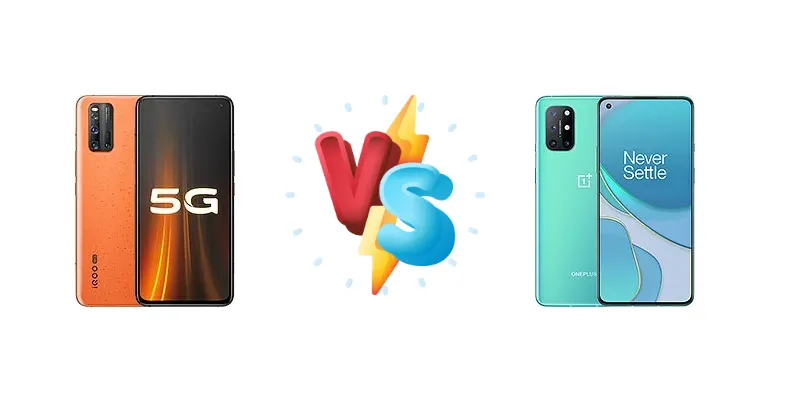
|
🏆 Quick Verdict
The iQOO 3 5G edges out the OnePlus 8T with superior battery life and a slightly brighter display. However, the OnePlus 8T boasts significantly faster charging and a potentially more refined software experience. Ultimately, the choice depends on your priorities: endurance or speed.
| PHONES | ||
|---|---|---|
| Phone Names | vivo iQOO 3 5G | OnePlus 8T |
| Network | ||
|---|---|---|
| 2G bands | GSM 850 / 900 / 1800 / 1900 | GSM 850 / 900 / 1800 / 1900 |
| 3G bands | HSDPA 850 / 900 / 1700(AWS) / 1900 / 2100 | HSDPA 800 / 850 / 900 / 1700(AWS) / 1800 / 1900 / 2100 |
| 4G bands | 1, 2, 3, 4, 5, 7, 8, 12, 17, 18, 19, 20, 25, 26, 34, 38, 39, 40, 41 | 1, 2, 3, 4, 5, 7, 8, 12, 13, 17, 18, 19, 20, 25, 26, 28, 32, 34, 38, 39, 40, 41, 42, 66 - EU |
| 5G bands | 1, 3, 41, 77, 78, 79 SA/NSA - China | 1, 3, 7, 28, 41, 78 SA/NSA - EU |
| Speed | HSPA, LTE, 5G (3.3 Gbps DL) | HSPA 42.2/5.76 Mbps, LTE (5CA) Cat18 1200/200 Mbps, 5G 7.5 Gbps DL |
| Technology | GSM / CDMA / HSPA / LTE / 5G | GSM / CDMA / HSPA / LTE / 5G |
| 41, 77, 78 - India | 41, 78, 79 SA/NSA - CN | |
| Launch | ||
|---|---|---|
| Announced | 2020, February 25. Released 2020, March 04 | 2020, October 14 |
| Status | Discontinued | Available. Released 2020, October 16 |
| Body | ||
|---|---|---|
| Build | Glass front (Gorilla Glass 6), glass back (Gorilla Glass 6), aluminum frame | Glass front (Gorilla Glass 5), glass back (Gorilla Glass 5), aluminum frame |
| Dimensions | 158.5 x 74.9 x 9.2 mm (6.24 x 2.95 x 0.36 in) | 160.7 x 74.1 x 8.4 mm (6.33 x 2.92 x 0.33 in) |
| SIM | Nano-SIM + Nano-SIM | Nano-SIM + Nano-SIM |
| Weight | 214.5 g (7.58 oz) | 188 g (6.63 oz) |
| Display | ||
|---|---|---|
| Protection | Corning Gorilla Glass 6 | Corning Gorilla Glass 5 |
| Resolution | 1080 x 2400 pixels, 20:9 ratio (~409 ppi density) | 1080 x 2400 pixels, 20:9 ratio (~402 ppi density) |
| Size | 6.44 inches, 100.1 cm2 (~84.3% screen-to-body ratio) | 6.55 inches, 103.6 cm2 (~87.0% screen-to-body ratio) |
| Type | Super AMOLED, HDR10+, 800 nits (typ) | Fluid AMOLED, 120Hz, HDR10+ |
| - | Always-on display | |
| Platform | ||
|---|---|---|
| CPU | Octa-core (1x2.84 GHz Cortex-A77 & 3x2.42 GHz Cortex-A77 & 4x1.80 GHz Cortex-A55) | Octa-core (1x2.84 GHz Cortex-A77 & 3x2.42 GHz Cortex-A77 & 4x1.80 GHz Cortex-A55) |
| Chipset | Qualcomm SM8250 Snapdragon 865 5G (7 nm+) | Qualcomm SM8250 Snapdragon 865 5G (7 nm+) |
| GPU | Adreno 650 | Adreno 650 |
| OS | Android 10, iQOO UI 1.0 | Android 11, upgradable to Android 14, OxygenOS 14 |
| Memory | ||
|---|---|---|
| Card slot | No | No |
| Internal | 128GB 6GB RAM, 128GB 8GB RAM, 128GB 12GB RAM, 256GB 8GB RAM, 256GB 12GB RAM | 128GB 8GB RAM, 256GB 12GB RAM |
| UFS 3.1 | UFS 3.1 | |
| Main Camera | ||
|---|---|---|
| Features | LED flash, HDR, panorama | Dual-LED flash, HDR, panorama |
| Quad | 48 MP, f/1.8, (wide), 1/2.0", 0.8µm, PDAF 13 MP, f/2.5, 50mm (telephoto), PDAF, 2x optical zoom 13 MP, f/2.2, 120˚, 16mm (ultrawide), AF Auxiliary lens | 48 MP, f/1.7, 26mm (wide), 1/2.0", 0.8µm, PDAF, OIS 16 MP, f/2.2, 14mm, 123˚ (ultrawide), 1/3.6", 1.0µm 5 MP (macro) 2 MP, f/2.4, (monochrome) |
| Video | 4K@30/60fps, 1080p@30fps; gyro-EIS | 4K@30/60fps, 1080p@30/60/240fps, Auto HDR, gyro-EIS |
| Selfie camera | ||
|---|---|---|
| Features | HDR | HDR |
| Single | 16 MP, f/2.5, (wide) | 16 MP, f/2.4, (wide), 1/3.06", 1.0µm |
| Video | 1080p@30fps | 1080p@30fps, gyro-EIS |
| Sound | ||
|---|---|---|
| 3.5mm jack | Yes | No |
| 35mm jack | Yes | No |
| Loudspeaker | Yes | Yes, with stereo speakers |
| 32-bit/192kHz audio | - | |
| Comms | ||
|---|---|---|
| Bluetooth | 5.1, A2DP, LE, aptX HD | 5.1, A2DP, LE, aptX HD |
| NFC | Yes (market/region dependent) | Yes |
| Positioning | GPS, GLONASS, BDS, GALILEO | GPS (L1+L5), GLONASS (G1), BDS (B1), GALILEO (E1+E5a) |
| Radio | No | No |
| USB | USB Type-C 2.0, OTG | USB Type-C 3.1, OTG |
| WLAN | Wi-Fi 802.11 a/b/g/n/ac/6, dual-band, Wi-Fi Direct | Wi-Fi 802.11 a/b/g/n/ac/6, dual-band, Wi-Fi Direct, DLNA |
| Features | ||
|---|---|---|
| Sensors | Fingerprint (under display, optical), accelerometer, gyro, proximity, compass | Fingerprint (under display, optical), accelerometer, gyro, proximity, compass, barometer (market dependant) |
| Battery | ||
|---|---|---|
| Charging | 55W wired, 50% in 15 min | 65W wired, 100% in 39 min |
| Type | 4400 mAh | Li-Po 4500 mAh |
| Misc | ||
|---|---|---|
| Colors | Volcano Orange, Tornado Black, Quantum Silver | Aquamarine Green, Lunar Silver, Cyberpunk 2077 Edition |
| Models | V1955A, I1927, I1928 | KB2001, KB2000, KB2003, KB2005 |
| Price | About 480 EUR | € 130.75 |
| SAR | 1.19 W/kg (head) 0.59 W/kg (body) | - |
| Tests | ||
|---|---|---|
| Battery life | Endurance rating 118h | Endurance rating 104h |
| Camera | Photo / Video | Photo / Video |
| Display | Contrast ratio: Infinite (nominal) | Contrast ratio: Infinite (nominal) |
| Loudspeaker | -26.3 LUFS (Good) | -24.0 LUFS (Very good) |
| Performance | AnTuTu: 575601 (v8) GeekBench: 13325 (v4.4), 3402 (v5.1) GFXBench: 42fps (ES 3.1 onscreen) | AnTuTu: 586000 (v8) GeekBench: 3126 (v5.1) GFXBench: 46fps (ES 3.1 onscreen) |
vivo iQOO 3 5G
- Exceptional battery life
- Slightly brighter display
- Powerful Snapdragon 865 5G chipset
- Competitive price
- Camera processing can be inconsistent
- Slower charging speed compared to OnePlus 8T
- Software updates might be less frequent
OnePlus 8T
- Faster charging (65W)
- Potentially more refined software experience
- Generally better camera image processing
- Smooth 120Hz display
- Shorter battery life compared to iQOO 3 5G
- Slightly lower peak brightness
- Can be more expensive
Display Comparison
Both phones feature excellent AMOLED displays with a 120Hz refresh rate for smooth scrolling and gaming. The iQOO 3 5G has a slightly higher peak brightness of 848 nits compared to the OnePlus 8T's 802 nits, offering better visibility in direct sunlight. Both have excellent contrast ratios, appearing virtually infinite. The OnePlus 8T's color calibration might be slightly more refined, but the difference is minimal.
Camera Comparison
The camera systems are a key differentiator. While both offer versatile setups, the OnePlus 8T generally receives praise for its more consistent and pleasing image processing. The iQOO 3 5G's camera is capable, but can sometimes produce slightly less natural-looking results. Video recording capabilities are comparable on both devices, offering 4K recording at 60fps. The OnePlus 8T often has better low-light performance.
Performance
Both devices are powered by the Qualcomm Snapdragon 865 5G chipset, ensuring flagship-level performance. They share the same CPU configuration, meaning you'll experience similar speeds in everyday tasks and demanding games. Real-world performance differences are likely to be negligible, with both phones handling multitasking and gaming with ease. Software optimization might play a role in perceived smoothness.
Battery Life
The iQOO 3 5G shines in battery life, boasting an endurance rating of 118 hours, significantly higher than the OnePlus 8T's 104 hours. This translates to noticeably longer usage times between charges. However, the OnePlus 8T compensates with its 65W Warp Charge, allowing it to charge from 0% to 100% in approximately 39 minutes, a considerable advantage over the iQOO 3 5G's 55W charging.
Buying Guide
The vivo iQOO 3 5G is ideal for users who prioritize long battery life and a vibrant display. It's a great choice for those who spend a lot of time on their phones and need a device that can last through the day and beyond. The OnePlus 8T is better suited for users who value fast charging and a smooth, streamlined software experience. It's perfect for those who want a phone that can quickly power up and deliver a fluid user interface.