
iQOO 3 5G vs OnePlus 8 Pro: A Deep Dive into Two 2020 Flagships
| Phones Images | |||||
|---|---|---|---|---|---|
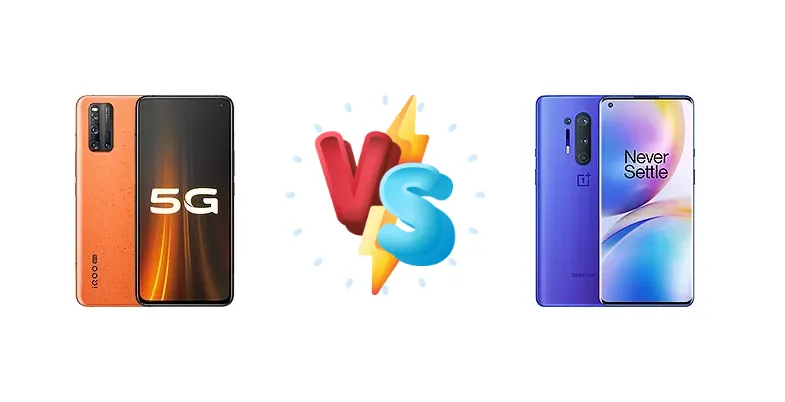
|
🏆 Quick Verdict
For the average user prioritizing rapid charging and a slightly brighter display, the iQOO 3 5G emerges as the winner. While the OnePlus 8 Pro offers wireless charging and a broader price range, the iQOO 3 5G’s 55W wired charging significantly reduces downtime, making it ideal for power users.
| PHONES | ||
|---|---|---|
| Phone Names | vivo iQOO 3 5G | OnePlus 8 Pro |
| Network | ||
|---|---|---|
| 2G bands | GSM 850 / 900 / 1800 / 1900 | GSM 850 / 900 / 1800 / 1900 |
| 3G bands | HSDPA 850 / 900 / 1700(AWS) / 1900 / 2100 | HSDPA 800 / 850 / 900 / 1700(AWS) / 1800 / 1900 / 2100 |
| 4G bands | 1, 2, 3, 4, 5, 7, 8, 12, 17, 18, 19, 20, 25, 26, 34, 38, 39, 40, 41 | 1, 2, 3, 4, 5, 7, 8, 12, 13, 17, 18, 19, 20, 25, 26, 28, 32, 34, 38, 39, 40, 41, 42, 46, 66 - EU |
| 5G bands | 1, 3, 41, 77, 78, 79 SA/NSA - China | 1, 3, 7, 28, 78 SA/NSA - EU |
| Speed | HSPA, LTE, 5G (3.3 Gbps DL) | HSPA 42.2/5.76 Mbps, LTE (5CA) Cat18 1200/150 Mbps, 5G 7.5 Gbps DL |
| Technology | GSM / CDMA / HSPA / LTE / 5G | GSM / CDMA / HSPA / LTE / 5G |
| 41, 77, 78 - India | 78 SA/NSA - IN | |
| Launch | ||
|---|---|---|
| Announced | 2020, February 25. Released 2020, March 04 | 2020, April 14 |
| Status | Discontinued | Available. Released 2020, April 21 |
| Body | ||
|---|---|---|
| Build | Glass front (Gorilla Glass 6), glass back (Gorilla Glass 6), aluminum frame | Glass front (Gorilla Glass 5), glass back (Gorilla Glass 5), aluminum frame |
| Dimensions | 158.5 x 74.9 x 9.2 mm (6.24 x 2.95 x 0.36 in) | 165.3 x 74.4 x 8.5 mm (6.51 x 2.93 x 0.33 in) |
| SIM | Nano-SIM + Nano-SIM | Nano-SIM + Nano-SIM |
| Weight | 214.5 g (7.58 oz) | 199 g (7.02 oz) |
| - | IP68 dust/water resistant | |
| Display | ||
|---|---|---|
| Protection | Corning Gorilla Glass 6 | Corning Gorilla Glass 5 |
| Resolution | 1080 x 2400 pixels, 20:9 ratio (~409 ppi density) | 1440 x 3168 pixels (~513 ppi density) |
| Size | 6.44 inches, 100.1 cm2 (~84.3% screen-to-body ratio) | 6.78 inches, 111.7 cm2 (~90.8% screen-to-body ratio) |
| Type | Super AMOLED, HDR10+, 800 nits (typ) | Fluid AMOLED, 1B colors, 120Hz, HDR10+ |
| Platform | ||
|---|---|---|
| CPU | Octa-core (1x2.84 GHz Cortex-A77 & 3x2.42 GHz Cortex-A77 & 4x1.80 GHz Cortex-A55) | Octa-core (1x2.84 GHz Cortex-A77 & 3x2.42 GHz Cortex-A77 & 4x1.80 GHz Cortex-A55) |
| Chipset | Qualcomm SM8250 Snapdragon 865 5G (7 nm+) | Qualcomm SM8250 Snapdragon 865 5G (7 nm+) |
| GPU | Adreno 650 | Adreno 650 |
| OS | Android 10, iQOO UI 1.0 | Android 10, upgradable to Android 13, OxygenOS 13 |
| Memory | ||
|---|---|---|
| Card slot | No | No |
| Internal | 128GB 6GB RAM, 128GB 8GB RAM, 128GB 12GB RAM, 256GB 8GB RAM, 256GB 12GB RAM | 128GB 8GB RAM, 256GB 12GB RAM |
| UFS 3.1 | UFS 3.0 | |
| Main Camera | ||
|---|---|---|
| Features | LED flash, HDR, panorama | Laser AF, Dual-LED flash, HDR, panorama |
| Quad | 48 MP, f/1.8, (wide), 1/2.0", 0.8µm, PDAF 13 MP, f/2.5, 50mm (telephoto), PDAF, 2x optical zoom 13 MP, f/2.2, 120˚, 16mm (ultrawide), AF Auxiliary lens | 48 MP, f/1.8, 25mm (wide), 1/1.43", 1.12µm, multi-directional PDAF, OIS 8 MP, f/2.4, (telephoto), 1/1.0µm, PDAF, OIS, 3x optical zoom 48 MP, f/2.2, 14mm, 116˚ (ultrawide), 1/2.0", 0.8µm, PDAF 5 MP, f/2.4, (Color filter camera) |
| Video | 4K@30/60fps, 1080p@30fps; gyro-EIS | 4K@30/60fps, 1080p@30/60/240fps, Auto HDR, gyro-EIS |
| Selfie camera | ||
|---|---|---|
| Features | HDR | HDR |
| Single | 16 MP, f/2.5, (wide) | 16 MP, f/2.5, (wide), 1/3.06", 1.0µm |
| Video | 1080p@30fps | 1080p@30fps, gyro-EIS |
| Sound | ||
|---|---|---|
| 3.5mm jack | Yes | No |
| 35mm jack | Yes | No |
| Loudspeaker | Yes | Yes, with stereo speakers |
| 32-bit/192kHz audio | - | |
| Comms | ||
|---|---|---|
| Bluetooth | 5.1, A2DP, LE, aptX HD | 5.1, A2DP, LE, aptX HD |
| NFC | Yes (market/region dependent) | Yes |
| Positioning | GPS, GLONASS, BDS, GALILEO | GPS (L1+L5), GLONASS (G1), BDS (B1), GALILEO (E1+E5a) |
| Radio | No | No |
| USB | USB Type-C 2.0, OTG | USB Type-C 3.1, OTG |
| WLAN | Wi-Fi 802.11 a/b/g/n/ac/6, dual-band, Wi-Fi Direct | Wi-Fi 802.11 a/b/g/n/ac/6, dual-band, Wi-Fi Direct, DLNA |
| Features | ||
|---|---|---|
| Sensors | Fingerprint (under display, optical), accelerometer, gyro, proximity, compass | Fingerprint (under display, optical), accelerometer, gyro, proximity, compass |
| Battery | ||
|---|---|---|
| Charging | 55W wired, 50% in 15 min | 30W wired, 50% in 23 min 30W wireless, 50% in 30 min 3W reverse wireless |
| Type | 4400 mAh | Li-Po 4510 mAh, non-removable |
| Misc | ||
|---|---|---|
| Colors | Volcano Orange, Tornado Black, Quantum Silver | Glacial Green, Ultramarine Blue, Onyx Black |
| Models | V1955A, I1927, I1928 | IN2023, IN2020, IN2021, IN2025 |
| Price | About 480 EUR | About 310 EUR |
| SAR | 1.19 W/kg (head) 0.59 W/kg (body) | - |
| Pricing | ||
|---|---|---|
| 128GB 8GB RAM | - | $ 428.39 |
| 256GB 12GB RAM | - | $ 853.51 |
| RENEWED | - | $ 486.00 |
| Tests | ||
|---|---|---|
| Battery life | Endurance rating 118h | Endurance rating 103h |
| Camera | Photo / Video | Photo / Video |
| Display | Contrast ratio: Infinite (nominal) | Contrast ratio: Infinite (nominal) |
| Loudspeaker | -26.3 LUFS (Good) | -23.5 LUFS (Very good) |
| Performance | AnTuTu: 575601 (v8) GeekBench: 13325 (v4.4), 3402 (v5.1) GFXBench: 42fps (ES 3.1 onscreen) | AnTuTu: 573276 (v8) GeekBench: 3374 (v5.1) GFXBench: 24fps (ES 3.1 onscreen) |
vivo iQOO 3 5G
- Significantly faster 55W wired charging
- Slightly better battery endurance (118h rating)
- Potentially brighter display (848 nits)
- Likely optimized for gaming performance
- No wireless charging
- Limited camera specification details
OnePlus 8 Pro
- Wireless charging support (30W)
- Reverse wireless charging
- Wider range of storage/RAM options
- More established software ecosystem
- Slower wired charging (30W)
- Lower battery endurance (103h rating)
- Potentially less bright display
Display Comparison
Both the iQOO 3 5G and OnePlus 8 Pro feature displays with an infinite (nominal) contrast ratio, typical of OLED panels. However, the iQOO 3 5G boasts a measured peak brightness of 848 nits, exceeding what’s commonly found in the OnePlus 8 Pro, though specific OnePlus 8 Pro brightness figures aren’t provided. This difference translates to better outdoor visibility for the iQOO 3 5G. While both likely employ high refresh rate panels (a common feature for 865-era flagships), the data doesn’t specify the exact refresh rate. The lack of LTPO technology in either device means refresh rate adjustments aren’t as dynamically power-efficient as newer displays.
Camera Comparison
Both phones offer photo and video capabilities, but the provided data lacks specifics to draw meaningful comparisons. Without sensor size, aperture details, or image processing algorithms, it’s difficult to assess camera quality. The absence of any mention of telephoto or ultrawide lenses suggests both may rely heavily on their primary sensors. The lack of detail makes a direct comparison impossible; users should consult independent camera reviews for detailed analysis.
Performance
Both devices are powered by the Qualcomm SM8250 Snapdragon 865 5G (7 nm+), featuring an identical CPU configuration: an octa-core setup with 1x2.84 GHz Cortex-A77, 3x2.42 GHz Cortex-A77, and 4x1.80 GHz Cortex-A55 cores. This means raw processing power will be nearly indistinguishable between the two. The performance bottleneck will likely be thermal management and sustained performance under load. While neither spec sheet details cooling solutions, iQOO historically focuses on gaming performance, suggesting potentially more aggressive cooling on the iQOO 3 5G. Both devices likely utilize LPDDR5 RAM, though the specific speed isn’t detailed.
Battery Life
The iQOO 3 5G achieves an endurance rating of 118 hours, while the OnePlus 8 Pro manages 103 hours. This suggests the iQOO 3 5G offers superior battery life, despite not having a significantly larger battery capacity (specific mAh figures are missing). The key differentiator is charging speed: the iQOO 3 5G supports 55W wired charging, reaching 50% charge in just 15 minutes. The OnePlus 8 Pro offers 30W wired charging (50% in 23 minutes), 30W wireless charging (50% in 30 minutes), and 3W reverse wireless charging. This makes the iQOO 3 5G the clear winner for users prioritizing quick top-ups.
Buying Guide
Buy the vivo iQOO 3 5G if you need the fastest possible wired charging and prioritize maximizing screen visibility in bright sunlight. It’s the choice for users who frequently top up their phones throughout the day and demand a responsive experience. Buy the OnePlus 8 Pro if you value wireless charging convenience, a wider range of storage/RAM configurations, and a more established software ecosystem, even if it means sacrificing some charging speed.