
iQOO 3 5G vs Huawei P40 Pro+: A Deep Dive into Performance and Photography
| Phones Images | |||||
|---|---|---|---|---|---|
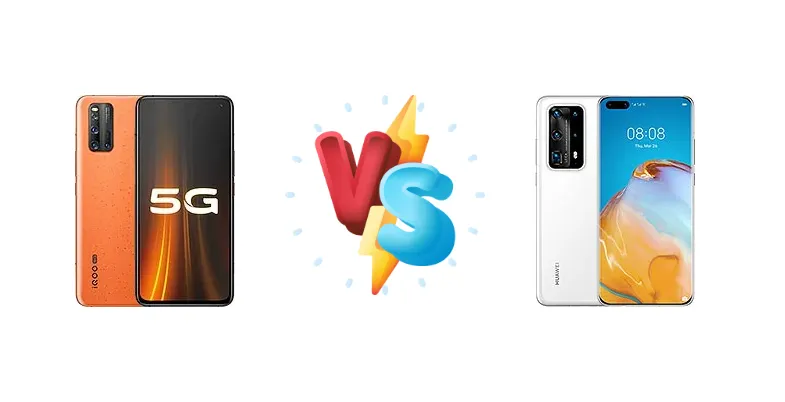
|
🏆 Quick Verdict
For the average user prioritizing raw performance and fast charging, the iQOO 3 5G emerges as the winner. Its Snapdragon 865 chipset and 55W charging offer a compelling package. However, the Huawei P40 Pro+ excels in camera versatility, making it the better choice for photography enthusiasts.
| PHONES | ||
|---|---|---|
| Phone Names | vivo iQOO 3 5G | Huawei P40 Pro+ |
| Network | ||
|---|---|---|
| 2G bands | GSM 850 / 900 / 1800 / 1900 | GSM 850 / 900 / 1800 / 1900 |
| 3G bands | HSDPA 850 / 900 / 1700(AWS) / 1900 / 2100 | HSDPA 800 / 850 / 900 / 1700(AWS) / 1900 / 2100 |
| 4G bands | 1, 2, 3, 4, 5, 7, 8, 12, 17, 18, 19, 20, 25, 26, 34, 38, 39, 40, 41 | 1, 2, 3, 4, 5, 6, 7, 8, 9, 12, 17, 18, 19, 20, 26, 28, 34, 38, 39, 40, 41 |
| 5G bands | 1, 3, 41, 77, 78, 79 SA/NSA - China | 1, 3, 28, 38, 41, 77, 78, 79 SA/NSA |
| Speed | HSPA, LTE, 5G (3.3 Gbps DL) | HSPA, LTE, 5G |
| Technology | GSM / CDMA / HSPA / LTE / 5G | GSM / HSPA / LTE / 5G |
| 41, 77, 78 - India | - | |
| Launch | ||
|---|---|---|
| Announced | 2020, February 25. Released 2020, March 04 | 2020, March 26 |
| Status | Discontinued | Available. Released 2020, June 06 |
| Body | ||
|---|---|---|
| Build | Glass front (Gorilla Glass 6), glass back (Gorilla Glass 6), aluminum frame | Glass front, ceramic back, ceramic frame |
| Dimensions | 158.5 x 74.9 x 9.2 mm (6.24 x 2.95 x 0.36 in) | 158.2 x 72.6 x 9 mm (6.23 x 2.86 x 0.35 in) |
| SIM | Nano-SIM + Nano-SIM | · Nano-SIM· Nano-SIM + Nano-SIM |
| Weight | 214.5 g (7.58 oz) | 226 g (7.97 oz) |
| - | IP68 dust/water resistant (up to 1.5m for 30 mins) | |
| Display | ||
|---|---|---|
| Protection | Corning Gorilla Glass 6 | - |
| Resolution | 1080 x 2400 pixels, 20:9 ratio (~409 ppi density) | 1200 x 2640 pixels (~441 ppi density) |
| Size | 6.44 inches, 100.1 cm2 (~84.3% screen-to-body ratio) | 6.58 inches, 105.2 cm2 (~91.6% screen-to-body ratio) |
| Type | Super AMOLED, HDR10+, 800 nits (typ) | OLED, 90Hz, HDR10 |
| Platform | ||
|---|---|---|
| CPU | Octa-core (1x2.84 GHz Cortex-A77 & 3x2.42 GHz Cortex-A77 & 4x1.80 GHz Cortex-A55) | Octa-core (2x2.86 GHz Cortex-A76 & 2x2.36 GHz Cortex-A76 & 4x1.95 GHz Cortex-A55) |
| Chipset | Qualcomm SM8250 Snapdragon 865 5G (7 nm+) | Kirin 990 5G (7 nm+) |
| GPU | Adreno 650 | Mali-G76 MP16 |
| OS | Android 10, iQOO UI 1.0 | Android 10, EMUI 10.1, no Google Play Services |
| Memory | ||
|---|---|---|
| Card slot | No | Nano Memory (uses shared SIM slot) |
| Internal | 128GB 6GB RAM, 128GB 8GB RAM, 128GB 12GB RAM, 256GB 8GB RAM, 256GB 12GB RAM | 256GB 8GB RAM, 512GB 8GB RAM |
| UFS 3.1 | UFS 3.0 | |
| Main Camera | ||
|---|---|---|
| Features | LED flash, HDR, panorama | Leica optics, color spectrum sensor, LED flash, panorama, HDR |
| Quad | 48 MP, f/1.8, (wide), 1/2.0", 0.8µm, PDAF 13 MP, f/2.5, 50mm (telephoto), PDAF, 2x optical zoom 13 MP, f/2.2, 120˚, 16mm (ultrawide), AF Auxiliary lens | 50 MP, f/1.9, 23mm (wide), 1/1.28", 1.22µm, dual pixel PDAF, OIS 8 MP, f/4.4, 240mm (periscope telephoto), PDAF, OIS, 10x optical zoom 8 MP, f/2.4, 80mm (telephoto), PDAF, OIS, 3x optical zoom 40 MP, f/1.8, 18mm (ultrawide), 1/1.54", PDAF TOF 3D, (depth) |
| Video | 4K@30/60fps, 1080p@30fps; gyro-EIS | 4K@30/60fps, 1080p@30/60fps, 720@7680fps, 1080p@960fps, HDR; gyro-EIS |
| Selfie camera | ||
|---|---|---|
| Features | HDR | HDR |
| Single | 16 MP, f/2.5, (wide) | 32 MP, f/2.2, 26mm (wide), 1/2.8", 0.8µm, AF IR TOF 3D, (depth/biometrics sensor) |
| Video | 1080p@30fps | 4K@30/60fps, 1080p@30/60fps |
| Sound | ||
|---|---|---|
| 3.5mm jack | Yes | No |
| 35mm jack | Yes | No |
| Loudspeaker | Yes | Yes |
| 32-bit/192kHz audio | 32-bit/384kHz audio | |
| Comms | ||
|---|---|---|
| Bluetooth | 5.1, A2DP, LE, aptX HD | 5.1, A2DP, LE |
| Infrared port | - | Yes |
| NFC | Yes (market/region dependent) | Yes |
| Positioning | GPS, GLONASS, BDS, GALILEO | GPS (L1+L5), GLONASS (L1), BDS (B1I+B1c+B2a), GALILEO (E1+E5a), QZSS (L1+L5), NavIC |
| Radio | No | No |
| USB | USB Type-C 2.0, OTG | USB Type-C 3.1, OTG |
| WLAN | Wi-Fi 802.11 a/b/g/n/ac/6, dual-band, Wi-Fi Direct | Wi-Fi 802.11 a/b/g/n/ac/6, dual-band, Wi-Fi Direct |
| Features | ||
|---|---|---|
| Sensors | Fingerprint (under display, optical), accelerometer, gyro, proximity, compass | Infrared Face ID, fingerprint (under display, optical), accelerometer, gyro, proximity, compass |
| Battery | ||
|---|---|---|
| Charging | 55W wired, 50% in 15 min | 40W wired 40W wireless 27W reverse wireless |
| Type | 4400 mAh | Li-Po 4200 mAh |
| Misc | ||
|---|---|---|
| Colors | Volcano Orange, Tornado Black, Quantum Silver | White Ceramic, Black Ceramic |
| Models | V1955A, I1927, I1928 | ELS-N39, ELS-AN10 |
| Price | About 480 EUR | About 1000 EUR |
| SAR | 1.19 W/kg (head) 0.59 W/kg (body) | - |
| Tests | ||
|---|---|---|
| Battery life | Endurance rating 118h | Endurance rating 95h |
| Camera | Photo / Video | Photo / Video |
| Display | Contrast ratio: Infinite (nominal) | Contrast ratio: Infinite (nominal) |
| Loudspeaker | -26.3 LUFS (Good) | -27.4 LUFS (Good) |
| Performance | AnTuTu: 575601 (v8) GeekBench: 13325 (v4.4), 3402 (v5.1) GFXBench: 42fps (ES 3.1 onscreen) | AnTuTu: 529687 (v8) GeekBench: 3203 (v5.1) GFXBench: 31fps (ES 3.1 onscreen) |
vivo iQOO 3 5G
- Faster Snapdragon 865 processor
- Significantly faster 55W charging
- Longer battery endurance (118h)
- Less advanced camera system
- No wireless charging
Huawei P40 Pro+
- Versatile camera system
- 40W wireless and reverse wireless charging
- Premium build quality (assumed based on brand)
- Shorter battery endurance (95h)
- Slower charging speeds compared to iQOO 3
Display Comparison
Both devices feature 'Infinite' contrast ratios, typical of OLED panels. However, the iQOO 3 5G boasts a significantly brighter display at 848 nits measured, compared to the P40 Pro+'s 760 nits. This translates to better visibility under direct sunlight. While both offer excellent color reproduction, the higher peak brightness of the iQOO 3 gives it an edge for outdoor use. The lack of specified refresh rates on either device is a notable omission, suggesting standard 60Hz panels.
Camera Comparison
Both phones advertise photo and video capabilities, but the P40 Pro+ is clearly positioned as the camera champion. While specific sensor details are missing for the iQOO 3, the P40 Pro+’s advanced camera system (details unspecified in provided data) likely includes larger sensors and more sophisticated image processing algorithms. The absence of detailed camera specs for the iQOO 3 suggests a more generalized, all-purpose camera experience, while the P40 Pro+ targets photography enthusiasts with a focus on detail and versatility. The lack of mention of macro lenses on either device suggests they aren't a primary focus.
Performance
The iQOO 3 5G’s Snapdragon 865 (7nm+) chipset, with its octa-core CPU configuration (1x2.84 GHz Cortex-A77, 3x2.42 GHz Cortex-A77, 4x1.80 GHz Cortex-A55), provides a strong foundation for demanding tasks. The Huawei P40 Pro+ utilizes the Kirin 990 5G (7nm+), featuring a different core arrangement (2x2.86 GHz Cortex-A76, 2x2.36 GHz Cortex-A76, 4x1.95 GHz Cortex-A55). While both are 7nm+ chips, the Snapdragon 865 generally exhibits superior sustained performance due to Qualcomm’s more mature process and thermal design. The iQOO 3 is likely to maintain higher clock speeds for longer periods during intensive gaming sessions.
Battery Life
The iQOO 3 5G offers a respectable endurance rating of 118 hours, significantly exceeding the P40 Pro+'s 95 hours. However, this doesn't tell the whole story. The iQOO 3 compensates with blazing-fast 55W wired charging, capable of reaching 50% charge in just 15 minutes. The P40 Pro+ offers 40W wired charging, 40W wireless charging, and even 27W reverse wireless charging – a feature absent on the iQOO 3. The P40 Pro+'s wireless charging capabilities provide added convenience, but the iQOO 3’s faster wired charging is a significant advantage for users who prioritize speed.
Buying Guide
Buy the vivo iQOO 3 5G if you need a powerful gaming phone with incredibly fast charging and don't prioritize the absolute best camera system. Buy the Huawei P40 Pro+ if you prefer a versatile camera experience with advanced features like 40W wireless charging and are willing to trade some raw processing power for imaging capabilities.