
iQOO 3 5G vs Asus ROG Phone 3: A Deep Dive into Gaming and Performance
| Phones Images | |||||
|---|---|---|---|---|---|
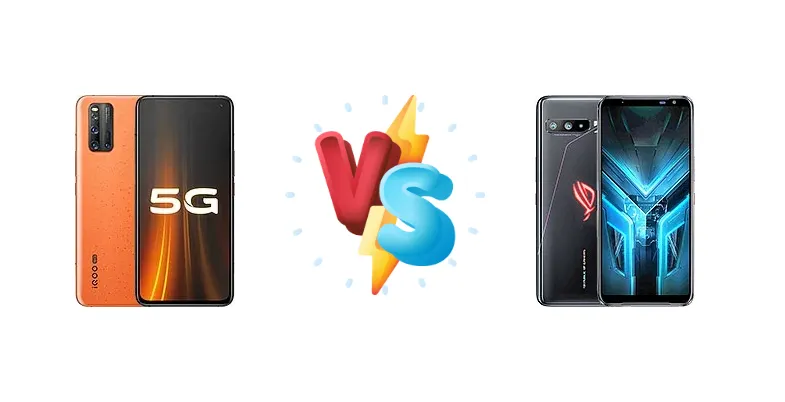
|
🏆 Quick Verdict
For the average user prioritizing raw gaming performance and a feature-rich experience, the Asus ROG Phone 3 emerges as the winner. Its Snapdragon 865+ chipset and superior cooling system provide a noticeable edge in sustained performance. However, the iQOO 3 5G offers excellent value and incredibly fast 55W charging, making it a compelling choice for budget-conscious gamers.
| PHONES | ||
|---|---|---|
| Phone Names | vivo iQOO 3 5G | Asus ROG Phone 3 |
| Network | ||
|---|---|---|
| 2G bands | GSM 850 / 900 / 1800 / 1900 | GSM 850 / 900 / 1800 / 1900 |
| 3G bands | HSDPA 850 / 900 / 1700(AWS) / 1900 / 2100 | HSDPA 800 / 850 / 900 / 1700(AWS) / 1800 / 1900 / 2100 - A version |
| 4G bands | 1, 2, 3, 4, 5, 7, 8, 12, 17, 18, 19, 20, 25, 26, 34, 38, 39, 40, 41 | 1, 2, 3, 4, 5, 7, 8, 12, 13, 17, 18, 19, 20, 25, 26, 28, 29, 30, 32, 34, 38, 39, 40, 41, 42, 48, 66, 71 - A version |
| 5G bands | 1, 3, 41, 77, 78, 79 SA/NSA - China | 1, 2, 3, 5, 28, 41, 66, 71, 77, 78, 79 SA/NSA - A version |
| Speed | HSPA, LTE, 5G (3.3 Gbps DL) | HSPA 42.2/5.76 Mbps, LTE (6CA) Cat20 2000/150 Mbps, 5G 4.4 Gbps DL |
| Technology | GSM / CDMA / HSPA / LTE / 5G | GSM / CDMA / HSPA / LTE / 5G |
| 41, 77, 78 - India | - | |
| Launch | ||
|---|---|---|
| Announced | 2020, February 25. Released 2020, March 04 | 2020, July 22. Released 2020, July 23 |
| Status | Discontinued | Discontinued |
| Body | ||
|---|---|---|
| Build | Glass front (Gorilla Glass 6), glass back (Gorilla Glass 6), aluminum frame | Glass front (Gorilla Glass 6), glass back (Gorilla Glass 3), aluminum frame |
| Dimensions | 158.5 x 74.9 x 9.2 mm (6.24 x 2.95 x 0.36 in) | 171 x 78 x 9.9 mm (6.73 x 3.07 x 0.39 in) |
| SIM | Nano-SIM + Nano-SIM | Nano-SIM + Nano-SIM |
| Weight | 214.5 g (7.58 oz) | 240 g (8.47 oz) |
| Display | ||
|---|---|---|
| Protection | Corning Gorilla Glass 6 | Corning Gorilla Glass 6 |
| Resolution | 1080 x 2400 pixels, 20:9 ratio (~409 ppi density) | 1080 x 2340 pixels, 19.5:9 ratio (~391 ppi density) |
| Size | 6.44 inches, 100.1 cm2 (~84.3% screen-to-body ratio) | 6.59 inches, 106.6 cm2 (~79.9% screen-to-body ratio) |
| Type | Super AMOLED, HDR10+, 800 nits (typ) | AMOLED, 1B colors, 144Hz, HDR10+, 650 nits (typ) |
| Platform | ||
|---|---|---|
| CPU | Octa-core (1x2.84 GHz Cortex-A77 & 3x2.42 GHz Cortex-A77 & 4x1.80 GHz Cortex-A55) | Octa-core (1x3.10 GHz Cortex-A77 & 3x2.42 GHz Cortex-A77 & 4x1.80 GHz Cortex-A55) |
| Chipset | Qualcomm SM8250 Snapdragon 865 5G (7 nm+) | Qualcomm SM8250 Snapdragon 865 5G+ (7 nm+) |
| GPU | Adreno 650 | Adreno 650 |
| OS | Android 10, iQOO UI 1.0 | Android 10, upgradable to Android 12, ROG UI |
| Memory | ||
|---|---|---|
| Card slot | No | No |
| Internal | 128GB 6GB RAM, 128GB 8GB RAM, 128GB 12GB RAM, 256GB 8GB RAM, 256GB 12GB RAM | 128GB 8GB RAM, 128GB 12GB RAM, 256GB 12GB RAM, 512GB 12GB RAM, 512GB 16GB RAM |
| UFS 3.1 | - | |
| Main Camera | ||
|---|---|---|
| Features | LED flash, HDR, panorama | LED flash, HDR, panorama |
| Quad | 48 MP, f/1.8, (wide), 1/2.0", 0.8µm, PDAF 13 MP, f/2.5, 50mm (telephoto), PDAF, 2x optical zoom 13 MP, f/2.2, 120˚, 16mm (ultrawide), AF Auxiliary lens | - |
| Triple | - | 64 MP, f/1.8, 26mm (wide), 1/1.73", 0.8µm, PDAF 13 MP, f/2.4, 11mm, 125˚ (ultrawide) 5 MP (macro) |
| Video | 4K@30/60fps, 1080p@30fps; gyro-EIS | 8K@30fps, 4K@30/60/120fps, 1080p@30/60/240fps, 720p@480fps; gyro-EIS |
| Selfie camera | ||
|---|---|---|
| Features | HDR | Panorama, HDR |
| Single | 16 MP, f/2.5, (wide) | 24 MP, f/2.0, 27mm (wide), 0.9µm |
| Video | 1080p@30fps | 1080p@30fps |
| Sound | ||
|---|---|---|
| 3.5mm jack | Yes | No |
| 35mm jack | Yes | No |
| Loudspeaker | Yes | Yes, with DTS:X stereo speakers (2 dedicated amplifiers) |
| 32-bit/192kHz audio | - | |
| Comms | ||
|---|---|---|
| Bluetooth | 5.1, A2DP, LE, aptX HD | 5.1, A2DP, LE, aptX HD, aptX Adaptive |
| NFC | Yes (market/region dependent) | Yes |
| Positioning | GPS, GLONASS, BDS, GALILEO | GPS (L1+L5), GLONASS, BDS, GALILEO, QZSS |
| Radio | No | No |
| USB | USB Type-C 2.0, OTG | USB Type-C 3.1 (side), USB Type-C 2.0 (bottom), OTG, accessory connector |
| WLAN | Wi-Fi 802.11 a/b/g/n/ac/6, dual-band, Wi-Fi Direct | Wi-Fi 802.11 a/b/g/n/ac/6, dual-band, Wi-Fi Direct |
| Features | ||
|---|---|---|
| Sensors | Fingerprint (under display, optical), accelerometer, gyro, proximity, compass | Fingerprint (under display, optical), accelerometer, gyro, proximity, compass |
| Battery | ||
|---|---|---|
| Charging | 55W wired, 50% in 15 min | 30W wired, PD3.0, QC4 10W reverse wired |
| Type | 4400 mAh | Li-Po 6000 mAh |
| Misc | ||
|---|---|---|
| Colors | Volcano Orange, Tornado Black, Quantum Silver | Black Glare |
| Models | V1955A, I1927, I1928 | ASUS_I003D, ZS661KS, I003DD, I003D |
| Price | About 480 EUR | About 650 EUR |
| SAR | 1.19 W/kg (head) 0.59 W/kg (body) | 0.74 W/kg (head) 1.50 W/kg (body) |
| Tests | ||
|---|---|---|
| Battery life | Endurance rating 118h | Endurance rating 120h |
| Camera | Photo / Video | Photo / Video |
| Display | Contrast ratio: Infinite (nominal) | Contrast ratio: Infinite (nominal) |
| Loudspeaker | -26.3 LUFS (Good) | -23.1 LUFS (Very good) |
| Performance | AnTuTu: 575601 (v8) GeekBench: 13325 (v4.4), 3402 (v5.1) GFXBench: 42fps (ES 3.1 onscreen) | AnTuTu: 621932 (v8) GeekBench: 13306 (v4.4), 3386 (v5.1) GFXBench: 48fps (ES 3.1 onscreen) |
vivo iQOO 3 5G
- Incredibly fast 55W charging
- Brighter display for outdoor visibility
- Excellent value for the performance offered
- Slightly less powerful processor than the ROG Phone 3
- Potentially more susceptible to thermal throttling
Asus ROG Phone 3
- More powerful Snapdragon 865+ processor
- Superior cooling system for sustained performance
- Reverse wireless charging capability
- Slower 30W charging
- Dimmer display compared to the iQOO 3 5G
- Higher price point
Display Comparison
Both phones feature displays with an infinite (nominal) contrast ratio, typical for OLED panels. However, the iQOO 3 5G boasts a significantly brighter panel at 848 nits measured, compared to the ROG Phone 3’s 719 nits. This translates to better visibility under direct sunlight. While both are excellent for gaming, the iQOO 3’s higher brightness provides a more comfortable viewing experience in bright environments. Neither specification details refresh rate, but both were common at 120Hz for this generation.
Camera Comparison
Both devices offer photo and video capabilities, but detailed camera specifications are lacking in the provided data. Given the ROG Phone 3’s positioning as a gaming phone, its camera is likely optimized for general use, while the iQOO 3 may prioritize image quality. Without sensor size or aperture information, a definitive comparison is impossible. It's reasonable to assume both phones offer competent camera performance for social media and casual photography, but neither is likely to compete with dedicated camera flagships.
Performance
The ROG Phone 3 gains a slight edge with its Snapdragon 865+ chipset, clocked at 3.10 GHz, versus the iQOO 3 5G’s Snapdragon 865 running at 2.84 GHz. While both utilize the same 7nm+ process, the ‘Plus’ variant offers a modest performance boost, particularly in sustained workloads. Both phones share the same CPU core configuration (1x Cortex-A77 @ 3.1/2.84 GHz, 3x Cortex-A77 @ 2.42 GHz, 4x Cortex-A55 @ 1.80 GHz). The ROG Phone 3’s more advanced cooling system is crucial for maintaining peak performance during extended gaming sessions, mitigating thermal throttling that could affect the iQOO 3.
Battery Life
Both phones exhibit excellent battery endurance, with the ROG Phone 3 edging out the iQOO 3 at 120 hours versus 118 hours. However, the iQOO 3 compensates with significantly faster charging – 55W wired, capable of reaching 50% charge in just 15 minutes. The ROG Phone 3’s 30W charging, while supporting PD3.0 and QC4 standards, is considerably slower. The ROG Phone 3 also offers 10W reverse wired charging, a feature absent on the iQOO 3. The iQOO 3’s faster charging is a major convenience factor for users who frequently need to top up their battery quickly.
Buying Guide
Buy the vivo iQOO 3 5G if you need a powerful gaming phone that doesn't break the bank, and prioritize incredibly fast charging speeds. It's ideal for users who want flagship-level performance without the premium price tag. Buy the Asus ROG Phone 3 if you prefer a no-compromise gaming experience with advanced features like AirTriggers, a higher-clocked processor, and a more robust cooling solution, and are willing to pay a premium for it.