
iQOO 15 vs Asus ROG Phone 8 Pro: A Deep Dive into Flagship Performance
| Phones Images | |||||
|---|---|---|---|---|---|
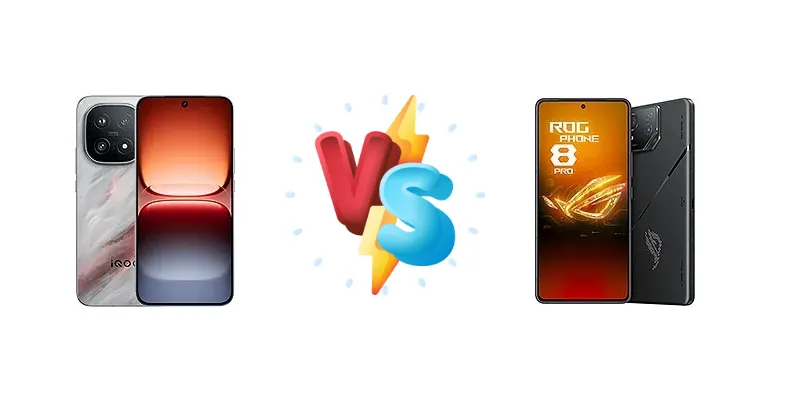
|
🏆 Quick Verdict
For the average user prioritizing longevity and a stunning display, the iQOO 15 is the clear winner. Its 21:47h active use battery score and 2933 nits peak brightness significantly outperform the ROG Phone 8 Pro. However, dedicated gamers will find the ROG Phone 8 Pro’s gaming-centric features more compelling.
| PHONES | ||
|---|---|---|
| Phone Names | vivo iQOO 15 | Asus ROG Phone 8 Pro |
| Network | ||
|---|---|---|
| 2G bands | GSM 850 / 900 / 1800 / 1900 | GSM 850 / 900 / 1800 / 1900 |
| 3G bands | HSDPA 800 / 850 / 900 / 1700(AWS) / 1900 / 2100 | HSDPA 850 / 900 / 1700(AWS) / 1800 / 1900 / 2100 - International |
| 4G bands | 1, 2, 3, 4, 5, 7, 8, 18, 19, 20, 26, 28, 34, 38, 39, 40, 41, 42, 43, 48, 66, 71 - International | 1, 2, 3, 4, 5, 7, 8, 12, 17, 18, 19, 20, 25, 26, 28, 32, 34, 38, 39, 40, 41, 42, 43, 48, 66 - International |
| 5G bands | 1, 2, 3, 5, 7, 8, 18, 20, 26, 28, 38, 40, 41, 48, 66, 71, 77, 78 SA/NSA - International | 1, 2, 3, 5, 7, 8, 12, 18, 20, 25, 26, 28, 38, 40, 41, 48, 66, 77, 78, 79 SA/NSA/Sub6 - International |
| Speed | HSPA, LTE, 5G | HSPA, LTE (Up to 7CA), 5G |
| Technology | GSM / HSPA / LTE / 5G | GSM / CDMA / HSPA / LTE / 5G |
| Launch | ||
|---|---|---|
| Announced | 2025, October 20 | 2024, January 08 |
| Status | Available. Released 2025, October 20 | Available. Released 2024, January 18 |
| Body | ||
|---|---|---|
| Build | Glass front, aluminum frame, fiber-reinforced plastic back or glass back | Glass front (Gorilla Glass Victus 2), glass back (Gorilla Glass), aluminum frame |
| Dimensions | 163.7 x 76.8 x 8.1 mm (6.44 x 3.02 x 0.32 in) | 163.8 x 76.8 x 8.9 mm (6.45 x 3.02 x 0.35 in) |
| SIM | · Nano-SIM + Nano-SIM + eSIM (max 2 at a time) - International· Nano-SIM + Nano-SIM - China | Nano-SIM + Nano-SIM |
| Weight | 215 g or 220 g (7.58 oz) | 225 g (7.94 oz) |
| Display | ||
|---|---|---|
| Protection | - | Corning Gorilla Glass Victus 2 |
| Resolution | 1440 x 3168 pixels (~508 ppi density) | 1080 x 2400 pixels, 20:9 ratio (~388 ppi density) |
| Size | 6.85 inches, 114.0 cm2 (~90.7% screen-to-body ratio) | 6.78 inches, 111.0 cm2 (~88.2% screen-to-body ratio) |
| Type | LTPO AMOLED, 1B colors, 144Hz, PWM, Dolby Vision, HDR10+, HDR Vivid, 1000 nits (typ), 2600 nits (HBM), 6000 nits (peak) | LTPO AMOLED, 1B colors, 165Hz, HDR10, 1600 nits (HBM), 2500 nits (peak) |
| Platform | ||
|---|---|---|
| CPU | Octa-core (2x4.6 GHz Oryon V3 Phoenix L + 6x3.62 GHz Oryon V3 Phoenix M) | Octa-core (1x3.3 GHz Cortex-X4 & 3x3.2 GHz Cortex-A720 & 2x3.0 GHz Cortex-A720 & 2x2.3 GHz Cortex-A520) |
| Chipset | Qualcomm SM8850-AC Snapdragon 8 Elite Gen 5 (3 nm) | Qualcomm SM8650-AB Snapdragon 8 Gen 3 (4 nm) |
| GPU | Adreno 840 | Adreno 750 |
| OS | Android 16, up to 5 major Android upgrades, OriginOS 6 | Android 14, up to 2 major Android upgrades |
| Memory | ||
|---|---|---|
| Card slot | No | No |
| Internal | 256GB 12GB RAM, 256GB 16GB RAM, 512GB 12GB RAM, 512GB 16GB RAM, 1TB 16GB RAM | 512GB 16GB RAM, 1TB 24GB RAM |
| Main Camera | ||
|---|---|---|
| Features | LED flash, HDR, panorama | LED flash, HDR, panorama |
| Triple | 50 MP, f/1.9, 24mm (wide), 1/1.56", 1.0µm, PDAF, OIS 50 MP, f/2.7, 85mm (periscope telephoto), 1/1.95", 0.8µm, PDAF, OIS, 3x optical zoom 50 MP, f/2.1, 15mm (ultrawide), 1/2.76", 0.64µm, AF | 50 MP, f/1.9, 24mm (wide), 1/1.56", 1.0µm, PDAF, gimbal OIS 32 MP, f/2.4, (telephoto), 1/3.2", 0.7µm, PDAF, OIS, 3x optical zoom 13 MP, f/2.2, 13mm, 120˚ (ultrawide) |
| Video | 8K@30fps, 4K@24/30/60fps, 1080p@30/60/120/240fps, gyro-EIS | 8K@24fps, 4K@30/60fps, 1080p@30/60/120/240fps, 720p@480fps; gyro-EIS, HDR10+ |
| Selfie camera | ||
|---|---|---|
| Features | HDR | Panorama, HDR |
| Single | 32 MP, f/2.2, 21mm (wide), 1/3.1", 0.7µm | 32 MP, f/2.5, 22mm (wide), 1/3.2", 0.7µm |
| Video | 4K@30/60fps, 1080p@30/60fps | 1080p@30fps |
| Sound | ||
|---|---|---|
| 35mm jack | No | Yes |
| Loudspeaker | Yes, with stereo speakers | Yes, with stereo speakers |
| Comms | ||
|---|---|---|
| Bluetooth | 6.0, A2DP, LE, aptX HD, aptX Adaptive, aptX Lossless, LHDC 5 | 5.4, A2DP, LE, aptX HD, aptX Adaptive, aptX Lossless |
| Infrared port | Yes | - |
| NFC | Yes | Yes |
| Positioning | GPS (L1+L5), GLONASS (G1), BDS (B1I+B1c+B2a), GALILEO (E1+E5a), QZSS (L1+L5) | GPS (L1+L5), BDS (B1I+B1c+B2a), GALILEO (E1+E5a), QZSS (L1+L5), NavIC (L5), GLONASS |
| Radio | No | No |
| USB | USB Type-C 3.2, OTG | USB Type-C (side), DisplayPort 1.4; USB Type-C (bottom), OTG |
| WLAN | Wi-Fi 802.11 a/b/g/n/ac/6/7, dual-band, Wi-Fi Direct | Wi-Fi 802.11 a/b/g/n/ac/6e/7, tri-band, Wi-Fi Direct |
| Features | ||
|---|---|---|
| Sensors | Fingerprint (under display, ultrasonic), accelerometer, gyro, proximity, compass | Fingerprint (under display, optical), accelerometer, gyro, proximity, compass |
| Battery | ||
|---|---|---|
| Charging | 100W wired, PPS, PD 40W wireless Bypass charging | 65W wired, PD3.0, PPS, QC5, 100% in 39 min - International 30W wired, PD3.0, PPS - India 15W wireless (Qi) 10W reverse wired |
| Type | Si/C Li-Ion 7000 mAh | 5500 mAh |
| Misc | ||
|---|---|---|
| Colors | Alpha, Legend, Gray, Green, Blue | Phantom Black |
| Models | I2501, V2505A | AI2401, AI2401_A, AI2401_D |
| Price | About 700 EUR | $ 1,157.98 / £ 1,693.75 / € 632.66 |
vivo iQOO 15
- Exceptional battery life (21:47h active use)
- Incredibly bright display (2933 nits)
- Powerful Snapdragon 8 Elite Gen 5 processor
- Camera details are currently unknown
- Gaming-specific features may be less extensive than the ROG Phone 8 Pro
Asus ROG Phone 8 Pro
- Gaming-focused features and optimizations
- Potentially superior camera system (based on brand history)
- Fast wired charging (65W international / 30W India)
- Significantly shorter battery life (14:43h active use)
- Dimmer display (1765 nits)
- Snapdragon 8 Gen 3 is less efficient than the 8 Elite Gen 5
Display Comparison
The iQOO 15’s display is a standout feature, achieving a measured peak brightness of 2933 nits, significantly exceeding the ROG Phone 8 Pro’s 1765 nits. This translates to superior visibility outdoors. While both likely employ AMOLED panels, the iQOO 15’s brightness advantage is substantial. We expect the iQOO 15 to have a higher contrast ratio as well. The ROG Phone 8 Pro, however, may benefit from Asus’s display calibration expertise, potentially offering more accurate colors out of the box, though this requires further testing. The iQOO 15’s brightness will be particularly beneficial for users consuming HDR content.
Camera Comparison
The provided data lacks detailed camera specifications for both devices. However, given the ROG Phone 8 Pro’s branding, we anticipate a more robust camera system geared towards both photo and video capture, potentially including features like 8K video recording and advanced image stabilization. The iQOO 15, while likely capable, may prioritize other features. Without sensor size or aperture information, it’s difficult to make a definitive judgment, but Asus typically invests heavily in camera technology for its ROG line.
Performance
The iQOO 15’s Qualcomm SM8850-AC Snapdragon 8 Elite Gen 5 (3nm) represents a leap in mobile silicon. Its Oryon V3 Phoenix cores, clocked up to 4.6 GHz, promise significant performance gains over the ROG Phone 8 Pro’s Snapdragon 8 Gen 3 (4nm). The 3nm process node of the iQOO 15’s chip should also result in improved thermal efficiency, potentially leading to sustained performance during demanding tasks. While the Snapdragon 8 Gen 3 is no slouch, the iQOO 15’s architecture suggests a clear advantage in raw processing power. The ROG Phone 8 Pro will likely compensate with optimized software and cooling solutions, but the iQOO 15 has a hardware advantage.
Battery Life
Battery life is where the iQOO 15 truly shines. Its active use score of 21:47h is a substantial improvement over the ROG Phone 8 Pro’s 14:43h. This difference is likely due to a combination of the more efficient Snapdragon 8 Elite Gen 5 and potentially a larger battery capacity (not specified). The iQOO 15 also boasts faster charging with 100W wired, 40W wireless, and bypass charging, compared to the ROG Phone 8 Pro’s 65W wired (international) / 30W (India), 15W wireless, and 10W reverse wired. The iQOO 15’s charging speed will significantly reduce downtime.
Buying Guide
Buy the vivo iQOO 15 if you need exceptional battery life, a brighter and more visible display in direct sunlight, and a balanced smartphone experience. Buy the Asus ROG Phone 8 Pro if you prioritize gaming performance, customizable gaming features, and are willing to trade battery life for a more focused gaming experience.