
iQOO 13 vs. ZTE nubia Z60 Ultra Leading: A Deep Dive into Flagship Performance
| Phones Images | |||||
|---|---|---|---|---|---|
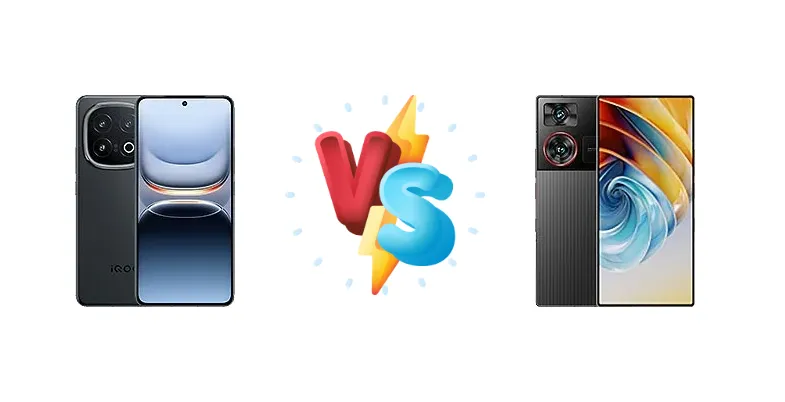
|
🏆 Quick Verdict
For the average user prioritizing all-day battery life and a brighter, more visible display, the vivo iQOO 13 emerges as the stronger choice. Its 18:03-hour active use score and 1804 nits peak brightness significantly outperform the nubia Z60 Ultra Leading, despite the latter’s newer chipset.
| PHONES | ||
|---|---|---|
| Phone Names | vivo iQOO 13 | ZTE nubia Z60 Ultra Leading |
| Network | ||
|---|---|---|
| 2G bands | GSM 850 / 900 / 1800 / 1900 | GSM 850 / 900 / 1800 / 1900 |
| 3G bands | HSDPA 800 / 850 / 900 / 1700(AWS) / 1900 / 2100 | HSDPA 850 / 900 / 1700(AWS) / 1900 / 2100 |
| 4G bands | 1, 2, 3, 4, 5, 7, 8, 18, 19, 20, 26, 28, 38, 40, 41, 42, 66 - International | 1, 2, 3, 4, 5, 7, 8, 12, 17, 18, 19, 20, 26, 28, 34, 38, 39, 40, 41, 66 - International |
| 5G bands | 1, 3, 5, 7, 8, 20, 28, 38, 40, 41, 77, 78 SA/NSA - International | 1, 2, 3, 5, 7, 8, 28, 38, 40, 41, 66, 77, 78 SA/NSA - International |
| Speed | HSPA, LTE, 5G | HSPA, LTE, 5G |
| Technology | GSM / HSPA / LTE / 5G | GSM / CDMA / HSPA / CDMA2000 / LTE / 5G |
| Launch | ||
|---|---|---|
| Announced | 2024, October 30 | 2024, July 23 |
| Status | Available. Released 2024, November 08 | Available. Released 2024, August 12 |
| Body | ||
|---|---|---|
| Build | Glass front, aluminum alloy frame, glass back or fiber-reinforced plastic back | Glass front, aluminum frame, glass back |
| Dimensions | 163.4 x 76.7 x 8 mm (6.43 x 3.02 x 0.31 in) | 164 x 76.4 x 8.8 mm (6.46 x 3.01 x 0.35 in) |
| SIM | Nano-SIM + Nano-SIM | Nano-SIM + Nano-SIM |
| Weight | 207 g or 213 g (7.30 oz) | 246 g (8.68 oz) |
| Display | ||
|---|---|---|
| Protection | Schott Xensation Alpha | - |
| Resolution | 1440 x 3168 pixels (~510 ppi density) | 1116 x 2480 pixels, 20:9 ratio (~400 ppi density) |
| Size | 6.82 inches, 113.0 cm2 (~90.2% screen-to-body ratio) | 6.8 inches, 111.6 cm2 (~89.1% screen-to-body ratio) |
| Type | LTPO AMOLED, 1B colors, 144Hz, 2592Hz PWM, HDR10+, 800 nits (typ), 1800 nits (HBM), 4500 nits (peak) | AMOLED, 1B colors, 120Hz, HDR10, 1500 nits (peak) |
| Platform | ||
|---|---|---|
| CPU | Octa-core (2x4.32 GHz Oryon V2 Phoenix L + 6x3.53 GHz Oryon V2 Phoenix M) | Octa-core (1x3.4 GHz Cortex-X4 & 3x3.2 GHz Cortex-A720 & 2x3.0 GHz Cortex-A720 & 2x2.3 GHz Cortex-A520) |
| Chipset | Qualcomm SM8750-AB Snapdragon 8 Elite (3 nm) | Qualcomm SM8650-AC Snapdragon 8 Gen 3 (4 nm) |
| GPU | Adreno 830 | Adreno 750 (1 GHz) |
| OS | Android 15, up to 4 major Android upgrades, Funtouch 15 (International), OriginOS 5 (China) | Android 14, MyOS 14 (International), MyOS 14.5 (China) |
| Memory | ||
|---|---|---|
| Card slot | No | No |
| Internal | 256GB 12GB RAM, 256GB 16GB RAM, 512GB 12GB RAM, 512GB 16GB RAM, 1TB 16GB RAM | 256GB 8GB RAM, 256GB 12GB RAM, 512GB 16GB RAM, 1TB 16GB RAM, 1TB 24GB RAM |
| Main Camera | ||
|---|---|---|
| Features | Color spectrum sensor, Dual-LED flash, HDR, panorama | Laser AF, color spectrum sensor, Ring-LED, dual-tone flash, panorama, HDR |
| Triple | 50 MP, f/1.9, 23mm (wide), 1/1.56", 1.0µm, PDAF, OIS 50 MP, f/1.9, 50mm (telephoto), 1/2.93", 0.6µm, PDAF, OIS, 2x optical zoom 50 MP, f/2.0, 15mm (ultrawide), 1/2.76", 0.64µm, AF | 50 MP, f/1.6, 35mm (standard), 1/1.56", 1.0µm, PDAF, OIS 64 MP, f/3.3, 85mm (periscope telephoto), 1/2.0", PDAF, OIS, 3.3x optical zoom (vs. 26mm cam) 50 MP, f/1.8, 18mm, 100˚ (ultrawide), 1/1.55", 1.0µm, PDAF, OIS |
| Video | 8K@30fps, 4K@24/30/60fps, 1080p@30/60/120/240fps, gyro-EIS | 8K@30fps, 4K@30/60/120fps, 1080p@30/60fps, gyro-EIS, HDR10, 10‑bit video |
| Selfie camera | ||
|---|---|---|
| Features | HDR | HDR |
| Single | 32 MP, f/2.5, 28mm (wide), 1/3.15", 0.7µm | 12 MP, under display |
| Video | 4K@30/60fps, 1080p@30/60fps | 1080p@30fps |
| Sound | ||
|---|---|---|
| 35mm jack | No | No |
| Loudspeaker | Yes, with stereo speakers | Yes, with stereo speakers |
| Comms | ||
|---|---|---|
| Bluetooth | 5.4, A2DP, LE, aptX HD, aptX Adaptive, aptX Lossless, LHDC 5 | 5.4, A2DP, LE, aptX HD, aptX Adaptive, aptX Lossless |
| Infrared port | Yes | Yes |
| NFC | Yes, 360˚ | Yes (market/region dependent) |
| Positioning | GPS (L1+L5), GLONASS (G1), BDS (B1I+B1c+B2a), GALILEO (E1+E5a), QZSS (L1+L5) | GPS (L1+L2+L5), GLONASS (G1+G5), BDS (B1I+B1C+B2a+B2b), GALILEO (E1+E5a), QZSS (L1+L5) |
| Radio | No | No |
| USB | USB Type-C 3.2, OTG | USB Type-C 3.1, OTG |
| WLAN | Wi-Fi 802.11 a/b/g/n/ac/6/7, dual-band, Wi-Fi Direct | Wi-Fi 802.11 a/b/g/n/ac/6e/7, dual-band, Wi-Fi Direct |
| Features | ||
|---|---|---|
| Sensors | Fingerprint (under display, ultrasonic), accelerometer, gyro, proximity, compass | Fingerprint (under display, optical), accelerometer, gyro, proximity, compass |
| Battery | ||
|---|---|---|
| Charging | 120W wired, PPS, 100% in 30 min | 80W wired, PD3.0, QC4 |
| Type | Market-dependent versions:· Si/C Li-Ion 6150 mAh (Global)· 6000 mAh (India only) | Li-Po 6000 mAh |
| Misc | ||
|---|---|---|
| Colors | Alpha (Black), Nardo Gray (Silver), White (BMW M branding), Ace Green | Black, Silver |
| Models | V2408A, I2401 | - |
| Price | About 590 EUR | About 730 EUR |
vivo iQOO 13
- Exceptional battery life (18:03h active use)
- Extremely bright display (1804 nits)
- Fast 120W charging with PPS
- Snapdragon 8 Elite is not the newest chipset
- Camera specs are currently unknown
ZTE nubia Z60 Ultra Leading
- Latest Snapdragon 8 Gen 3 processor
- Potentially improved peak performance
- Modern chipset architecture
- Shorter battery life (14:04h active use)
- Slower 80W charging
- Display brightness data unavailable
Display Comparison
The iQOO 13’s display shines with a measured peak brightness of 1804 nits, offering superior visibility in direct sunlight compared to the nubia Z60 Ultra Leading (brightness data unavailable). While both likely employ high refresh rate panels, the iQOO 13’s brightness advantage is a tangible benefit for outdoor users. The absence of detailed display specs for the nubia Z60 Ultra Leading, such as PWM dimming frequency, leaves questions about potential eye strain for sensitive users unanswered. We expect both to utilize LTPO technology for adaptive refresh rates, but the iQOO 13’s brightness is a clear win.
Camera Comparison
Without detailed camera specifications for either device, a direct comparison is limited. However, given the flagship positioning, both are expected to feature multi-camera systems with optical image stabilization (OIS). The absence of sensor size information prevents a meaningful assessment of low-light performance. We can assume both will offer capable image processing, but the iQOO 13’s brand reputation suggests a focus on vibrant, social media-ready images, while nubia often leans towards a more natural color profile. The inclusion of a 2MP macro camera on either device is likely a marketing feature with limited practical benefit.
Performance
The iQOO 13’s Snapdragon 8 Elite (SM8750-AB) utilizes a unique Oryon V2 Phoenix architecture, featuring 2x 4.32 GHz prime cores and 6x 3.53 GHz performance cores. This contrasts with the nubia Z60 Ultra Leading’s Snapdragon 8 Gen 3 (SM8650-AC) with its 1x 3.4 GHz Cortex-X4, 3x 3.2 GHz Cortex-A720, 2x 3.0 GHz Cortex-A720, and 2x 2.3 GHz Cortex-A520 configuration. While the Gen 3 is newer, the Oryon cores in the 8 Elite are designed for sustained performance, potentially mitigating throttling during extended gaming sessions. The 3nm process of the 8 Elite also contributes to improved thermal efficiency. The nubia Z60 Ultra Leading benefits from the architectural improvements of the Gen 3, but the iQOO 13’s core configuration and process node suggest a more consistent performance profile.
Battery Life
The iQOO 13’s active use score of 18:03 hours significantly surpasses the nubia Z60 Ultra Leading’s 14:04 hours. This difference is substantial and highlights the iQOO 13’s superior battery endurance. The iQOO 13 also boasts 120W wired charging with PPS, achieving a full charge in 30 minutes, while the nubia Z60 Ultra Leading’s 80W charging (PD3.0, QC4) is slower. The faster charging speed and longer battery life of the iQOO 13 make it the clear winner for users who prioritize minimizing downtime.
Buying Guide
Buy the vivo iQOO 13 if you need exceptional battery life for demanding mobile use, value a vibrant and exceptionally bright display for outdoor visibility, and prioritize sustained gaming performance over raw benchmark scores. Buy the ZTE nubia Z60 Ultra Leading if you absolutely require the latest Snapdragon processor for future-proofing, and are willing to trade some battery life for the potential of slightly higher peak performance in short bursts.