
iQOO 13 vs Redmi K70 Pro: A Deep Dive into Flagship Performance and Value
| Phones Images | |||||
|---|---|---|---|---|---|
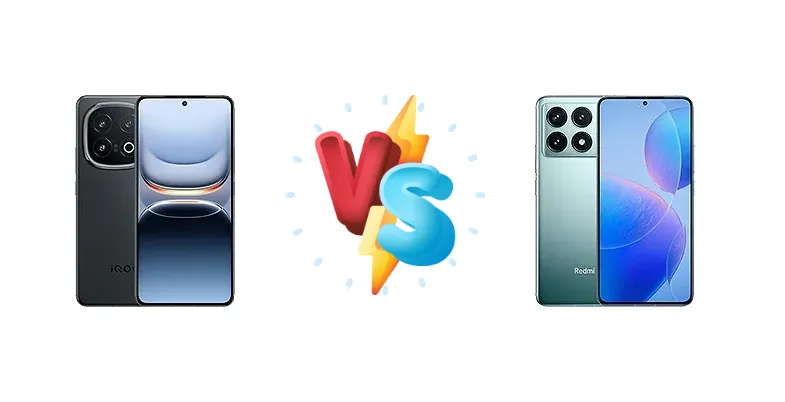
|
🏆 Quick Verdict
For the average user prioritizing sustained performance and battery life, the iQOO 13 emerges as the winner. Its Snapdragon 8 Elite, coupled with an impressive 18:03-hour active use score, provides a more consistent experience. However, the Redmi K70 Pro’s significantly faster charging is a compelling advantage for those constantly on the go.
| PHONES | ||
|---|---|---|
| Phone Names | vivo iQOO 13 | Xiaomi Redmi K70 Pro |
| Network | ||
|---|---|---|
| 2G bands | GSM 850 / 900 / 1800 / 1900 | GSM 850 / 900 / 1800 / 1900 |
| 3G bands | HSDPA 800 / 850 / 900 / 1700(AWS) / 1900 / 2100 | HSDPA 800 / 850 / 900 / 1700(AWS) / 2100 |
| 4G bands | 1, 2, 3, 4, 5, 7, 8, 18, 19, 20, 26, 28, 38, 40, 41, 42, 66 - International | 1, 3, 4, 5, 8, 18, 19, 26, 28, 34, 38, 39, 40, 41, 42, 48, 66 |
| 5G bands | 1, 3, 5, 7, 8, 20, 28, 38, 40, 41, 77, 78 SA/NSA - International | 1, 3, 5, 8, 28, 38, 41, 48, 66, 77, 78 SA/NSA |
| Speed | HSPA, LTE, 5G | HSPA, LTE, 5G |
| Technology | GSM / HSPA / LTE / 5G | GSM / CDMA / HSPA / CDMA2000 / LTE / 5G |
| Launch | ||
|---|---|---|
| Announced | 2024, October 30 | 2023, November 29 |
| Status | Available. Released 2024, November 08 | Available. Released 2023, November 29 |
| Body | ||
|---|---|---|
| Build | Glass front, aluminum alloy frame, glass back or fiber-reinforced plastic back | - |
| Dimensions | 163.4 x 76.7 x 8 mm (6.43 x 3.02 x 0.31 in) | 160.9 x 75 x 8.2 mm (6.33 x 2.95 x 0.32 in) |
| SIM | Nano-SIM + Nano-SIM | Nano-SIM + Nano-SIM |
| Weight | 207 g or 213 g (7.30 oz) | 209 g (7.37 oz) |
| Display | ||
|---|---|---|
| Protection | Schott Xensation Alpha | - |
| Resolution | 1440 x 3168 pixels (~510 ppi density) | 1440 x 3200 pixels, 20:9 ratio (~526 ppi density) |
| Size | 6.82 inches, 113.0 cm2 (~90.2% screen-to-body ratio) | 6.67 inches, 107.4 cm2 (~89.0% screen-to-body ratio) |
| Type | LTPO AMOLED, 1B colors, 144Hz, 2592Hz PWM, HDR10+, 800 nits (typ), 1800 nits (HBM), 4500 nits (peak) | OLED, 68B colors, 120Hz, Dolby Vision, HDR10+, 4000 nits (peak) |
| Platform | ||
|---|---|---|
| CPU | Octa-core (2x4.32 GHz Oryon V2 Phoenix L + 6x3.53 GHz Oryon V2 Phoenix M) | Octa-core (1x3.3 GHz Cortex-X4 & 3x3.2 GHz Cortex-A720 & 2x3.0 GHz Cortex-A720 & 2x2.3 GHz Cortex-A520) |
| Chipset | Qualcomm SM8750-AB Snapdragon 8 Elite (3 nm) | Qualcomm SM8650-AB Snapdragon 8 Gen 3 (4 nm) |
| GPU | Adreno 830 | Adreno 750 |
| OS | Android 15, up to 4 major Android upgrades, Funtouch 15 (International), OriginOS 5 (China) | Android 14, HyperOS |
| Memory | ||
|---|---|---|
| Card slot | No | No |
| Internal | 256GB 12GB RAM, 256GB 16GB RAM, 512GB 12GB RAM, 512GB 16GB RAM, 1TB 16GB RAM | 256GB 12GB RAM, 256GB 16GB RAM, 512GB 12GB RAM, 512GB 16GB RAM, 1TB 24GB RAM |
| Main Camera | ||
|---|---|---|
| Features | Color spectrum sensor, Dual-LED flash, HDR, panorama | Color spectrum sensor, LED flash, HDR, panorama |
| Triple | 50 MP, f/1.9, 23mm (wide), 1/1.56", 1.0µm, PDAF, OIS 50 MP, f/1.9, 50mm (telephoto), 1/2.93", 0.6µm, PDAF, OIS, 2x optical zoom 50 MP, f/2.0, 15mm (ultrawide), 1/2.76", 0.64µm, AF | 50 MP, f/1.6, (wide), 1/1.55", 1.0µm, PDAF, OIS 50 MP, (telephoto), PDAF, 2x optical zoom 12 MP, (ultrawide) |
| Video | 8K@30fps, 4K@24/30/60fps, 1080p@30/60/120/240fps, gyro-EIS | 8K@24fps, 4K@24/30/60fps, 1080p@30/60/120/240/960fps, 720p@1920fps, gyro-EIS |
| Selfie camera | ||
|---|---|---|
| Features | HDR | HDR |
| Single | 32 MP, f/2.5, 28mm (wide), 1/3.15", 0.7µm | 16 MP, (wide) |
| Video | 4K@30/60fps, 1080p@30/60fps | 1080p@30/60fps, gyro-EIS |
| Sound | ||
|---|---|---|
| 35mm jack | No | No |
| Loudspeaker | Yes, with stereo speakers | Yes, with stereo speakers |
| Comms | ||
|---|---|---|
| Bluetooth | 5.4, A2DP, LE, aptX HD, aptX Adaptive, aptX Lossless, LHDC 5 | 5.4, A2DP, LE, aptX HD, aptX Adaptive, aptX Lossless |
| Infrared port | Yes | Yes |
| NFC | Yes, 360˚ | Yes |
| Positioning | GPS (L1+L5), GLONASS (G1), BDS (B1I+B1c+B2a), GALILEO (E1+E5a), QZSS (L1+L5) | GPS (L1+L5), GLONASS (G1), BDS (B1I+B1c+B2a), GALILEO (E1+E5a), QZSS (L1+L5), NavIC (L5) |
| Radio | No | No |
| USB | USB Type-C 3.2, OTG | USB Type-C, OTG |
| WLAN | Wi-Fi 802.11 a/b/g/n/ac/6/7, dual-band, Wi-Fi Direct | Wi-Fi 802.11 a/b/g/n/ac/6e/7, dual-band, Wi-Fi Direct |
| Features | ||
|---|---|---|
| Sensors | Fingerprint (under display, ultrasonic), accelerometer, gyro, proximity, compass | Fingerprint (under display, optical), accelerometer, proximity, gyro, compass |
| Battery | ||
|---|---|---|
| Charging | 120W wired, PPS, 100% in 30 min | 120W wired, PD3.0, QC3+, 100% in 18 min |
| Type | Market-dependent versions:· Si/C Li-Ion 6150 mAh (Global)· 6000 mAh (India only) | Li-Po 5000 mAh |
| Misc | ||
|---|---|---|
| Colors | Alpha (Black), Nardo Gray (Silver), White (BMW M branding), Ace Green | Black, Silver, Blue/Green, Lamborgini Green, Lamborgini Yellow |
| Models | V2408A, I2401 | 23117RK66C |
| Price | About 590 EUR | About 430 EUR |
vivo iQOO 13
- Superior sustained performance due to Snapdragon 8 Elite and 3nm process
- Excellent battery life with 18:03 hours of active use
- Higher peak display brightness for better outdoor visibility
- Slower charging speed (30 minutes to 100%)
- Camera specifications are unknown
Xiaomi Redmi K70 Pro
- Blazing-fast 18-minute charging with PD3.0 and QC3+ support
- Proven Snapdragon 8 Gen 3 performance
- Likely competitive camera system (based on brand reputation)
- Potentially lower sustained performance due to 4nm process
- Battery life is unknown, but likely less than iQOO 13
Display Comparison
The iQOO 13 boasts a display capable of reaching a measured 1804 nits of peak brightness, ensuring excellent visibility even in direct sunlight. While the Redmi K70 Pro’s display specifications aren’t provided, Xiaomi typically employs high-quality AMOLED panels. The iQOO 13’s brightness advantage is significant, potentially offering a superior outdoor viewing experience. Without knowing the K70 Pro’s panel technology (LTPO or not), it’s difficult to assess power efficiency differences, but the iQOO 13’s brightness is a clear win.
Camera Comparison
Unfortunately, detailed camera specifications are absent for both devices. Given their flagship positioning, both are expected to feature capable camera systems. However, without sensor size, aperture, or OIS details, a meaningful comparison is impossible. We can assume both will offer multi-camera setups, but the image processing style – whether leaning towards natural colors or more saturated tones – remains unknown. The absence of information prevents us from assessing low-light performance or video capabilities.
Performance
This is where the core battle lies. The iQOO 13’s Snapdragon 8 Elite (SM8750-AB) utilizes a unique Oryon V2 Phoenix core configuration (2x4.32 GHz + 6x3.53 GHz) built on a 3nm process. This contrasts with the Redmi K70 Pro’s Snapdragon 8 Gen 3 (SM8650-AB) featuring a more traditional octa-core setup (1x3.3 GHz Cortex-X4 + 3x3.2 GHz Cortex-A720 + 2x3.0 GHz Cortex-A720 + 2x2.3 GHz Cortex-A520) fabricated on a 4nm node. The 3nm process of the Snapdragon 8 Elite *should* translate to improved thermal efficiency and potentially higher sustained performance, mitigating throttling during prolonged intensive tasks. The Oryon cores are also designed for higher single-core performance, which benefits responsiveness and app loading times. However, the Snapdragon 8 Gen 3 is a proven performer, and its optimizations are well-established.
Battery Life
The iQOO 13 delivers an impressive 18:03 hours of active use, indicating excellent battery life. The Redmi K70 Pro’s battery capacity is unknown, but its 120W wired charging with PD3.0 and QC3+ support is significantly faster than the iQOO 13’s 120W PPS charging, achieving a full charge in just 18 minutes compared to the iQOO 13’s 30 minutes. This difference is substantial for users who frequently need to top up their battery quickly. While the iQOO 13 offers longer overall runtime, the K70 Pro prioritizes charging speed.
Buying Guide
Buy the vivo iQOO 13 if you need a phone that can consistently deliver peak performance during extended gaming sessions and daily use, and value long-lasting battery life. Buy the Xiaomi Redmi K70 Pro if you prioritize the absolute fastest charging speeds and are willing to trade a bit of sustained performance for that convenience. Both are excellent choices, but cater to different priorities.