
iQOO 13 vs Samsung Galaxy S24 Ultra: A Deep Dive into Performance and Value
| Phones Images | |||||
|---|---|---|---|---|---|
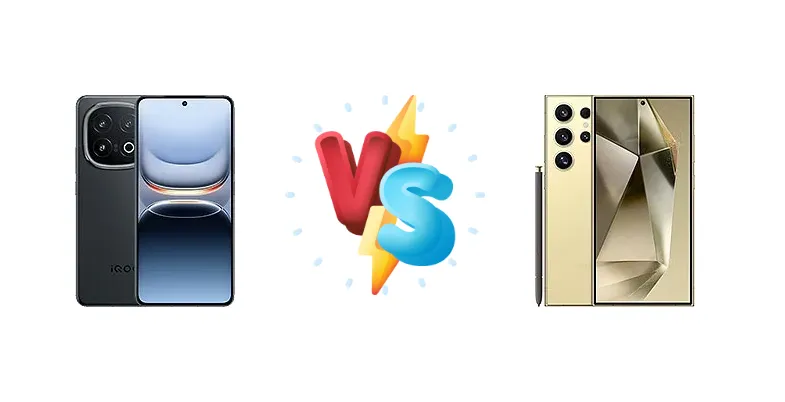
|
🏆 Quick Verdict
For the power user prioritizing raw speed and incredibly fast charging, the iQOO 13 emerges as the winner. Its Snapdragon 8 Elite and 120W charging significantly outperform the S24 Ultra in these areas. However, the Galaxy S24 Ultra’s superior camera system and broader ecosystem make it the better choice for mainstream users.
| PHONES | ||
|---|---|---|
| Phone Names | vivo iQOO 13 | Samsung Galaxy S24 Ultra |
| Network | ||
|---|---|---|
| 2G bands | GSM 850 / 900 / 1800 / 1900 | GSM 850 / 900 / 1800 / 1900 |
| 3G bands | HSDPA 800 / 850 / 900 / 1700(AWS) / 1900 / 2100 | HSDPA 850 / 900 / 1700(AWS) / 1900 / 2100 |
| 4G bands | 1, 2, 3, 4, 5, 7, 8, 18, 19, 20, 26, 28, 38, 40, 41, 42, 66 - International | 1, 2, 3, 4, 5, 7, 8, 12, 13, 17, 18, 19, 20, 25, 26, 28, 32, 38, 39, 40, 41, 66 - International |
| 5G bands | 1, 3, 5, 7, 8, 20, 28, 38, 40, 41, 77, 78 SA/NSA - International | 1, 2, 3, 5, 7, 8, 12, 20, 25, 26, 28, 38, 40, 41, 66, 75, 77, 78 SA/NSA/Sub6 - International |
| Speed | HSPA, LTE, 5G | HSPA, LTE (up to 7CA), 5G |
| Technology | GSM / HSPA / LTE / 5G | GSM / CDMA / HSPA / EVDO / LTE / 5G |
| Launch | ||
|---|---|---|
| Announced | 2024, October 30 | 2024, January 17 |
| Status | Available. Released 2024, November 08 | Available. Released 2024, January 24 |
| Body | ||
|---|---|---|
| Build | Glass front, aluminum alloy frame, glass back or fiber-reinforced plastic back | Glass front (Corning Gorilla Armor), glass back (Corning Gorilla Armor), titanium frame (grade 2) |
| Dimensions | 163.4 x 76.7 x 8 mm (6.43 x 3.02 x 0.31 in) | 162.3 x 79 x 8.6 mm (6.39 x 3.11 x 0.34 in) |
| SIM | Nano-SIM + Nano-SIM | · Nano-SIM + Nano-SIM + eSIM + eSIM (max 2 at a time) - INT· Nano-SIM + eSIM + eSIM (max 2 at a time) - USA· Nano-SIM + Nano-SIM - CN |
| Weight | 207 g or 213 g (7.30 oz) | 232 g or 233 g (8.18 oz) |
| Display | ||
|---|---|---|
| Protection | Schott Xensation Alpha | Corning Gorilla Armor |
| Resolution | 1440 x 3168 pixels (~510 ppi density) | 1440 x 3120 pixels, 19.5:9 ratio (~505 ppi density) |
| Size | 6.82 inches, 113.0 cm2 (~90.2% screen-to-body ratio) | 6.8 inches, 113.5 cm2 (~88.5% screen-to-body ratio) |
| Type | LTPO AMOLED, 1B colors, 144Hz, 2592Hz PWM, HDR10+, 800 nits (typ), 1800 nits (HBM), 4500 nits (peak) | Dynamic LTPO AMOLED 2X, 120Hz, HDR10+, 2600 nits (peak) |
| Platform | ||
|---|---|---|
| CPU | Octa-core (2x4.32 GHz Oryon V2 Phoenix L + 6x3.53 GHz Oryon V2 Phoenix M) | 8-core (1x3.39GHz Cortex-X4 & 3x3.1GHz Cortex-A720 & 2x2.9GHz Cortex-A720 & 2x2.2GHz Cortex-A520) |
| Chipset | Qualcomm SM8750-AB Snapdragon 8 Elite (3 nm) | Qualcomm SM8650-AC Snapdragon 8 Gen 3 (4 nm) |
| GPU | Adreno 830 | Adreno 750 (1 GHz) |
| OS | Android 15, up to 4 major Android upgrades, Funtouch 15 (International), OriginOS 5 (China) | Android 14, up to 7 major Android upgrades, One UI 8.0 |
| Memory | ||
|---|---|---|
| Card slot | No | No |
| Internal | 256GB 12GB RAM, 256GB 16GB RAM, 512GB 12GB RAM, 512GB 16GB RAM, 1TB 16GB RAM | 256GB 12GB RAM, 512GB 12GB RAM, 1TB 12GB RAM |
| Main Camera | ||
|---|---|---|
| Features | Color spectrum sensor, Dual-LED flash, HDR, panorama | Laser AF, LED flash, auto-HDR, panorama |
| Quad | - | 200 MP, f/1.7, 24mm (wide), 1/1.3", 0.6µm, multi-directional PDAF, OIS 10 MP, f/2.4, 67mm (telephoto), 1/3.52", 1.12µm, PDAF, OIS, 3x optical zoom 50 MP, f/3.4, 111mm (periscope telephoto), 1/2.52", 0.7µm, PDAF, OIS, 5x optical zoom 12 MP, f/2.2, 13mm, 120˚ (ultrawide), 1/2.55", 1.4µm, dual pixel PDAF, Super Steady video |
| Triple | 50 MP, f/1.9, 23mm (wide), 1/1.56", 1.0µm, PDAF, OIS 50 MP, f/1.9, 50mm (telephoto), 1/2.93", 0.6µm, PDAF, OIS, 2x optical zoom 50 MP, f/2.0, 15mm (ultrawide), 1/2.76", 0.64µm, AF | - |
| Video | 8K@30fps, 4K@24/30/60fps, 1080p@30/60/120/240fps, gyro-EIS | 8K@24/30fps, 4K@30/60/120fps, 1080p@30/60/120/240fps, HDR10+, stereo sound rec., gyro-EIS |
| Selfie camera | ||
|---|---|---|
| Features | HDR | HDR, HDR10+ |
| Single | 32 MP, f/2.5, 28mm (wide), 1/3.15", 0.7µm | 12 MP, f/2.2, 26mm (wide), 1/3.2", 1.12µm, dual pixel PDAF |
| Video | 4K@30/60fps, 1080p@30/60fps | 4K@30/60fps, 1080p@30fps |
| Sound | ||
|---|---|---|
| 35mm jack | No | No |
| Loudspeaker | Yes, with stereo speakers | Yes, with stereo speakers |
| Comms | ||
|---|---|---|
| Bluetooth | 5.4, A2DP, LE, aptX HD, aptX Adaptive, aptX Lossless, LHDC 5 | 5.3, A2DP, LE |
| Infrared port | Yes | - |
| NFC | Yes, 360˚ | Yes |
| Positioning | GPS (L1+L5), GLONASS (G1), BDS (B1I+B1c+B2a), GALILEO (E1+E5a), QZSS (L1+L5) | GPS, GLONASS, BDS, GALILEO, QZSS |
| Radio | No | No |
| USB | USB Type-C 3.2, OTG | USB Type-C 3.2, DisplayPort 1.2, OTG |
| WLAN | Wi-Fi 802.11 a/b/g/n/ac/6/7, dual-band, Wi-Fi Direct | Wi-Fi 802.11 a/b/g/n/ac/6e/7, tri-band, Wi-Fi Direct |
| Features | ||
|---|---|---|
| Sensors | Fingerprint (under display, ultrasonic), accelerometer, gyro, proximity, compass | Fingerprint (under display, ultrasonic), accelerometer, gyro, proximity, compass, barometer |
| Battery | ||
|---|---|---|
| Charging | 120W wired, PPS, 100% in 30 min | 45W wired, PD3.0, 65% in 30 min 15W wireless (Qi) 4.5W reverse wireless |
| Type | Market-dependent versions:· Si/C Li-Ion 6150 mAh (Global)· 6000 mAh (India only) | Li-Ion 5000 mAh |
| Misc | ||
|---|---|---|
| Colors | Alpha (Black), Nardo Gray (Silver), White (BMW M branding), Ace Green | Titanium Black, Titanium Gray, Titanium Violet, Titanium Yellow, Titanium Blue, Titanium Green, Titanium Orange |
| Models | V2408A, I2401 | SM-S928B, SM-S928B/DS, SM-S928U, SM-S928U1, SM-S928W, SM-S928N, SM-S9280, SM-S928E, SM-S928E/DS |
| Price | About 590 EUR | $ 514.94 / C$ 929.99 / £ 630.00 / € 658.53 / ₹ 84,999 |
| SAR | - | 1.26 W/kg (head) 0.62 W/kg (body) |
| SAR EU | - | 1.06 W/kg (head) 1.30 W/kg (body) |
vivo iQOO 13
- Blazing-fast 120W charging
- Potentially superior sustained CPU performance with Snapdragon 8 Elite
- Longer battery life in active use
- Camera specs unknown, potentially less versatile
- Software ecosystem less mature than Samsung's
Samsung Galaxy S24 Ultra
- Versatile and high-quality camera system
- Polished software experience with long-term updates
- Seamless integration with Samsung ecosystem
- Slower charging speed (45W)
- Shorter battery life in active use
- Potentially more thermal throttling under sustained load
Display Comparison
The iQOO 13 boasts a peak brightness of 1804 nits, exceeding the Galaxy S24 Ultra’s 1447 nits. This translates to better visibility in direct sunlight. While both likely employ LTPO technology for adaptive refresh rates, the iQOO 13’s higher peak brightness is a clear advantage for outdoor use. The S24 Ultra’s display is known for its color accuracy, but the iQOO 13’s brightness could compensate for any minor color differences for most users.
Camera Comparison
The context data for the S24 Ultra highlights its camera capabilities, but lacks specifics. Samsung typically excels in computational photography and video recording. The iQOO 13’s camera specs are not provided, making a direct comparison difficult. However, given iQOO’s focus on performance, it’s likely the camera prioritizes speed and responsiveness over advanced features like periscope zoom. The S24 Ultra’s likely larger sensor and more sophisticated image processing will likely result in superior image quality, especially in low-light conditions.
Performance
The iQOO 13’s Qualcomm SM8750-AB Snapdragon 8 Elite (3nm) chipset, with its Oryon V2 Phoenix cores (2x4.32 GHz + 6x3.53 GHz), is architecturally distinct from the S24 Ultra’s Snapdragon 8 Gen 3 (4nm). The Oryon cores, designed by Qualcomm, are expected to deliver superior sustained performance compared to the Cortex-based cores in the Gen 3, potentially leading to less thermal throttling during extended gaming sessions. The 3nm process node of the Snapdragon 8 Elite further enhances efficiency. However, the S24 Ultra’s Gen 3 benefits from optimizations across the Android ecosystem. The iQOO 13’s architecture suggests a focus on raw CPU power, while the S24 Ultra prioritizes balanced performance and efficiency.
Battery Life
The iQOO 13 achieves an impressive 18:03h active use score, significantly outperforming the Galaxy S24 Ultra’s 13:49h. This suggests a more efficient chipset or larger battery capacity (though capacity isn't specified). Crucially, the iQOO 13’s 120W wired charging fully charges the device in just 30 minutes, a massive advantage over the S24 Ultra’s 45W charging, which only reaches 65% in the same timeframe. The S24 Ultra offers 15W wireless and 4.5W reverse wireless charging, features absent from the iQOO 13’s specifications.
Buying Guide
Buy the vivo iQOO 13 if you need uncompromising performance for gaming and demanding tasks, and value the convenience of incredibly fast charging. You're willing to potentially sacrifice some camera versatility and software features for this focused experience. Buy the Samsung Galaxy S24 Ultra if you prioritize a versatile camera system, a polished software experience with long-term updates, and seamless integration with the Samsung ecosystem. You're willing to pay a premium for these features and don't mind slightly slower charging.