
iQOO 13 vs OnePlus 12R: A Head-to-Head Battle of Snapdragon Power
| Phones Images | |||||
|---|---|---|---|---|---|
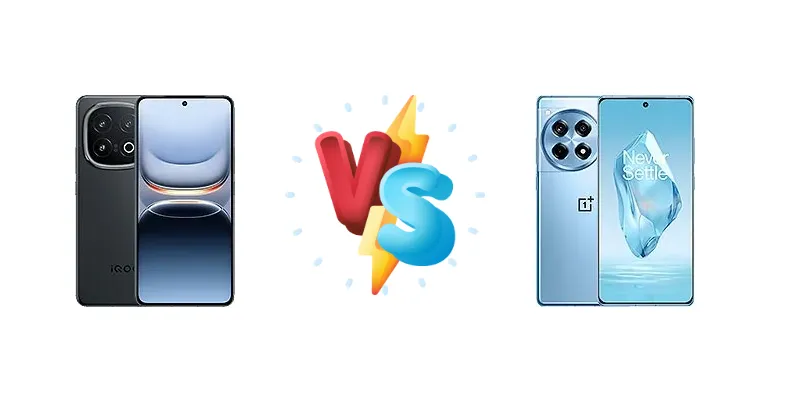
|
🏆 Quick Verdict
For users prioritizing raw performance and display brightness, the iQOO 13 emerges as the winner. Its Snapdragon 8 Elite and significantly brighter display justify the price premium. However, the OnePlus 12R offers excellent value, delivering a strong experience with impressive battery life at a more accessible price point.
| PHONES | ||
|---|---|---|
| Phone Names | vivo iQOO 13 | OnePlus 12R |
| Network | ||
|---|---|---|
| 2G bands | GSM 850 / 900 / 1800 / 1900 | GSM 850 / 900 / 1800 / 1900 |
| 3G bands | HSDPA 800 / 850 / 900 / 1700(AWS) / 1900 / 2100 | HSDPA 850 / 900 / 1700(AWS) / 1900 / 2100 |
| 4G bands | 1, 2, 3, 4, 5, 7, 8, 18, 19, 20, 26, 28, 38, 40, 41, 42, 66 - International | 1, 2, 3, 4, 5, 7, 8, 12, 17, 18, 19, 20, 26, 28, 32, 38, 39, 40, 41, 66 |
| 5G bands | 1, 3, 5, 7, 8, 20, 28, 38, 40, 41, 77, 78 SA/NSA - International | 1, 2, 3, 5, 7, 8, 12, 20, 28, 38, 40, 41, 66, 77, 78 SA/NSA |
| Speed | HSPA, LTE, 5G | HSPA, LTE, 5G |
| Technology | GSM / HSPA / LTE / 5G | GSM / CDMA / HSPA / LTE / 5G |
| Launch | ||
|---|---|---|
| Announced | 2024, October 30 | 2024, January 23 |
| Status | Available. Released 2024, November 08 | Available. Released 2024, February 06 |
| Body | ||
|---|---|---|
| Build | Glass front, aluminum alloy frame, glass back or fiber-reinforced plastic back | Glass front (Gorilla Glass Victus 2), aluminum frame, glass back |
| Dimensions | 163.4 x 76.7 x 8 mm (6.43 x 3.02 x 0.31 in) | 163.3 x 75.3 x 8.8 mm (6.43 x 2.96 x 0.35 in) |
| SIM | Nano-SIM + Nano-SIM | · Nano-SIM + Nano-SIM + eSIM (max 2 at a time)· Nano-SIM + Nano-SIM |
| Weight | 207 g or 213 g (7.30 oz) | 207 g (7.30 oz) |
| Display | ||
|---|---|---|
| Protection | Schott Xensation Alpha | Corning Gorilla Glass Victus 2 |
| Resolution | 1440 x 3168 pixels (~510 ppi density) | 1264 x 2780 pixels (~450 ppi density) |
| Size | 6.82 inches, 113.0 cm2 (~90.2% screen-to-body ratio) | 6.78 inches, 111.7 cm2 (~90.9% screen-to-body ratio) |
| Type | LTPO AMOLED, 1B colors, 144Hz, 2592Hz PWM, HDR10+, 800 nits (typ), 1800 nits (HBM), 4500 nits (peak) | LTPO4 AMOLED, 1B colors, 120Hz, HDR10+, Dolby Vision, 1600 nits (HBM), 4500 nits (peak) |
| Platform | ||
|---|---|---|
| CPU | Octa-core (2x4.32 GHz Oryon V2 Phoenix L + 6x3.53 GHz Oryon V2 Phoenix M) | Octa-core (1x3.2 GHz Cortex-X3 & 2x2.8 GHz Cortex-A715 & 2x2.8 GHz Cortex-A710 & 3x2.0 GHz Cortex-A510) |
| Chipset | Qualcomm SM8750-AB Snapdragon 8 Elite (3 nm) | Qualcomm SM8550-AB Snapdragon 8 Gen 2 (4 nm) |
| GPU | Adreno 830 | Adreno 740 |
| OS | Android 15, up to 4 major Android upgrades, Funtouch 15 (International), OriginOS 5 (China) | Android 14, up to 3 major Android upgrades, OxygenOS 15 |
| Memory | ||
|---|---|---|
| Card slot | No | No |
| Internal | 256GB 12GB RAM, 256GB 16GB RAM, 512GB 12GB RAM, 512GB 16GB RAM, 1TB 16GB RAM | 128GB 8GB RAM, 256GB 8GB RAM, 256GB 12GB RAM, 256GB 16GB RAM |
| Main Camera | ||
|---|---|---|
| Features | Color spectrum sensor, Dual-LED flash, HDR, panorama | Laser AF, color spectrum sensor, LED flash, HDR, panorama |
| Triple | 50 MP, f/1.9, 23mm (wide), 1/1.56", 1.0µm, PDAF, OIS 50 MP, f/1.9, 50mm (telephoto), 1/2.93", 0.6µm, PDAF, OIS, 2x optical zoom 50 MP, f/2.0, 15mm (ultrawide), 1/2.76", 0.64µm, AF | 50 MP, f/1.8, 24mm (wide), 1/1.56", 1.0µm, multi-directional PDAF, OIS 8 MP, f/2.2, 16mm, 112˚ (ultrawide), 1/4.0", 1.12µm 2 MP (macro) |
| Video | 8K@30fps, 4K@24/30/60fps, 1080p@30/60/120/240fps, gyro-EIS | 4K@30/60fps, 1080p@30/60/120/240fps, gyro-EIS, OIS |
| Selfie camera | ||
|---|---|---|
| Features | HDR | HDR, panorama |
| Single | 32 MP, f/2.5, 28mm (wide), 1/3.15", 0.7µm | 16 MP, f/2.4, 26mm (wide), 1/3", 1.0µm |
| Video | 4K@30/60fps, 1080p@30/60fps | 1080p@30fps, gyro-EIS |
| Sound | ||
|---|---|---|
| 35mm jack | No | No |
| Loudspeaker | Yes, with stereo speakers | Yes, with stereo speakers |
| Comms | ||
|---|---|---|
| Bluetooth | 5.4, A2DP, LE, aptX HD, aptX Adaptive, aptX Lossless, LHDC 5 | 5.3, A2DP, LE, aptX HD |
| Infrared port | Yes | Yes |
| NFC | Yes, 360˚ | Yes |
| Positioning | GPS (L1+L5), GLONASS (G1), BDS (B1I+B1c+B2a), GALILEO (E1+E5a), QZSS (L1+L5) | GPS, GALILEO, GLONASS, BDS, QZSS |
| Radio | No | No |
| USB | USB Type-C 3.2, OTG | USB Type-C 2.0 |
| WLAN | Wi-Fi 802.11 a/b/g/n/ac/6/7, dual-band, Wi-Fi Direct | Wi-Fi 802.11 a/b/g/n/ac/6/7, dual-band |
| Features | ||
|---|---|---|
| Sensors | Fingerprint (under display, ultrasonic), accelerometer, gyro, proximity, compass | Fingerprint (under display, optical), accelerometer, gyro, proximity, compass |
| Battery | ||
|---|---|---|
| Charging | 120W wired, PPS, 100% in 30 min | 100W wired, 100% in 26 min |
| Type | Market-dependent versions:· Si/C Li-Ion 6150 mAh (Global)· 6000 mAh (India only) | Li-Ion 5500 mAh |
| Misc | ||
|---|---|---|
| Colors | Alpha (Black), Nardo Gray (Silver), White (BMW M branding), Ace Green | Iron Gray, Cool Blue, Electric Violet, Sunset Dune |
| Models | V2408A, I2401 | CPH2609, CPH2585, CPH2611 |
| Price | About 590 EUR | € 410.84 / $ 399.95 / £ 649.00 |
| SAR | - | 1.19 W/kg (head) 0.82 W/kg (body) |
vivo iQOO 13
- Superior performance with Snapdragon 8 Elite
- Brighter and more vibrant display
- Faster charging speed (120W)
- Potentially higher price
- May run hotter under sustained load (needs further testing)
OnePlus 12R
- Excellent value for money
- Impressive battery life
- Fast 100W charging
- Less powerful processor
- Dimmer display compared to iQOO 13
Display Comparison
The iQOO 13’s display boasts a measured peak brightness of 1804 nits, a substantial leap over the OnePlus 12R’s 1181 nits. This difference is immediately noticeable in outdoor visibility. While both likely utilize AMOLED panels, the iQOO 13’s higher brightness and potential for a wider color gamut provide a more immersive viewing experience. Details regarding refresh rate and panel technology (LTPO) are missing, but the brightness advantage alone positions the iQOO 13 as the superior choice for media consumption and outdoor use.
Camera Comparison
Without detailed camera specifications, a direct comparison is limited. However, given the iQOO brand’s focus on performance, it’s reasonable to expect a camera system geared towards computational photography and fast processing. The OnePlus 12R, while likely offering a capable camera, may prioritize a more balanced approach. Sensor size and aperture details are crucial here, but absent that data, the iQOO 13’s more powerful chipset could provide an advantage in image processing speed and low-light performance.
Performance
The iQOO 13’s Snapdragon 8 Elite (SM8750-AB) built on a 3nm process represents a significant architectural upgrade over the OnePlus 12R’s Snapdragon 8 Gen 2 (SM8550-AB) fabricated on a 4nm node. The iQOO 13’s CPU configuration – 2x4.32 GHz Oryon V2 Phoenix L cores and 6x3.53 GHz Oryon V2 Phoenix M cores – promises faster processing speeds compared to the OnePlus 12R’s 1x3.2 GHz Cortex-X3, 2x2.8 GHz Cortex-A715, 2x2.8 GHz Cortex-A710, and 3x2.0 GHz Cortex-A510 setup. The 3nm process should also translate to improved thermal efficiency, potentially reducing throttling during sustained workloads. While the Gen 2 is no slouch, the 8 Elite is designed for a performance edge.
Battery Life
The iQOO 13 achieves a commendable 18:03h active use score, exceeding the OnePlus 12R’s 14:32h. Despite the OnePlus 12R’s 100W charging (reaching 100% in 26 minutes), the iQOO 13’s 120W charging (100% in 30 minutes) offers a slightly faster top-up. The iQOO 13’s superior battery life, combined with its faster charging, provides a more convenient user experience, minimizing downtime.
Buying Guide
Buy the vivo iQOO 13 if you demand the absolute fastest performance for gaming and demanding applications, and if a vibrant, exceptionally bright display is crucial. Buy the OnePlus 12R if you prioritize all-day battery life, fast charging, and a balanced experience without breaking the bank. It’s the smart choice for users who want flagship-level performance without the flagship price tag.