
iQOO 13 vs. Asus ROG Phone 8 Pro: A Head-to-Head Flagship Showdown
| Phones Images | |||||
|---|---|---|---|---|---|
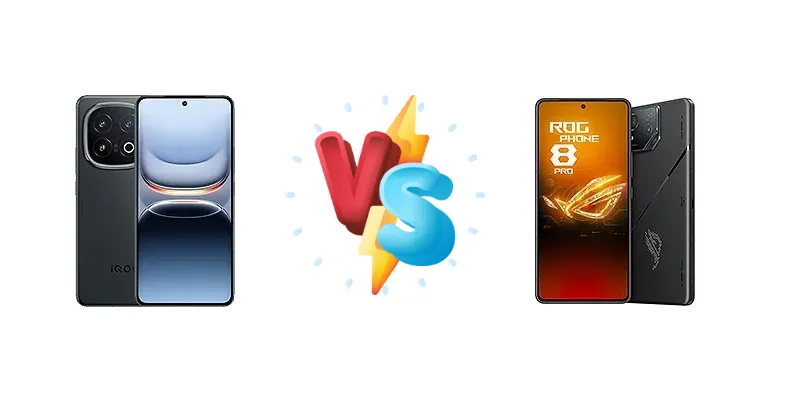
|
🏆 Quick Verdict
For the average user prioritizing battery life and peak CPU performance, the iQOO 13 emerges as the winner. Its 18:03 active use score and Snapdragon 8 Elite chipset offer a significant advantage. However, gamers will find the ROG Phone 8 Pro’s dedicated gaming features and ecosystem more compelling.
| PHONES | ||
|---|---|---|
| Phone Names | vivo iQOO 13 | Asus ROG Phone 8 Pro |
| Network | ||
|---|---|---|
| 2G bands | GSM 850 / 900 / 1800 / 1900 | GSM 850 / 900 / 1800 / 1900 |
| 3G bands | HSDPA 800 / 850 / 900 / 1700(AWS) / 1900 / 2100 | HSDPA 850 / 900 / 1700(AWS) / 1800 / 1900 / 2100 - International |
| 4G bands | 1, 2, 3, 4, 5, 7, 8, 18, 19, 20, 26, 28, 38, 40, 41, 42, 66 - International | 1, 2, 3, 4, 5, 7, 8, 12, 17, 18, 19, 20, 25, 26, 28, 32, 34, 38, 39, 40, 41, 42, 43, 48, 66 - International |
| 5G bands | 1, 3, 5, 7, 8, 20, 28, 38, 40, 41, 77, 78 SA/NSA - International | 1, 2, 3, 5, 7, 8, 12, 18, 20, 25, 26, 28, 38, 40, 41, 48, 66, 77, 78, 79 SA/NSA/Sub6 - International |
| Speed | HSPA, LTE, 5G | HSPA, LTE (Up to 7CA), 5G |
| Technology | GSM / HSPA / LTE / 5G | GSM / CDMA / HSPA / LTE / 5G |
| Launch | ||
|---|---|---|
| Announced | 2024, October 30 | 2024, January 08 |
| Status | Available. Released 2024, November 08 | Available. Released 2024, January 18 |
| Body | ||
|---|---|---|
| Build | Glass front, aluminum alloy frame, glass back or fiber-reinforced plastic back | Glass front (Gorilla Glass Victus 2), glass back (Gorilla Glass), aluminum frame |
| Dimensions | 163.4 x 76.7 x 8 mm (6.43 x 3.02 x 0.31 in) | 163.8 x 76.8 x 8.9 mm (6.45 x 3.02 x 0.35 in) |
| SIM | Nano-SIM + Nano-SIM | Nano-SIM + Nano-SIM |
| Weight | 207 g or 213 g (7.30 oz) | 225 g (7.94 oz) |
| Display | ||
|---|---|---|
| Protection | Schott Xensation Alpha | Corning Gorilla Glass Victus 2 |
| Resolution | 1440 x 3168 pixels (~510 ppi density) | 1080 x 2400 pixels, 20:9 ratio (~388 ppi density) |
| Size | 6.82 inches, 113.0 cm2 (~90.2% screen-to-body ratio) | 6.78 inches, 111.0 cm2 (~88.2% screen-to-body ratio) |
| Type | LTPO AMOLED, 1B colors, 144Hz, 2592Hz PWM, HDR10+, 800 nits (typ), 1800 nits (HBM), 4500 nits (peak) | LTPO AMOLED, 1B colors, 165Hz, HDR10, 1600 nits (HBM), 2500 nits (peak) |
| Platform | ||
|---|---|---|
| CPU | Octa-core (2x4.32 GHz Oryon V2 Phoenix L + 6x3.53 GHz Oryon V2 Phoenix M) | Octa-core (1x3.3 GHz Cortex-X4 & 3x3.2 GHz Cortex-A720 & 2x3.0 GHz Cortex-A720 & 2x2.3 GHz Cortex-A520) |
| Chipset | Qualcomm SM8750-AB Snapdragon 8 Elite (3 nm) | Qualcomm SM8650-AB Snapdragon 8 Gen 3 (4 nm) |
| GPU | Adreno 830 | Adreno 750 |
| OS | Android 15, up to 4 major Android upgrades, Funtouch 15 (International), OriginOS 5 (China) | Android 14, up to 2 major Android upgrades |
| Memory | ||
|---|---|---|
| Card slot | No | No |
| Internal | 256GB 12GB RAM, 256GB 16GB RAM, 512GB 12GB RAM, 512GB 16GB RAM, 1TB 16GB RAM | 512GB 16GB RAM, 1TB 24GB RAM |
| Main Camera | ||
|---|---|---|
| Features | Color spectrum sensor, Dual-LED flash, HDR, panorama | LED flash, HDR, panorama |
| Triple | 50 MP, f/1.9, 23mm (wide), 1/1.56", 1.0µm, PDAF, OIS 50 MP, f/1.9, 50mm (telephoto), 1/2.93", 0.6µm, PDAF, OIS, 2x optical zoom 50 MP, f/2.0, 15mm (ultrawide), 1/2.76", 0.64µm, AF | 50 MP, f/1.9, 24mm (wide), 1/1.56", 1.0µm, PDAF, gimbal OIS 32 MP, f/2.4, (telephoto), 1/3.2", 0.7µm, PDAF, OIS, 3x optical zoom 13 MP, f/2.2, 13mm, 120˚ (ultrawide) |
| Video | 8K@30fps, 4K@24/30/60fps, 1080p@30/60/120/240fps, gyro-EIS | 8K@24fps, 4K@30/60fps, 1080p@30/60/120/240fps, 720p@480fps; gyro-EIS, HDR10+ |
| Selfie camera | ||
|---|---|---|
| Features | HDR | Panorama, HDR |
| Single | 32 MP, f/2.5, 28mm (wide), 1/3.15", 0.7µm | 32 MP, f/2.5, 22mm (wide), 1/3.2", 0.7µm |
| Video | 4K@30/60fps, 1080p@30/60fps | 1080p@30fps |
| Sound | ||
|---|---|---|
| 35mm jack | No | Yes |
| Loudspeaker | Yes, with stereo speakers | Yes, with stereo speakers |
| Comms | ||
|---|---|---|
| Bluetooth | 5.4, A2DP, LE, aptX HD, aptX Adaptive, aptX Lossless, LHDC 5 | 5.4, A2DP, LE, aptX HD, aptX Adaptive, aptX Lossless |
| Infrared port | Yes | - |
| NFC | Yes, 360˚ | Yes |
| Positioning | GPS (L1+L5), GLONASS (G1), BDS (B1I+B1c+B2a), GALILEO (E1+E5a), QZSS (L1+L5) | GPS (L1+L5), BDS (B1I+B1c+B2a), GALILEO (E1+E5a), QZSS (L1+L5), NavIC (L5), GLONASS |
| Radio | No | No |
| USB | USB Type-C 3.2, OTG | USB Type-C (side), DisplayPort 1.4; USB Type-C (bottom), OTG |
| WLAN | Wi-Fi 802.11 a/b/g/n/ac/6/7, dual-band, Wi-Fi Direct | Wi-Fi 802.11 a/b/g/n/ac/6e/7, tri-band, Wi-Fi Direct |
| Features | ||
|---|---|---|
| Sensors | Fingerprint (under display, ultrasonic), accelerometer, gyro, proximity, compass | Fingerprint (under display, optical), accelerometer, gyro, proximity, compass |
| Battery | ||
|---|---|---|
| Charging | 120W wired, PPS, 100% in 30 min | 65W wired, PD3.0, PPS, QC5, 100% in 39 min - International 30W wired, PD3.0, PPS - India 15W wireless (Qi) 10W reverse wired |
| Type | Market-dependent versions:· Si/C Li-Ion 6150 mAh (Global)· 6000 mAh (India only) | 5500 mAh |
| Misc | ||
|---|---|---|
| Colors | Alpha (Black), Nardo Gray (Silver), White (BMW M branding), Ace Green | Phantom Black |
| Models | V2408A, I2401 | AI2401, AI2401_A, AI2401_D |
| Price | About 590 EUR | $ 1,157.98 / £ 1,693.75 / € 632.66 |
vivo iQOO 13
- Exceptional battery life (18:03h)
- Blazing-fast 120W charging
- Superior CPU performance with Snapdragon 8 Elite
- Camera specs are unknown
- Lacks gaming-specific features of the ROG Phone
Asus ROG Phone 8 Pro
- Dedicated gaming features (AirTriggers, customizable UI)
- Versatile camera system (expected)
- Wireless and reverse wireless charging
- Shorter battery life (14:43h)
- Slower charging speeds (65W/30W)
- Less powerful CPU compared to Snapdragon 8 Elite
Display Comparison
Both phones feature excellent displays, with the iQOO 13 achieving a measured peak brightness of 1804 nits and the ROG Phone 8 Pro reaching 1765 nits. While the difference is minimal, the iQOO 13’s slightly higher brightness could be noticeable in direct sunlight. Both likely employ LTPO technology for adaptive refresh rates, though this isn't explicitly stated. The ROG Phone 8 Pro’s display is likely tuned for color accuracy in gaming, while the iQOO 13 may prioritize vibrant, punchy colors for general consumption. Bezels are expected to be similarly slim on both devices, reflecting current flagship design trends.
Camera Comparison
The context data for the ROG Phone 8 Pro only mentions 'Photo / Video,' lacking specifics. Given Asus’s history, we can expect a versatile camera system with a focus on video recording capabilities. The iQOO 13’s camera specs are absent, but it’s reasonable to assume a high-resolution main sensor. Without detailed sensor size and aperture information, a direct comparison is difficult. However, the ROG Phone 8 Pro’s likely emphasis on computational photography and video stabilization could give it an edge in challenging shooting conditions. We'll need to see sample images to assess the image processing styles of both phones.
Performance
The performance gap is significant. The iQOO 13’s Qualcomm SM8750-AB Snapdragon 8 Elite (3nm) boasts an octa-core configuration with 2x4.32 GHz Oryon V2 Phoenix L cores and 6x3.53 GHz Oryon V2 Phoenix M cores. This architecture, built on a cutting-edge 3nm process, promises superior efficiency and raw power compared to the ROG Phone 8 Pro’s Snapdragon 8 Gen 3 (4nm). The ROG Phone 8 Pro’s CPU, with its 1x3.3 GHz Cortex-X4, 3x3.2 GHz Cortex-A720, 2x3.0 GHz Cortex-A720, and 2x2.3 GHz Cortex-A520 cores, is still incredibly capable, but the iQOO 13’s Oryon cores are expected to deliver a noticeable performance uplift in CPU-bound tasks. The 3nm process also translates to better thermal management, potentially reducing throttling during sustained workloads. Both phones will likely utilize LPDDR5x RAM, but the iQOO 13’s superior chipset will be the primary performance driver.
Battery Life
Battery life is a clear win for the iQOO 13. Its active use score of 18:03 hours significantly surpasses the ROG Phone 8 Pro’s 14:43 hours. This difference is likely attributable to the more efficient 3nm Snapdragon 8 Elite chipset and potentially a larger battery capacity (though not specified). The iQOO 13 also boasts significantly faster charging at 120W, achieving a full charge in just 30 minutes, compared to the ROG Phone 8 Pro’s 65W (International) or 30W (India) which takes 39 minutes. The ROG Phone 8 Pro does offer 15W wireless charging and 10W reverse wired charging, features absent on the iQOO 13, adding to its versatility.
Buying Guide
Buy the vivo iQOO 13 if you need exceptional battery life, the fastest possible CPU performance for demanding tasks, and rapid 120W charging. Buy the Asus ROG Phone 8 Pro if you prioritize a dedicated gaming experience, value features like AirTriggers and a customizable gaming interface, and are willing to trade some battery life for those enhancements.