
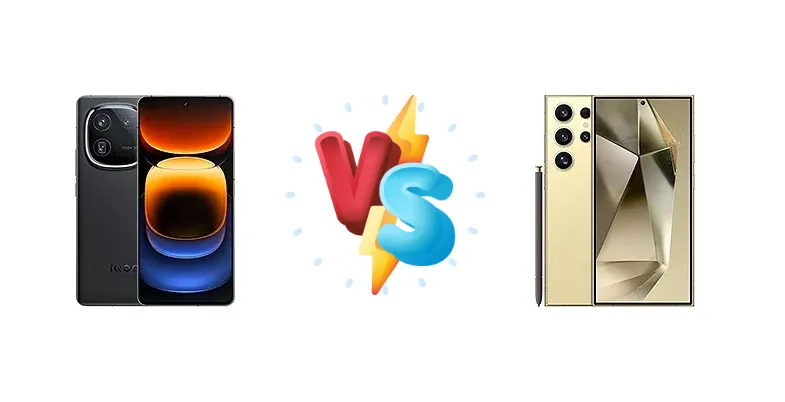
iQOO 12 vs Samsung Galaxy S24 Ultra: A Deep Dive into Snapdragon Power
| Phones Images | |||||
|---|---|---|---|---|---|
|
🏆 Quick Verdict
For the average user prioritizing a complete package with a refined software experience and versatile camera system, the Samsung Galaxy S24 Ultra is the superior choice. However, the iQOO 12 offers exceptional value and blazing-fast 120W charging, making it ideal for power users who prioritize speed and affordability.
| PHONES | ||
|---|---|---|
| Phone Names | vivo iQOO 12 | Samsung Galaxy S24 Ultra |
| Network | ||
|---|---|---|
| 2G bands | GSM 850 / 900 / 1800 / 1900 | GSM 850 / 900 / 1800 / 1900 |
| 3G bands | HSDPA 800 / 850 / 900 / 1700(AWS) / 1900 / 2100 | HSDPA 850 / 900 / 1700(AWS) / 1900 / 2100 |
| 4G bands | 1, 2, 3, 5, 7, 8, 20, 28, 38, 40, 41 - India | 1, 2, 3, 4, 5, 7, 8, 12, 13, 17, 18, 19, 20, 25, 26, 28, 32, 38, 39, 40, 41, 66 - International |
| 5G bands | 1, 3, 5, 7, 8, 28, 38, 40, 41, 77, 78 SA/NSA - India | 1, 2, 3, 5, 7, 8, 12, 20, 25, 26, 28, 38, 40, 41, 66, 75, 77, 78 SA/NSA/Sub6 - International |
| Speed | HSPA, LTE, 5G | HSPA, LTE (up to 7CA), 5G |
| Technology | GSM / CDMA / HSPA / CDMA2000 / LTE / 5G | GSM / CDMA / HSPA / EVDO / LTE / 5G |
| Launch | ||
|---|---|---|
| Announced | 2023, November 07 | 2024, January 17 |
| Status | Available. Released 2023, November 14 | Available. Released 2024, January 24 |
| Body | ||
|---|---|---|
| Build | Glass front, aluminum frame, glass back | Glass front (Corning Gorilla Armor), glass back (Corning Gorilla Armor), titanium frame (grade 2) |
| Dimensions | 163.2 x 75.9 x 8.1 mm or 8.4 mm | 162.3 x 79 x 8.6 mm (6.39 x 3.11 x 0.34 in) |
| SIM | Nano-SIM + Nano-SIM | · Nano-SIM + Nano-SIM + eSIM + eSIM (max 2 at a time) - INT· Nano-SIM + eSIM + eSIM (max 2 at a time) - USA· Nano-SIM + Nano-SIM - CN |
| Weight | 198.5 g or 203.7 g (7.02 oz) | 232 g or 233 g (8.18 oz) |
| Display | ||
|---|---|---|
| Protection | - | Corning Gorilla Armor |
| Resolution | 1260 x 2800 pixels, 20:9 ratio (~453 ppi density) | 1440 x 3120 pixels, 19.5:9 ratio (~505 ppi density) |
| Size | 6.78 inches, 111.0 cm2 (~89.6% screen-to-body ratio) | 6.8 inches, 113.5 cm2 (~88.5% screen-to-body ratio) |
| Type | LTPO AMOLED, 1B colors, 144Hz, HDR10+, 1400 nits (HBM), 3000 nits (peak) | Dynamic LTPO AMOLED 2X, 120Hz, HDR10+, 2600 nits (peak) |
| Platform | ||
|---|---|---|
| CPU | Octa-core (1x3.3 GHz Cortex-X4 & 3x3.2 GHz Cortex-A720 & 2x3.0 GHz Cortex-A720 & 2x2.3 GHz Cortex-A520) | 8-core (1x3.39GHz Cortex-X4 & 3x3.1GHz Cortex-A720 & 2x2.9GHz Cortex-A720 & 2x2.2GHz Cortex-A520) |
| Chipset | Qualcomm SM8650-AB Snapdragon 8 Gen 3 (4 nm) | Qualcomm SM8650-AC Snapdragon 8 Gen 3 (4 nm) |
| GPU | Adreno 750 | Adreno 750 (1 GHz) |
| OS | Android 14, upgradable to Android 15, up to 4 major Android upgrades, Funtouch 15 (International), OriginOS 4 (China) | Android 14, up to 7 major Android upgrades, One UI 8.0 |
| Memory | ||
|---|---|---|
| Card slot | No | No |
| Internal | 256GB 12GB RAM, 512GB 12GB RAM, 512GB 16GB RAM, 1TB 16GB RAM | 256GB 12GB RAM, 512GB 12GB RAM, 1TB 12GB RAM |
| Main Camera | ||
|---|---|---|
| Features | Color spectrum sensor, Dual-LED flash, HDR, panorama | Laser AF, LED flash, auto-HDR, panorama |
| Quad | - | 200 MP, f/1.7, 24mm (wide), 1/1.3", 0.6µm, multi-directional PDAF, OIS 10 MP, f/2.4, 67mm (telephoto), 1/3.52", 1.12µm, PDAF, OIS, 3x optical zoom 50 MP, f/3.4, 111mm (periscope telephoto), 1/2.52", 0.7µm, PDAF, OIS, 5x optical zoom 12 MP, f/2.2, 13mm, 120˚ (ultrawide), 1/2.55", 1.4µm, dual pixel PDAF, Super Steady video |
| Triple | 50 MP, f/1.7, 23mm (wide), 1/1.3", 1.2µm, multi-directional PDAF, OIS 64 MP, f/2.6, 70mm (periscope telephoto), 1/2.0", PDAF, OIS, 3x optical zoom 50 MP, f/2.0, 15mm, 119˚ (ultrawide), AF | - |
| Video | 8K@30fps, 4K@24/30/60fps, 1080p@30/60/120/240fps, gyro-EIS | 8K@24/30fps, 4K@30/60/120fps, 1080p@30/60/120/240fps, HDR10+, stereo sound rec., gyro-EIS |
| Selfie camera | ||
|---|---|---|
| Features | HDR | HDR, HDR10+ |
| Single | 16 MP, f/2.5, (wide) | 12 MP, f/2.2, 26mm (wide), 1/3.2", 1.12µm, dual pixel PDAF |
| Video | 1080p@30fps | 4K@30/60fps, 1080p@30fps |
| Sound | ||
|---|---|---|
| 35mm jack | No | No |
| Loudspeaker | Yes, with stereo speakers | Yes, with stereo speakers |
| Comms | ||
|---|---|---|
| Bluetooth | 5.4, A2DP, LE, aptX HD, aptX Adaptive, aptX Lossless (market/region dependent) | 5.3, A2DP, LE |
| Infrared port | Yes | - |
| NFC | Yes | Yes |
| Positioning | GPS (L1+L5), GLONASS (G1), BDS (B1I+B1c+B2a), GALILEO (E1+E5a), QZSS (L1+L5) | GPS, GLONASS, BDS, GALILEO, QZSS |
| Radio | No | No |
| USB | USB Type-C 2.0, OTG | USB Type-C 3.2, DisplayPort 1.2, OTG |
| WLAN | Wi-Fi 802.11 a/b/g/n/ac/6/7, tri-band, Wi-Fi Direct | Wi-Fi 802.11 a/b/g/n/ac/6e/7, tri-band, Wi-Fi Direct |
| Features | ||
|---|---|---|
| Sensors | Fingerprint (under display, optical), accelerometer, gyro, proximity, compass | Fingerprint (under display, ultrasonic), accelerometer, gyro, proximity, compass, barometer |
| Battery | ||
|---|---|---|
| Charging | 120W wired | 45W wired, PD3.0, 65% in 30 min 15W wireless (Qi) 4.5W reverse wireless |
| Type | 5000 mAh | Li-Ion 5000 mAh |
| Misc | ||
|---|---|---|
| Colors | Black, Red, White (BMW M branding) | Titanium Black, Titanium Gray, Titanium Violet, Titanium Yellow, Titanium Blue, Titanium Green, Titanium Orange |
| Models | V2307A | SM-S928B, SM-S928B/DS, SM-S928U, SM-S928U1, SM-S928W, SM-S928N, SM-S9280, SM-S928E, SM-S928E/DS |
| Price | About 640 EUR | $ 514.94 / C$ 929.99 / £ 630.00 / € 658.53 / ₹ 84,999 |
| SAR | - | 1.26 W/kg (head) 0.62 W/kg (body) |
| SAR EU | - | 1.06 W/kg (head) 1.30 W/kg (body) |
vivo iQOO 12
- Blazing-fast 120W wired charging
- Excellent performance-per-dollar ratio
- Potentially optimized for gaming
- Lacks wireless charging
- Less refined software experience compared to Samsung
Samsung Galaxy S24 Ultra
- Versatile and advanced camera system
- Polished software experience with One UI
- Wireless charging and reverse wireless power share
- Slower 45W wired charging
- Higher price point
Display Comparison
Both the iQOO 12 and Galaxy S24 Ultra boast high-quality displays, achieving measured peak brightness levels of 1425 nits and 1447 nits respectively. While the S24 Ultra marginally edges out the iQOO 12 in peak brightness, the difference is unlikely to be noticeable in most real-world scenarios. Both likely utilize LTPO technology for adaptive refresh rates, conserving battery life. Samsung’s display benefits from its established color calibration expertise, potentially offering more accurate color reproduction, though this requires detailed calibration testing beyond the provided specs.
Camera Comparison
Both phones feature capable camera systems, but detailed sensor information is missing. The context data only indicates 'Photo / Video' capabilities. Given Samsung’s history, the S24 Ultra likely features a larger main sensor and a more sophisticated image processing pipeline, offering greater dynamic range and detail. The S24 Ultra’s camera system is known for its versatility, including advanced zoom capabilities. The iQOO 12 may focus on delivering vibrant, social media-ready images, potentially prioritizing speed over absolute image fidelity. Without specific sensor details, a definitive camera comparison is impossible.
Performance
Both devices are equipped with the Qualcomm SM8650-AB/AC Snapdragon 8 Gen 3 (4nm), but subtle CPU clock speed differences exist. The S24 Ultra’s CPU runs at 3.39GHz versus the iQOO 12’s 3.3 GHz. While seemingly minor, this, combined with slightly higher clock speeds on the A720 cores (3.1GHz vs 3.0GHz), could translate to a marginal performance advantage for the S24 Ultra in sustained workloads. Both utilize LPDDR5x RAM, but the specific speed isn’t provided. Thermal management will be crucial; the iQOO 12, often targeting gamers, may prioritize sustained performance over absolute peak clocks, while Samsung typically balances performance and thermal comfort.
Battery Life
The Galaxy S24 Ultra delivers a slightly longer active use battery score of 13:49h compared to the iQOO 12’s 13:30h. This difference, while not massive, suggests better power efficiency or a slightly larger battery capacity in the S24 Ultra. However, the iQOO 12’s 120W wired charging is a game-changer, significantly faster than the S24 Ultra’s 45W charging (65% in 30 minutes). This means the iQOO 12 can replenish its battery much more quickly, mitigating the slightly shorter battery life. The S24 Ultra adds the convenience of 15W wireless charging and 4.5W reverse wireless charging, features absent on the iQOO 12.
Buying Guide
Buy the vivo iQOO 12 if you need the absolute fastest charging speeds available on a smartphone and prioritize raw performance-per-dollar. It’s a fantastic option for gamers and those who frequently top up their battery throughout the day. Buy the Samsung Galaxy S24 Ultra if you prefer a more polished software experience, a more versatile camera system with advanced features, and the added convenience of wireless charging and reverse wireless power share.