
iQOO 12 vs Asus ROG Phone 8 Pro: A Deep Dive into Gaming and Performance
| Phones Images | |||||
|---|---|---|---|---|---|
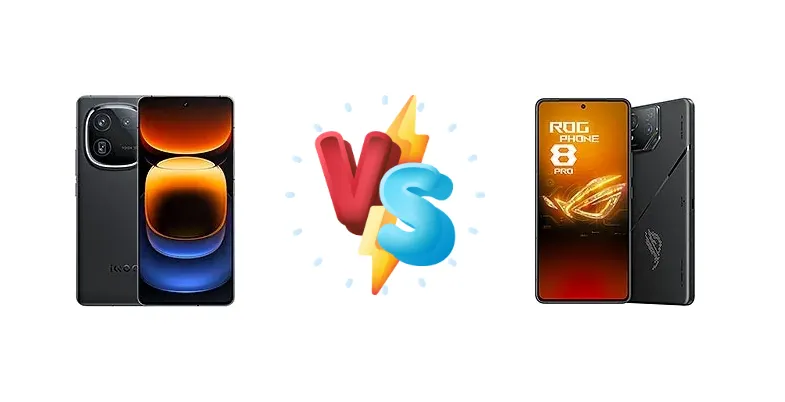
|
🏆 Quick Verdict
For the average user prioritizing all-around performance and incredibly fast charging, the iQOO 12 offers compelling value. However, the Asus ROG Phone 8 Pro edges ahead for dedicated mobile gamers thanks to its brighter display and more comprehensive gaming-focused features, despite its slower charging.
| PHONES | ||
|---|---|---|
| Phone Names | vivo iQOO 12 | Asus ROG Phone 8 Pro |
| Network | ||
|---|---|---|
| 2G bands | GSM 850 / 900 / 1800 / 1900 | GSM 850 / 900 / 1800 / 1900 |
| 3G bands | HSDPA 800 / 850 / 900 / 1700(AWS) / 1900 / 2100 | HSDPA 850 / 900 / 1700(AWS) / 1800 / 1900 / 2100 - International |
| 4G bands | 1, 2, 3, 5, 7, 8, 20, 28, 38, 40, 41 - India | 1, 2, 3, 4, 5, 7, 8, 12, 17, 18, 19, 20, 25, 26, 28, 32, 34, 38, 39, 40, 41, 42, 43, 48, 66 - International |
| 5G bands | 1, 3, 5, 7, 8, 28, 38, 40, 41, 77, 78 SA/NSA - India | 1, 2, 3, 5, 7, 8, 12, 18, 20, 25, 26, 28, 38, 40, 41, 48, 66, 77, 78, 79 SA/NSA/Sub6 - International |
| Speed | HSPA, LTE, 5G | HSPA, LTE (Up to 7CA), 5G |
| Technology | GSM / CDMA / HSPA / CDMA2000 / LTE / 5G | GSM / CDMA / HSPA / LTE / 5G |
| Launch | ||
|---|---|---|
| Announced | 2023, November 07 | 2024, January 08 |
| Status | Available. Released 2023, November 14 | Available. Released 2024, January 18 |
| Body | ||
|---|---|---|
| Build | Glass front, aluminum frame, glass back | Glass front (Gorilla Glass Victus 2), glass back (Gorilla Glass), aluminum frame |
| Dimensions | 163.2 x 75.9 x 8.1 mm or 8.4 mm | 163.8 x 76.8 x 8.9 mm (6.45 x 3.02 x 0.35 in) |
| SIM | Nano-SIM + Nano-SIM | Nano-SIM + Nano-SIM |
| Weight | 198.5 g or 203.7 g (7.02 oz) | 225 g (7.94 oz) |
| Display | ||
|---|---|---|
| Protection | - | Corning Gorilla Glass Victus 2 |
| Resolution | 1260 x 2800 pixels, 20:9 ratio (~453 ppi density) | 1080 x 2400 pixels, 20:9 ratio (~388 ppi density) |
| Size | 6.78 inches, 111.0 cm2 (~89.6% screen-to-body ratio) | 6.78 inches, 111.0 cm2 (~88.2% screen-to-body ratio) |
| Type | LTPO AMOLED, 1B colors, 144Hz, HDR10+, 1400 nits (HBM), 3000 nits (peak) | LTPO AMOLED, 1B colors, 165Hz, HDR10, 1600 nits (HBM), 2500 nits (peak) |
| Platform | ||
|---|---|---|
| CPU | Octa-core (1x3.3 GHz Cortex-X4 & 3x3.2 GHz Cortex-A720 & 2x3.0 GHz Cortex-A720 & 2x2.3 GHz Cortex-A520) | Octa-core (1x3.3 GHz Cortex-X4 & 3x3.2 GHz Cortex-A720 & 2x3.0 GHz Cortex-A720 & 2x2.3 GHz Cortex-A520) |
| Chipset | Qualcomm SM8650-AB Snapdragon 8 Gen 3 (4 nm) | Qualcomm SM8650-AB Snapdragon 8 Gen 3 (4 nm) |
| GPU | Adreno 750 | Adreno 750 |
| OS | Android 14, upgradable to Android 15, up to 4 major Android upgrades, Funtouch 15 (International), OriginOS 4 (China) | Android 14, up to 2 major Android upgrades |
| Memory | ||
|---|---|---|
| Card slot | No | No |
| Internal | 256GB 12GB RAM, 512GB 12GB RAM, 512GB 16GB RAM, 1TB 16GB RAM | 512GB 16GB RAM, 1TB 24GB RAM |
| Main Camera | ||
|---|---|---|
| Features | Color spectrum sensor, Dual-LED flash, HDR, panorama | LED flash, HDR, panorama |
| Triple | 50 MP, f/1.7, 23mm (wide), 1/1.3", 1.2µm, multi-directional PDAF, OIS 64 MP, f/2.6, 70mm (periscope telephoto), 1/2.0", PDAF, OIS, 3x optical zoom 50 MP, f/2.0, 15mm, 119˚ (ultrawide), AF | 50 MP, f/1.9, 24mm (wide), 1/1.56", 1.0µm, PDAF, gimbal OIS 32 MP, f/2.4, (telephoto), 1/3.2", 0.7µm, PDAF, OIS, 3x optical zoom 13 MP, f/2.2, 13mm, 120˚ (ultrawide) |
| Video | 8K@30fps, 4K@24/30/60fps, 1080p@30/60/120/240fps, gyro-EIS | 8K@24fps, 4K@30/60fps, 1080p@30/60/120/240fps, 720p@480fps; gyro-EIS, HDR10+ |
| Selfie camera | ||
|---|---|---|
| Features | HDR | Panorama, HDR |
| Single | 16 MP, f/2.5, (wide) | 32 MP, f/2.5, 22mm (wide), 1/3.2", 0.7µm |
| Video | 1080p@30fps | 1080p@30fps |
| Sound | ||
|---|---|---|
| 35mm jack | No | Yes |
| Loudspeaker | Yes, with stereo speakers | Yes, with stereo speakers |
| Comms | ||
|---|---|---|
| Bluetooth | 5.4, A2DP, LE, aptX HD, aptX Adaptive, aptX Lossless (market/region dependent) | 5.4, A2DP, LE, aptX HD, aptX Adaptive, aptX Lossless |
| Infrared port | Yes | - |
| NFC | Yes | Yes |
| Positioning | GPS (L1+L5), GLONASS (G1), BDS (B1I+B1c+B2a), GALILEO (E1+E5a), QZSS (L1+L5) | GPS (L1+L5), BDS (B1I+B1c+B2a), GALILEO (E1+E5a), QZSS (L1+L5), NavIC (L5), GLONASS |
| Radio | No | No |
| USB | USB Type-C 2.0, OTG | USB Type-C (side), DisplayPort 1.4; USB Type-C (bottom), OTG |
| WLAN | Wi-Fi 802.11 a/b/g/n/ac/6/7, tri-band, Wi-Fi Direct | Wi-Fi 802.11 a/b/g/n/ac/6e/7, tri-band, Wi-Fi Direct |
| Features | ||
|---|---|---|
| Sensors | Fingerprint (under display, optical), accelerometer, gyro, proximity, compass | Fingerprint (under display, optical), accelerometer, gyro, proximity, compass |
| Battery | ||
|---|---|---|
| Charging | 120W wired | 65W wired, PD3.0, PPS, QC5, 100% in 39 min - International 30W wired, PD3.0, PPS - India 15W wireless (Qi) 10W reverse wired |
| Type | 5000 mAh | 5500 mAh |
| Misc | ||
|---|---|---|
| Colors | Black, Red, White (BMW M branding) | Phantom Black |
| Models | V2307A | AI2401, AI2401_A, AI2401_D |
| Price | About 640 EUR | $ 1,157.98 / £ 1,693.75 / € 632.66 |
vivo iQOO 12
- Incredibly fast 120W wired charging
- Excellent value for the performance offered
- Vibrant and responsive display
- Battery life slightly shorter than the ROG Phone 8 Pro
- Less focused on dedicated gaming features
Asus ROG Phone 8 Pro
- Significantly brighter display for outdoor use
- Superior thermal management for sustained gaming
- Comprehensive gaming features and accessories
- Slower 65W (international) / 30W (India) wired charging
- Higher price point
Display Comparison
The Asus ROG Phone 8 Pro boasts a significantly brighter display, reaching a measured 1765 nits compared to the iQOO 12’s 1425 nits. This translates to superior visibility in direct sunlight. While both utilize high refresh rate panels, the ROG Phone 8 Pro’s higher peak brightness is a clear advantage for outdoor gaming and content consumption. Both devices likely employ LTPO technology for adaptive refresh rates, conserving battery life, but Asus’s implementation is known for its responsiveness. Bezels appear comparable, but the ROG Phone’s design language is more overtly ‘gamer’ focused.
Camera Comparison
Both devices feature capable photo and video capabilities, but detailed camera specs beyond 'Photo / Video' are unavailable. Given the ROG Phone’s gaming focus, its camera system is likely optimized for versatility rather than outright image quality. The iQOO 12, positioned as a more general-purpose flagship, may prioritize camera performance. Without sensor size or aperture information, it’s difficult to make a definitive judgment. We can assume both will offer standard features like night mode and portrait mode, but the ROG Phone’s image processing may lean towards more vibrant, game-ready aesthetics.
Performance
Both the iQOO 12 and ROG Phone 8 Pro are equipped with the Qualcomm SM8650-AB Snapdragon 8 Gen 3 (4 nm) chipset, featuring the same CPU configuration: 1x3.3 GHz Cortex-X4, 3x3.2 GHz Cortex-A720, 2x3.0 GHz Cortex-A720, and 2x2.3 GHz Cortex-A520. Performance will be largely identical in CPU-bound tasks. The key differentiator lies in thermal management. Asus ROG Phones are renowned for their advanced cooling systems, which are likely to sustain peak performance for longer durations during extended gaming sessions. While the iQOO 12’s cooling is adequate, the ROG Phone 8 Pro’s is likely more robust. Both utilize LPDDR5x RAM, ensuring fast memory access.
Battery Life
The Asus ROG Phone 8 Pro delivers a longer active use battery score of 14:43h compared to the iQOO 12’s 13:30h. This suggests better overall battery efficiency, potentially due to software optimizations or a more efficient display panel. However, the iQOO 12 compensates with significantly faster charging: 120W wired, capable of rapidly replenishing the battery. The ROG Phone 8 Pro offers 65W wired charging (international), 30W in India, 15W wireless, and 10W reverse wired. While 65W is still fast, it’s considerably slower than the iQOO 12’s 120W, meaning a full charge will take noticeably longer. The ROG Phone’s wireless and reverse wireless charging are features absent on the iQOO 12.
Buying Guide
Buy the vivo iQOO 12 if you need blazing-fast 120W charging, a vibrant display for everyday use, and a more streamlined software experience. It’s ideal for power users who want flagship performance without the dedicated gaming aesthetic. Buy the Asus ROG Phone 8 Pro if you prioritize a superior gaming experience, a significantly brighter display for outdoor visibility, and a wider range of gaming accessories and customization options. It’s built for those who live and breathe mobile gaming.