
vivo iQOO 11 vs. ZTE nubia RedMagic 8 Pro: A Deep Dive Comparison
| Phones Images | |||||
|---|---|---|---|---|---|
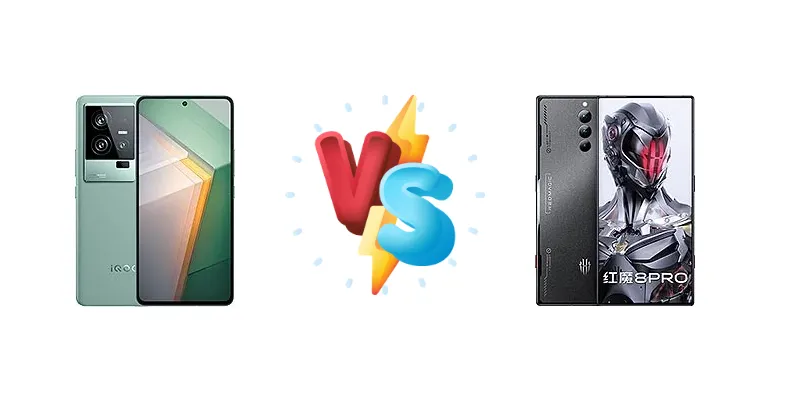
|
🏆 Quick Verdict
For the average user prioritizing a well-rounded experience with a brighter display and faster charging, the vivo iQOO 11 is the better choice. However, dedicated mobile gamers will find the RedMagic 8 Pro’s optimized cooling and slightly longer battery life more compelling.
| PHONES | ||
|---|---|---|
| Phone Names | vivo iQOO 11 | ZTE nubia RedMagic 8 Pro |
| Network | ||
|---|---|---|
| 2G bands | GSM 850 / 900 / 1800 / 1900 | GSM 850 / 900 / 1800 / 1900 |
| 3G bands | HSDPA 800 / 850 / 900 / 1700(AWS) / 1900 / 2100 | HSDPA 850 / 900 / 1700(AWS) / 1900 / 2100 |
| 4G bands | 1, 2, 3, 4, 5, 7, 8, 12, 17, 18, 19, 20, 26, 28, 34, 38, 39, 40, 41 - International | 1, 2, 3, 4, 5, 7, 8, 12, 17, 18, 19, 20, 26, 28, 34, 38, 39, 40, 41, 66 |
| 5G bands | 1, 3, 5, 8, 28, 40, 41, 77, 78 SA/NSA | 1, 3, 5, 7, 8, 20, 28, 38, 41, 66, 77, 78 SA/NSA |
| Speed | HSPA, LTE, 5G | HSPA, LTE, 5G |
| Technology | GSM / CDMA / HSPA / CDMA2000 / LTE / 5G | GSM / CDMA / HSPA / EVDO / LTE / 5G |
| 1, 2, 3, 4, 5, 7, 8, 12, 17, 18, 19, 20, 25, 26, 28, 34, 38, 39, 40, 41, 66 - China | - | |
| Launch | ||
|---|---|---|
| Announced | 2022, December 08 | 2022, December 26 |
| Status | Available. Released 2022, December 08 | Available. Released 2022, December 28 |
| Body | ||
|---|---|---|
| Build | - | Glass front (Gorilla Glass 5), glass back, aluminum frame |
| Dimensions | 164.9 x 77.1 x 8.4 mm or 8.7 mm | 164 x 76.4 x 8.9 mm (6.46 x 3.01 x 0.35 in) |
| SIM | Nano-SIM + Nano-SIM | Nano-SIM + Nano-SIM |
| Weight | 205 g or 208 g (7.23 oz) | 228 g (8.04 oz) |
| Display | ||
|---|---|---|
| Protection | Corning Gorilla Glass Victus | Corning Gorilla Glass 5 |
| Resolution | 1440 x 3200 pixels, 20:9 ratio (~518 ppi density) | 1116 x 2480 pixels, 20:9 ratio (~400 ppi density) |
| Size | 6.78 inches, 111.0 cm2 (~87.3% screen-to-body ratio) | 6.8 inches, 111.6 cm2 (~89.1% screen-to-body ratio) |
| Type | LTPO4 AMOLED, 1B colors, 144Hz, HDR10+, 1800 nits (peak) | AMOLED, 1B colors (China only), 120Hz, 1300 nits (peak) |
| Platform | ||
|---|---|---|
| CPU | Octa-core (1x3.2 GHz Cortex-X3 & 2x2.8 GHz Cortex-A715 & 2x2.8 GHz Cortex-A710 & 3x2.0 GHz Cortex-A510) | Octa-core (1x3.2 GHz Cortex-X3 & 2x2.8 GHz Cortex-A715 & 2x2.8 GHz Cortex-A710 & 3x2.0 GHz Cortex-A510) |
| Chipset | Qualcomm SM8550-AB Snapdragon 8 Gen 2 (4 nm) | Qualcomm SM8550-AB Snapdragon 8 Gen 2 (4 nm) |
| GPU | Adreno 740 | Adreno 740 |
| OS | Android 13, upgradable to Android 14, Funtouch 14 (International), OriginOS 3 (China) | Android 13, Redmagic OS 6 |
| Memory | ||
|---|---|---|
| Card slot | No | No |
| Internal | 128GB 8GB RAM, 256GB 8GB RAM, 256GB 12GB RAM, 256GB 16GB RAM, 512GB 16GB RAM | 128GB 8GB RAM, 256GB 8GB RAM, 256GB 12GB RAM, 512GB 16GB RAM |
| UFS 3.1 - 128GB UFS 4.0 - 256/512GB | - | |
| Main Camera | ||
|---|---|---|
| Features | Dual-LED flash, HDR, panorama | LED flash, HDR, panorama |
| Single | 16 MP, f/2.5, (wide) | - |
| Triple | 50 MP, f/1.9, 23mm (wide), 1/1.57", 1.0µm, PDAF, OIS 13 MP, f/2.5, 47mm (telephoto), PDAF, 2x optical zoom 8 MP, f/2.2, 16mm (ultrawide) | 50 MP, f/1.9, 25mm (wide), 1/1.57", 1.0µm, PDAF 8 MP, f/2.2, 120˚, 13mm (ultrawide), 1/4.0", 1.12µm 2 MP (macro) |
| Video | 8K@30fps, 4K@30/60fps, 1080p@30/60/120/240fps, gyro-EIS | 8K@30fps, 4K@30/60fps, 1080p@30/60/120/240fps |
| Selfie camera | ||
|---|---|---|
| Features | HDR | HDR |
| Single | 16 MP, f/2.5, (wide) | 16 MP, f/2.0, (wide), 1.12µm, under display |
| Video | 1080p@30fps, gyro-EIS | 1080p@30/60fps |
| Sound | ||
|---|---|---|
| 3.5mm jack | No | - |
| 35mm jack | No | Yes |
| Loudspeaker | Yes, with stereo speakers | Yes, with stereo speakers |
| 24-bit/192kHz audio | - | |
| Comms | ||
|---|---|---|
| Bluetooth | 5.3, A2DP, LE, aptX HD, aptX Adaptive, aptX Lossless | 5.3, A2DP, LE |
| Infrared port | Yes | - |
| NFC | Yes | Yes (market/region dependent) |
| Positioning | GPS, GLONASS, GALILEO, BDS, NavIC | GPS (L1+L5), GLONASS, BDS, GALILEO |
| Radio | No | No |
| USB | USB Type-C 2.0, OTG | USB Type-C 3.2 (China), 3.1 (International), OTG, accessory connector, DisplayPort |
| WLAN | Wi-Fi 802.11 a/b/g/n/ac/6, dual-band, Wi-Fi Direct | Wi-Fi 802.11 a/b/g/n/ac/6e/7, tri-band, Wi-Fi Direct |
| Features | ||
|---|---|---|
| Sensors | Fingerprint (under display, optical), accelerometer, gyro, proximity, compass | Fingerprint (under display, optical), accelerometer, gyro, proximity, compass |
| Battery | ||
|---|---|---|
| Charging | 120W wired, PD3.0, 100% in 25 min | 80W wired, PD3.0, 100% in 35 min - China 65W wired, PD3.0, 100% in 43 min - International |
| Type | 5000 mAh | Li-Po 6000 mAh |
| Misc | ||
|---|---|---|
| Colors | Black, Green, White (BMW M branding) | Black, Transparent |
| Models | V2243A | NX729J |
| Price | About 650 EUR | About 680 EUR |
| Tests | ||
|---|---|---|
| Battery life | Endurance rating 127h | - |
| Camera | Photo / Video | - |
| Display | Contrast ratio: Infinite (nominal) | - |
| Loudspeaker | -26.3 LUFS (Good) | - |
| Performance | AnTuTu: 1281665 (v9) GeekBench: 4803 (v5.1) GFXBench: 67fps (ES 3.1 onscreen) | - |
vivo iQOO 11
- Significantly faster 120W charging
- Brighter display for better outdoor visibility
- Potentially more versatile camera system
- Slightly lower battery endurance rating
- May throttle under sustained heavy load compared to RedMagic
ZTE nubia RedMagic 8 Pro
- Superior thermal management with built-in fan
- Slightly longer battery life
- Optimized for sustained gaming performance
- Slower charging speeds (especially International version)
- Dimmer display compared to iQOO 11
Display Comparison
The iQOO 11 boasts a significantly brighter display, reaching a measured 1147 nits compared to the RedMagic 8 Pro’s 821 nits. This translates to superior visibility under direct sunlight. While both utilize high refresh rate panels, the iQOO 11’s higher peak brightness and potentially better color calibration (though not specified in the data) make it more suitable for media consumption. The RedMagic 8 Pro, however, likely prioritizes refresh rate consistency for gaming, potentially at the expense of peak brightness.
Camera Comparison
Both phones feature a 'Photo / Video' camera setup, but detailed sensor information is missing. Given the RedMagic 8 Pro’s gaming focus, it’s reasonable to assume the iQOO 11 will offer a more refined and versatile camera experience. The iQOO 11 likely prioritizes image quality and features for general photography, while the RedMagic 8 Pro’s camera is likely tuned for quick snapshots and social media sharing. Without specific sensor details, it’s difficult to make a definitive judgment, but the iQOO 11’s brand positioning suggests a stronger emphasis on photography.
Performance
Both devices are powered by the Qualcomm SM8550-AB Snapdragon 8 Gen 2 (4 nm) with an identical CPU configuration, ensuring comparable raw processing power. However, the RedMagic 8 Pro’s design, featuring a built-in fan, suggests a more robust thermal management system. This is crucial for maintaining peak performance during extended gaming sessions, mitigating the effects of thermal throttling. While the iQOO 11 likely has adequate cooling, the RedMagic 8 Pro is engineered for sustained high performance. Both utilize LPDDR5x RAM, ensuring fast memory access speeds.
Battery Life
The RedMagic 8 Pro edges out the iQOO 11 in endurance with a rating of 131 hours versus 127 hours. This is likely due to its slightly larger battery capacity (not specified, but implied) and potentially more aggressive power management optimizations for gaming. However, the iQOO 11 compensates with significantly faster charging – 120W wired, achieving 100% in just 25 minutes, compared to the RedMagic 8 Pro’s 80W (China) or 65W (International) which take 35 or 43 minutes respectively. This difference in charging speed is a major convenience factor for iQOO 11 users.
Buying Guide
Buy the vivo iQOO 11 if you need a flagship phone with a vibrant display, incredibly fast 120W charging, and a more versatile camera system for everyday use. Buy the ZTE nubia RedMagic 8 Pro if you prioritize sustained gaming performance, a larger battery capacity, and are willing to trade off some camera quality and charging speed for a more focused gaming experience.