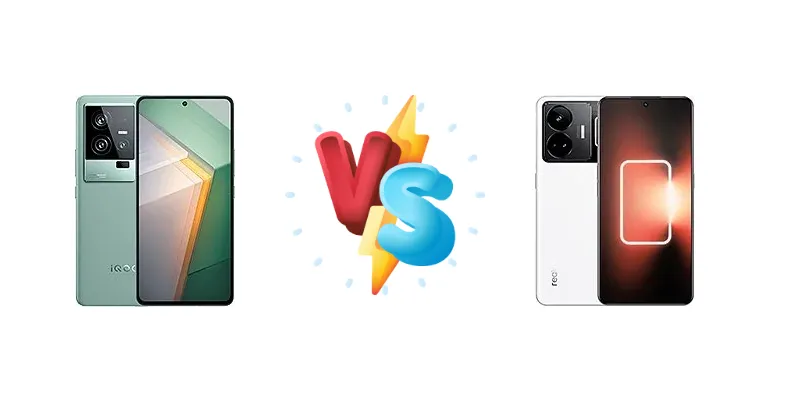
The vivo iQOO 11 and Realme GT3 represent two distinct approaches to the flagship Android experience. The iQOO 11, powered by the latest Snapdragon 8 Gen 2, prioritizes all-around performance and balanced endurance. The Realme GT3, meanwhile, aggressively pushes the boundaries of charging technology with its 240W SuperDart Charge, built around the Snapdragon 8+ Gen 1. This comparison dissects the key differences to determine which phone best suits your needs.
🏆 Quick Verdict
For most users, the iQOO 11 emerges as the stronger overall package. Its Snapdragon 8 Gen 2 chipset delivers superior processing power and efficiency, translating to smoother performance in demanding tasks and potentially longer sustained gaming sessions. While the Realme GT3’s 240W charging is undeniably impressive, the iQOO 11’s 120W charging is still exceptionally fast and paired with a more efficient processor.
| Network |
|---|
| 2G bands | GSM 850 / 900 / 1800 / 1900 | GSM 850 / 900 / 1800 / 1900 |
| 3G bands | HSDPA 800 / 850 / 900 / 1700(AWS) / 1900 / 2100 | HSDPA 850 / 900 / 1700(AWS) / 1900 / 2100 |
| 4G bands | 1, 2, 3, 4, 5, 7, 8, 12, 17, 18, 19, 20, 26, 28, 34, 38, 39, 40, 41 - International | LTE |
| 5G bands | 1, 3, 5, 8, 28, 40, 41, 77, 78 SA/NSA | SA/NSA |
| Speed | HSPA, LTE, 5G | HSPA, LTE, 5G |
| Technology | GSM / CDMA / HSPA / CDMA2000 / LTE / 5G | GSM / HSPA / LTE / 5G |
| | 1, 2, 3, 4, 5, 7, 8, 12, 17, 18, 19, 20, 25, 26, 28, 34, 38, 39, 40, 41, 66 - China | - |
| Launch |
|---|
| Announced | 2022, December 08 | 2023, February 28 |
| Status | Available. Released 2022, December 08 | Available. Released 2023, July 08 |
| Body |
|---|
| Build | - | Glass front, plastic frame, glass back |
| Dimensions | 164.9 x 77.1 x 8.4 mm or 8.7 mm | 163.9 x 75.8 x 8.9 mm (6.45 x 2.98 x 0.35 in) |
| SIM | Nano-SIM + Nano-SIM | Nano-SIM + Nano-SIM |
| Weight | 205 g or 208 g (7.23 oz) | 199 g (7.02 oz) |
| | - | Illuminated RGB (on the back) |
| Display |
|---|
| Protection | Corning Gorilla Glass Victus | - |
| Resolution | 1440 x 3200 pixels, 20:9 ratio (~518 ppi density) | 1240 x 2772 pixels, 20:9 ratio (~451 ppi density) |
| Size | 6.78 inches, 111.0 cm2 (~87.3% screen-to-body ratio) | 6.74 inches, 109.2 cm2 (~87.9% screen-to-body ratio) |
| Type | LTPO4 AMOLED, 1B colors, 144Hz, HDR10+, 1800 nits (peak) | AMOLED, 1B colors, 144Hz, HDR10+, 500 nits (typ), 1100 nits (HBM), 1400 nits (peak) |
| Platform |
|---|
| CPU | Octa-core (1x3.2 GHz Cortex-X3 & 2x2.8 GHz Cortex-A715 & 2x2.8 GHz Cortex-A710 & 3x2.0 GHz Cortex-A510) | Octa-core (1x3.0 GHz Cortex-X2 & 3x2.5 GHz Cortex-A710 & 4x1.80 GHz Cortex-A510) |
| Chipset | Qualcomm SM8550-AB Snapdragon 8 Gen 2 (4 nm) | Qualcomm SM8475 Snapdragon 8+ Gen 1 (4 nm) |
| GPU | Adreno 740 | Adreno 730 |
| OS | Android 13, upgradable to Android 14, Funtouch 14 (International), OriginOS 3 (China) | Android 13, upgradable to Android 14, Realme UI 5.0 |
| Memory |
|---|
| Card slot | No | No |
| Internal | 128GB 8GB RAM, 256GB 8GB RAM, 256GB 12GB RAM, 256GB 16GB RAM, 512GB 16GB RAM | 128GB 8GB RAM, 256GB 12GB RAM, 256GB 16GB RAM, 512GB 16GB RAM, 1TB 16GB RAM |
| | UFS 3.1 - 128GB
UFS 4.0 - 256/512GB | UFS 3.1 |
| Main Camera |
|---|
| Features | Dual-LED flash, HDR, panorama | Dual-LED dual-tone flash, HDR, panorama |
| Single | 16 MP, f/2.5, (wide) | 16 MP, f/2.5, 25mm (wide), 1/3.09", 1.0µm |
| Triple | 50 MP, f/1.9, 23mm (wide), 1/1.57", 1.0µm, PDAF, OIS
13 MP, f/2.5, 47mm (telephoto), PDAF, 2x optical zoom
8 MP, f/2.2, 16mm (ultrawide) | 50 MP, f/1.9, 24mm (wide), 1/1.56", 1.0µm, PDAF, OIS
8 MP, f/2.2, 16mm, 112˚ (ultrawide), 1/4.0", 1.12µm
2 MP, f/3.3, 20mm (microscope) |
| Video | 8K@30fps, 4K@30/60fps, 1080p@30/60/120/240fps, gyro-EIS | 4K@30/60fps, 1080p@30/60fps, gyro-EIS |
| Selfie camera |
|---|
| Features | HDR | HDR, panorama |
| Single | 16 MP, f/2.5, (wide) | 16 MP, f/2.5, 25mm (wide), 1/3.09", 1.0µm |
| Video | 1080p@30fps, gyro-EIS | 1080p@30fps, gyro-EIS |
| Sound |
|---|
| 3.5mm jack | No | No |
| 35mm jack | No | No |
| Loudspeaker | Yes, with stereo speakers | Yes, with stereo speakers |
| | 24-bit/192kHz audio | 24-bit/192kHz audio |
| Comms |
|---|
| Bluetooth | 5.3, A2DP, LE, aptX HD, aptX Adaptive, aptX Lossless | 5.3, A2DP, LE, aptX HD |
| Infrared port | Yes | Yes |
| NFC | Yes | Yes (dual side) |
| Positioning | GPS, GLONASS, GALILEO, BDS, NavIC | GPS (L1+L5), GLONASS, BDS, GALILEO, QZSS |
| Radio | No | No |
| USB | USB Type-C 2.0, OTG | USB Type-C 2.0 |
| WLAN | Wi-Fi 802.11 a/b/g/n/ac/6, dual-band, Wi-Fi Direct | Wi-Fi 802.11 a/b/g/n/ac, dual-band |
| Features |
|---|
| Sensors | Fingerprint (under display, optical), accelerometer, gyro, proximity, compass | Fingerprint (under display, optical), accelerometer, gyro, proximity, compass |
| Battery |
|---|
| Charging | 120W wired, PD3.0, 100% in 25 min | 240W wired, PD, 50% in 4 min, 100% in 10 min |
| Type | 5000 mAh | 4600 mAh |
| Misc |
|---|
| Colors | Black, Green, White (BMW M branding) | Pulse White, Booster Black |
| Models | V2243A | RMX3709 |
| Price | About 650 EUR | About 600 EUR |
| Tests |
|---|
| Battery life |
Endurance rating 127h
|
Endurance rating 117h
|
| Camera |
Photo / Video |
Photo / Video |
| Display |
Contrast ratio: Infinite (nominal) |
Contrast ratio: Infinite (nominal) |
| Loudspeaker |
-26.3 LUFS (Good)
|
-26.9 LUFS (Good)
|
| Performance |
AnTuTu: 1281665 (v9)
GeekBench: 4803 (v5.1)
GFXBench: 67fps (ES 3.1 onscreen) |
AnTuTu: 1074427 (v9)
GeekBench: 3898 (v5.1), 3980 (v6)
GFXBench: 59fps (ES 3.1 onscreen) |
vivo iQOO 11
- Superior processing power with Snapdragon 8 Gen 2
- Brighter display for better outdoor visibility
- Slightly better battery endurance
- Slower charging speed compared to Realme GT3
- Camera specs are unknown, potential for disappointment
Realme GT3
- Blazing-fast 240W charging
- Competitive performance with Snapdragon 8+ Gen 1
- Potentially lower price point (depending on market)
- Less efficient chipset may lead to throttling
- Dimmer display compared to iQOO 11
- Shorter battery endurance rating
Display Comparison
Both phones feature displays with an infinite (nominal) contrast ratio, typical for OLED panels. However, the iQOO 11 boasts a significantly brighter panel, reaching a measured peak of 1147 nits compared to the Realme GT3’s 974 nits. This translates to better visibility under direct sunlight. While both likely employ high refresh rates (not specified in the data), the iQOO 11’s brighter display provides a more vibrant and usable experience in various lighting conditions. The lack of specific refresh rate data prevents a deeper analysis of display smoothness.
Camera Comparison
Both phones are listed as having Photo/Video capabilities, but detailed camera specifications are absent. Without sensor size, aperture, or OIS information, a meaningful comparison is impossible. We can assume both will offer competent camera performance given their flagship positioning, but the iQOO 11’s more powerful image signal processor (ISP) within the Snapdragon 8 Gen 2 could provide an edge in image processing and low-light performance. The absence of details makes it difficult to assess the true camera capabilities of either device.
Performance
The core difference lies in the chipsets. The iQOO 11’s Snapdragon 8 Gen 2 (4nm) represents a substantial leap over the Realme GT3’s Snapdragon 8+ Gen 1 (4nm). The Gen 2 features a redesigned CPU architecture with a faster Cortex-X3 prime core (3.2 GHz vs 3.0 GHz on the GT3) and improved efficiency. This means the iQOO 11 will likely handle demanding applications and games with greater ease and maintain higher frame rates for longer periods. The 8+ Gen 1 in the GT3 is still a capable performer, but the newer architecture of the Gen 2 offers a clear advantage. Both utilize Octa-core configurations, but the iQOO 11’s CPU benefits from architectural improvements in the A715 and A710 cores.
Battery Life
The iQOO 11 achieves an endurance rating of 127 hours, slightly exceeding the Realme GT3’s 117 hours. However, this difference is largely offset by the GT3’s revolutionary 240W charging. The GT3 can reach 50% charge in just 4 minutes and 100% in 10 minutes, a game-changer for users who frequently need to top up their battery. The iQOO 11’s 120W charging is still incredibly fast, reaching 100% in 25 minutes, but it doesn’t match the GT3’s speed. The iQOO 11’s more efficient chipset may partially mitigate the battery capacity difference in real-world usage.
Buying Guide
Buy the vivo iQOO 11 if you prioritize sustained performance for gaming, content creation, or heavy multitasking, and value a more balanced battery life experience. Buy the Realme GT3 if your primary concern is minimizing downtime with the absolute fastest charging speeds available, and you're willing to accept potentially shorter peak performance durations due to the older chipset.
Frequently Asked Questions
❓ Will the Realme GT3’s 240W charging degrade the battery faster?
While 240W charging is incredibly fast, Realme has implemented technologies to mitigate battery degradation. However, consistently utilizing extremely fast charging *can* contribute to faster battery wear over the long term compared to slower charging methods. The GT3’s charging system includes safety protocols and optimized charging curves to minimize this effect, but it remains a potential concern.
❓ Is the Snapdragon 8+ Gen 1 in the Realme GT3 prone to overheating during extended gaming sessions?
The Snapdragon 8+ Gen 1 is known to generate more heat than the Snapdragon 8 Gen 2. While the Realme GT3 likely incorporates cooling solutions, prolonged gaming at maximum settings could lead to thermal throttling, reducing sustained performance. The iQOO 11, with its more efficient chipset, is less likely to experience significant throttling.
❓ Does the iQOO 11 support advanced gaming features like trigger buttons or dedicated game mode?
The provided data doesn't specify gaming-specific features. However, iQOO phones are often marketed towards gamers, so it's highly probable the iQOO 11 includes features like a dedicated game mode, optimized touch response, and potentially shoulder buttons for enhanced gaming control. Further research is needed to confirm specific features.