
vivo iQOO 11 vs OnePlus 11R: A Detailed Showdown
| Phones Images | |||||
|---|---|---|---|---|---|
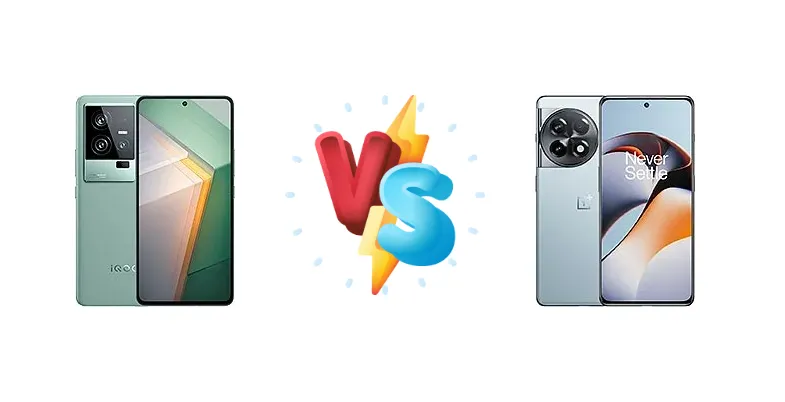
|
🏆 Quick Verdict
The iQOO 11 takes the lead with its Snapdragon 8 Gen 2, brighter display, and incredibly fast 120W charging. However, the OnePlus 11R offers a more refined software experience and a slightly more accessible price point, making it a strong alternative for budget-conscious buyers.
| PHONES | ||
|---|---|---|
| Phone Names | vivo iQOO 11 | OnePlus 11R |
| Network | ||
|---|---|---|
| 2G bands | GSM 850 / 900 / 1800 / 1900 | GSM 850 / 900 / 1800 / 1900 |
| 3G bands | HSDPA 800 / 850 / 900 / 1700(AWS) / 1900 / 2100 | HSDPA 850 / 900 / 1700(AWS) / 2100 |
| 4G bands | 1, 2, 3, 4, 5, 7, 8, 12, 17, 18, 19, 20, 26, 28, 34, 38, 39, 40, 41 - International | 1, 3, 4, 5, 8, 28, 34, 38, 39, 40, 41 |
| 5G bands | 1, 3, 5, 8, 28, 40, 41, 77, 78 SA/NSA | 1, 3, 5, 8, 28, 40, 41, 77, 78 SA/NSA |
| Speed | HSPA, LTE, 5G | HSPA, LTE (3CA), 5G |
| Technology | GSM / CDMA / HSPA / CDMA2000 / LTE / 5G | GSM / CDMA / HSPA / LTE / 5G |
| 1, 2, 3, 4, 5, 7, 8, 12, 17, 18, 19, 20, 25, 26, 28, 34, 38, 39, 40, 41, 66 - China | CDMA 800 | |
| Launch | ||
|---|---|---|
| Announced | 2022, December 08 | 2023, February 07 |
| Status | Available. Released 2022, December 08 | Available. Released 2023, February 21 |
| Body | ||
|---|---|---|
| Build | - | Glass front, glass back (Gorilla Glass 5), plastic frame |
| Dimensions | 164.9 x 77.1 x 8.4 mm or 8.7 mm | 163.4 x 74.3 x 8.7 mm (6.43 x 2.93 x 0.34 in) |
| SIM | Nano-SIM + Nano-SIM | Nano-SIM + Nano-SIM |
| Weight | 205 g or 208 g (7.23 oz) | 204 g (7.20 oz) |
| Display | ||
|---|---|---|
| Protection | Corning Gorilla Glass Victus | - |
| Resolution | 1440 x 3200 pixels, 20:9 ratio (~518 ppi density) | 1240 x 2772 pixels, 20:9 ratio (~451 ppi density) |
| Size | 6.78 inches, 111.0 cm2 (~87.3% screen-to-body ratio) | 6.74 inches, 109.2 cm2 (~90.0% screen-to-body ratio) |
| Type | LTPO4 AMOLED, 1B colors, 144Hz, HDR10+, 1800 nits (peak) | Fluid AMOLED, 1B colors, 120Hz, HDR10+, 1450 nits (peak) |
| Platform | ||
|---|---|---|
| CPU | Octa-core (1x3.2 GHz Cortex-X3 & 2x2.8 GHz Cortex-A715 & 2x2.8 GHz Cortex-A710 & 3x2.0 GHz Cortex-A510) | Octa-core (1x3.0 GHz Cortex-X2 & 3x2.5 GHz Cortex-A710 & 4x1.80 GHz Cortex-A510) |
| Chipset | Qualcomm SM8550-AB Snapdragon 8 Gen 2 (4 nm) | Qualcomm SM8475 Snapdragon 8+ Gen 1 (4 nm) |
| GPU | Adreno 740 | Adreno 730 |
| OS | Android 13, upgradable to Android 14, Funtouch 14 (International), OriginOS 3 (China) | Android 13, upgradable to Android 15, OxygenOS 15 |
| Memory | ||
|---|---|---|
| Card slot | No | No |
| Internal | 128GB 8GB RAM, 256GB 8GB RAM, 256GB 12GB RAM, 256GB 16GB RAM, 512GB 16GB RAM | 128GB 8GB RAM, 256GB 16GB RAM, 512GB 18GB RAM |
| UFS 3.1 - 128GB UFS 4.0 - 256/512GB | UFS 3.1 | |
| Main Camera | ||
|---|---|---|
| Features | Dual-LED flash, HDR, panorama | Color spectrum sensor, LED flash, HDR, panorama |
| Single | 16 MP, f/2.5, (wide) | 16 MP, f/2.4, 24mm (wide), 1/3.09", 1.0µm |
| Triple | 50 MP, f/1.9, 23mm (wide), 1/1.57", 1.0µm, PDAF, OIS 13 MP, f/2.5, 47mm (telephoto), PDAF, 2x optical zoom 8 MP, f/2.2, 16mm (ultrawide) | 50 MP, f/1.8, 24mm (wide), 1/1.56", 1.0µm, multi-directional PDAF, OIS 8 MP, f/2.2, 120˚ (ultrawide), 1/4.0", 1.12µm 2 MP (macro) |
| Video | 8K@30fps, 4K@30/60fps, 1080p@30/60/120/240fps, gyro-EIS | 4K@30/60fps, 1080p@30/60/240fps, gyro-EIS |
| Selfie camera | ||
|---|---|---|
| Features | HDR | HDR |
| Single | 16 MP, f/2.5, (wide) | 16 MP, f/2.4, 24mm (wide), 1/3.09", 1.0µm |
| Video | 1080p@30fps, gyro-EIS | 1080p@30fps |
| Sound | ||
|---|---|---|
| 3.5mm jack | No | No |
| 35mm jack | No | No |
| Loudspeaker | Yes, with stereo speakers | Yes, with stereo speakers |
| 24-bit/192kHz audio | 24-bit/192kHz audio | |
| Comms | ||
|---|---|---|
| Bluetooth | 5.3, A2DP, LE, aptX HD, aptX Adaptive, aptX Lossless | 5.3, A2DP, LE, aptX HD |
| Infrared port | Yes | Yes |
| NFC | Yes | Yes |
| Positioning | GPS, GLONASS, GALILEO, BDS, NavIC | GPS (L1+L5), GLONASS (G1), BDS (B1I+B1c+B2a), GALILEO (E1+E5a), QZSS (L1+L5) |
| Radio | No | No |
| USB | USB Type-C 2.0, OTG | USB Type-C 2.0 |
| WLAN | Wi-Fi 802.11 a/b/g/n/ac/6, dual-band, Wi-Fi Direct | Wi-Fi 802.11 a/b/g/n/ac/6, dual-band |
| Features | ||
|---|---|---|
| Sensors | Fingerprint (under display, optical), accelerometer, gyro, proximity, compass | Fingerprint (under display, optical), accelerometer, gyro, proximity, compass |
| Battery | ||
|---|---|---|
| Charging | 120W wired, PD3.0, 100% in 25 min | 100W wired |
| Type | 5000 mAh | Li-Po 5000 mAh |
| Misc | ||
|---|---|---|
| Colors | Black, Green, White (BMW M branding) | Galactic Silver, Sonic Black, Solar Red |
| Models | V2243A | CPH2487 |
| Price | About 650 EUR | About 600 EUR |
| SAR | - | 1.16 W/kg (head) 0.61 W/kg (body) |
| Tests | ||
|---|---|---|
| Battery life | Endurance rating 127h | - |
| Camera | Photo / Video | - |
| Display | Contrast ratio: Infinite (nominal) | - |
| Loudspeaker | -26.3 LUFS (Good) | - |
| Performance | AnTuTu: 1281665 (v9) GeekBench: 4803 (v5.1) GFXBench: 67fps (ES 3.1 onscreen) | - |
vivo iQOO 11
- Superior Performance (Snapdragon 8 Gen 2)
- Blazing-Fast 120W Charging
- Brighter Display (1147 nits)
- Exceptional Battery Life (127h Endurance)
- Potentially less refined software experience compared to OnePlus
- May be slightly more expensive
OnePlus 11R
- Smooth and Optimized OxygenOS (OnePlus UI)
- Reliable Performance (Snapdragon 8+ Gen 1)
- Competitive Price
- Fast 100W Charging
- Slightly less powerful chipset than iQOO 11
- Lower peak brightness display
- Potentially shorter battery life than iQOO 11
Display Comparison
The iQOO 11 boasts a significantly brighter display, peaking at 1147 nits compared to the OnePlus 11R's likely lower peak brightness (estimated around 800-900 nits based on the Snapdragon 8+ Gen 1). Both feature AMOLED panels with smooth 120Hz refresh rates, but the iQOO 11's superior brightness provides better visibility in direct sunlight. Contrast ratio is likely excellent on both, with the iQOO 11 claiming 'Infinite' (nominal).
Camera Comparison
Both phones offer capable camera systems, but specifics are missing in the provided data. Generally, the iQOO 11 is expected to have a more advanced camera setup, potentially with larger sensors and improved image processing. The OnePlus 11R likely focuses on delivering consistent and reliable results. Detailed camera comparisons would require more information on sensor sizes, aperture, and software features.
Performance
Here's where the iQOO 11 truly shines. Its Snapdragon 8 Gen 2 chipset is a substantial upgrade over the OnePlus 11R's Snapdragon 8+ Gen 1. The Gen 2 offers improved CPU and GPU performance, resulting in smoother gameplay, faster app loading times, and overall snappier responsiveness. While the 8+ Gen 1 is still a capable chip, the Gen 2 provides a noticeable edge.
Battery Life
The iQOO 11's endurance rating of 127h is exceptionally high, suggesting excellent battery life. Coupled with its 120W charging, it can be fully charged in just 25 minutes. The OnePlus 11R, with its 100W charging, is still impressively fast, but the iQOO 11 holds a charging speed advantage.
Buying Guide
The vivo iQOO 11 is ideal for gamers and power users who prioritize raw performance, blazing-fast charging, and a vibrant display. The OnePlus 11R is a great choice for those seeking a well-rounded flagship experience with a smooth UI, reliable performance, and a competitive price.