
iQOO 11 vs. Motorola Edge 40 Pro: A Deep Dive into Snapdragon 8 Gen 2 Flagships
| Phones Images | |||||
|---|---|---|---|---|---|
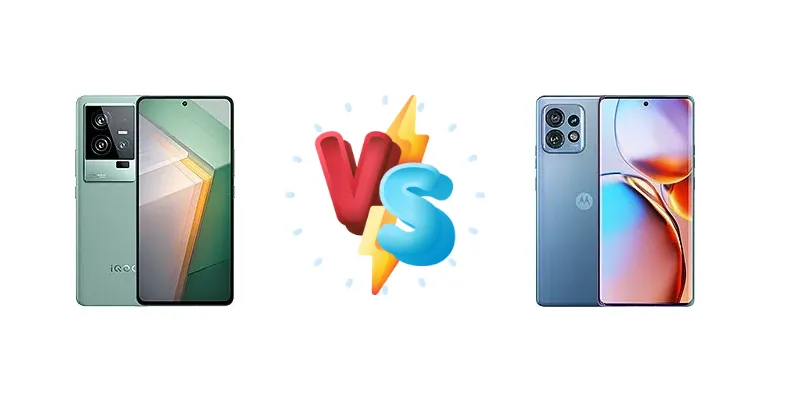
|
🏆 Quick Verdict
For the average user, the Motorola Edge 40 Pro edges out the iQOO 11. While both offer identical processing power, the Edge 40 Pro’s slightly faster charging (100% in 23 minutes vs 25) and inclusion of wireless charging provide a more versatile and convenient experience, justifying its potential price premium.
| PHONES | ||
|---|---|---|
| Phone Names | vivo iQOO 11 | Motorola Edge 40 Pro |
| Network | ||
|---|---|---|
| 2G bands | GSM 850 / 900 / 1800 / 1900 | GSM 850 / 900 / 1800 / 1900 |
| 3G bands | HSDPA 800 / 850 / 900 / 1700(AWS) / 1900 / 2100 | HSDPA 850 / 900 / 1700(AWS) / 1900 / 2100 |
| 4G bands | 1, 2, 3, 4, 5, 7, 8, 12, 17, 18, 19, 20, 26, 28, 34, 38, 39, 40, 41 - International | 1, 2, 3, 4, 5, 7, 8, 12, 13, 17, 18, 19, 20, 25, 26, 28, 32, 38, 39, 40, 41, 42, 43, 48, 66 |
| 5G bands | 1, 3, 5, 8, 28, 40, 41, 77, 78 SA/NSA | 1, 2, 3, 5, 7, 8, 20, 28, 38, 40, 41, 66, 77, 78 SA/NSA/Sub6 |
| Speed | HSPA, LTE, 5G | HSPA, LTE, 5G |
| Technology | GSM / CDMA / HSPA / CDMA2000 / LTE / 5G | GSM / HSPA / LTE / 5G |
| 1, 2, 3, 4, 5, 7, 8, 12, 17, 18, 19, 20, 25, 26, 28, 34, 38, 39, 40, 41, 66 - China | - | |
| Launch | ||
|---|---|---|
| Announced | 2022, December 08 | 2023, April 04 |
| Status | Available. Released 2022, December 08 | Available. Released 2023, April 04 |
| Body | ||
|---|---|---|
| Build | - | Glass front (Gorilla Glass Victus), glass back (Gorilla Glass Victus), aluminum frame |
| Dimensions | 164.9 x 77.1 x 8.4 mm or 8.7 mm | 161.2 x 74 x 8.6 mm (6.35 x 2.91 x 0.34 in) |
| SIM | Nano-SIM + Nano-SIM | Nano-SIM + eSIM |
| Weight | 205 g or 208 g (7.23 oz) | 199 g (7.02 oz) |
| - | IP68 dust/water resistant (up to 1.5m for 30 min) | |
| Display | ||
|---|---|---|
| Protection | Corning Gorilla Glass Victus | Corning Gorilla Glass Victus |
| Resolution | 1440 x 3200 pixels, 20:9 ratio (~518 ppi density) | 1080 x 2400 pixels, 20:9 ratio (~394 ppi density) |
| Size | 6.78 inches, 111.0 cm2 (~87.3% screen-to-body ratio) | 6.67 inches, 108.0 cm2 (~90.5% screen-to-body ratio) |
| Type | LTPO4 AMOLED, 1B colors, 144Hz, HDR10+, 1800 nits (peak) | OLED, 1B colors, 165Hz, HDR10+, Dolby Vision, 1300 nits (peak) |
| Platform | ||
|---|---|---|
| CPU | Octa-core (1x3.2 GHz Cortex-X3 & 2x2.8 GHz Cortex-A715 & 2x2.8 GHz Cortex-A710 & 3x2.0 GHz Cortex-A510) | Octa-core (1x3.2 GHz Cortex-X3 & 2x2.8 GHz Cortex-A715 & 2x2.8 GHz Cortex-A710 & 3x2.0 GHz Cortex-A510) |
| Chipset | Qualcomm SM8550-AB Snapdragon 8 Gen 2 (4 nm) | Qualcomm SM8550-AB Snapdragon 8 Gen 2 (4 nm) |
| GPU | Adreno 740 | Adreno 740 |
| OS | Android 13, upgradable to Android 14, Funtouch 14 (International), OriginOS 3 (China) | Android 13, up to 3 major Android upgrades |
| Memory | ||
|---|---|---|
| Card slot | No | No |
| Internal | 128GB 8GB RAM, 256GB 8GB RAM, 256GB 12GB RAM, 256GB 16GB RAM, 512GB 16GB RAM | 256GB 12GB RAM, 512GB 12GB RAM |
| UFS 3.1 - 128GB UFS 4.0 - 256/512GB | UFS 4.0 | |
| Main Camera | ||
|---|---|---|
| Features | Dual-LED flash, HDR, panorama | Dual-LED flash, panorama, HDR |
| Single | 16 MP, f/2.5, (wide) | - |
| Triple | 50 MP, f/1.9, 23mm (wide), 1/1.57", 1.0µm, PDAF, OIS 13 MP, f/2.5, 47mm (telephoto), PDAF, 2x optical zoom 8 MP, f/2.2, 16mm (ultrawide) | 50 MP, f/1.8, (wide), 1/1.55", 1.0µm, multi-directional PDAF, OIS 12 MP, f/1.6, (telephoto), 1/2.93", 1.22µm, PDAF, 2x optical zoom 50 MP, f/2.2, 114˚ (ultrawide), 1/2.76", 0.64µm, AF |
| Video | 8K@30fps, 4K@30/60fps, 1080p@30/60/120/240fps, gyro-EIS | 8K@30fps, 4K@30/60fps, 1080p@30/60/120/240/960fps, 10-bit HDR10+, gyro-EIS |
| Selfie camera | ||
|---|---|---|
| Features | HDR | HDR |
| Single | 16 MP, f/2.5, (wide) | 60 MP, f/2.2, (wide), 1/2.8", 0.61µm |
| Video | 1080p@30fps, gyro-EIS | 4K@30/60fps, 1080p@30/60fps |
| Sound | ||
|---|---|---|
| 3.5mm jack | No | No |
| 35mm jack | No | No |
| Loudspeaker | Yes, with stereo speakers | Yes, with stereo speakers |
| 24-bit/192kHz audio | - | |
| Comms | ||
|---|---|---|
| Bluetooth | 5.3, A2DP, LE, aptX HD, aptX Adaptive, aptX Lossless | 5.3, A2DP, LE |
| Infrared port | Yes | - |
| NFC | Yes | Yes |
| Positioning | GPS, GLONASS, GALILEO, BDS, NavIC | GPS, GLONASS, GALILEO, BDS |
| Radio | No | No |
| USB | USB Type-C 2.0, OTG | USB Type-C 3.2, OTG, DisplayPort 1.4 |
| WLAN | Wi-Fi 802.11 a/b/g/n/ac/6, dual-band, Wi-Fi Direct | Wi-Fi 802.11 a/b/g/n/ac/6e/7, tri-band, Wi-Fi Direct |
| Features | ||
|---|---|---|
| Sensors | Fingerprint (under display, optical), accelerometer, gyro, proximity, compass | Fingerprint (under display, optical), accelerometer, gyro, proximity, compass |
| - | Ready For 3.5 support | |
| Battery | ||
|---|---|---|
| Charging | 120W wired, PD3.0, 100% in 25 min | 125W wired, PD3.0, QC5, 50% in 6 min, 100% in 23 min 15W wireless 5W reverse wired 5W reverse wireless |
| Type | 5000 mAh | Li-Po 4600 mAh |
| Misc | ||
|---|---|---|
| Colors | Black, Green, White (BMW M branding) | Interstellar Black, Lunar Blue |
| Models | V2243A | - |
| Price | About 650 EUR | € 313.87 |
| Tests | ||
|---|---|---|
| Battery life | Endurance rating 127h | Endurance rating 117h |
| Camera | Photo / Video | Photo / Video |
| Display | Contrast ratio: Infinite (nominal) | Contrast ratio: Infinite (nominal) |
| Loudspeaker | -26.3 LUFS (Good) | -22.6 LUFS (Excellent) |
| Performance | AnTuTu: 1281665 (v9) GeekBench: 4803 (v5.1) GFXBench: 67fps (ES 3.1 onscreen) | AnTuTu: 1273764 (v9) GeekBench: 4896 (v5.1), 5352 (v6) GFXBench: 112fps (ES 3.1 onscreen) |
vivo iQOO 11
- Longer battery endurance (127h)
- Higher peak display brightness (1147 nits)
- Potentially better image processing (vivo's camera expertise)
- Slower wired charging (25 minutes)
- No wireless or reverse charging
Motorola Edge 40 Pro
- Faster wired charging (23 minutes)
- Wireless charging support (15W)
- Reverse charging capabilities
- Slightly lower battery endurance (117h)
- Lower peak display brightness (1050 nits)
Display Comparison
Both devices feature displays with an infinite (nominal) contrast ratio, typical of OLED panels. However, the iQOO 11 boasts a measured peak brightness of 1147 nits, significantly exceeding the Motorola Edge 40 Pro’s 1050 nits. This translates to better visibility in direct sunlight for the iQOO 11. While both likely employ high refresh rate panels (not specified in the data), the brightness difference is a clear win for the iQOO 11 for outdoor usability. The lack of information on panel technology (LTPO, PWM dimming) prevents a deeper analysis of display quality.
Camera Comparison
Both phones are listed as having Photo/Video capabilities, but lack specific details regarding sensor size, aperture, or optical image stabilization (OIS). Without this information, a meaningful camera comparison is impossible. The absence of details suggests neither phone is explicitly targeting camera enthusiasts with exceptionally large sensors or advanced features. We can assume both will deliver competent results, but the iQOO 11’s potential for better image processing (based on vivo’s camera reputation) is a possible, though unconfirmed, advantage.
Performance
The core performance is identical: both phones are equipped with the Qualcomm SM8550-AB Snapdragon 8 Gen 2 (4 nm) chipset, featuring the same Octa-core CPU configuration (1x3.2 GHz Cortex-X3, 2x2.8 GHz Cortex-A715, 2x2.8 GHz Cortex-A710, and 3x2.0 GHz Cortex-A510). This means comparable CPU and GPU performance in demanding tasks like gaming and video editing. Thermal management, which isn’t detailed here, will likely be the differentiating factor in sustained performance, but based on the chipset alone, there’s no performance advantage for either device.
Battery Life
The iQOO 11 claims an endurance rating of 127 hours, while the Motorola Edge 40 Pro achieves 117 hours. This 10-hour difference suggests the iQOO 11 offers superior battery life under typical usage. However, the Edge 40 Pro compensates with significantly faster charging: 125W wired charging (0-100% in 23 minutes) versus the iQOO 11’s 120W (25 minutes). Furthermore, the Edge 40 Pro adds 15W wireless charging, 5W reverse wired charging, and 5W reverse wireless charging – features entirely absent on the iQOO 11. This makes the Edge 40 Pro more versatile, especially for users who frequently top up their devices or need to charge accessories.
Buying Guide
Buy the vivo iQOO 11 if you prioritize maximizing battery endurance and are comfortable with a purely wired charging solution. Its 127-hour endurance rating offers a tangible advantage for heavy users. Buy the Motorola Edge 40 Pro if you value faster overall charging, the convenience of wireless charging, and the added flexibility of reverse wireless charging, even if it means a slightly shorter battery life on paper.