
iQOO 10 vs Xiaomi 12S Ultra: A Deep Dive into Speed and Stamina
| Phones Images | |||||
|---|---|---|---|---|---|
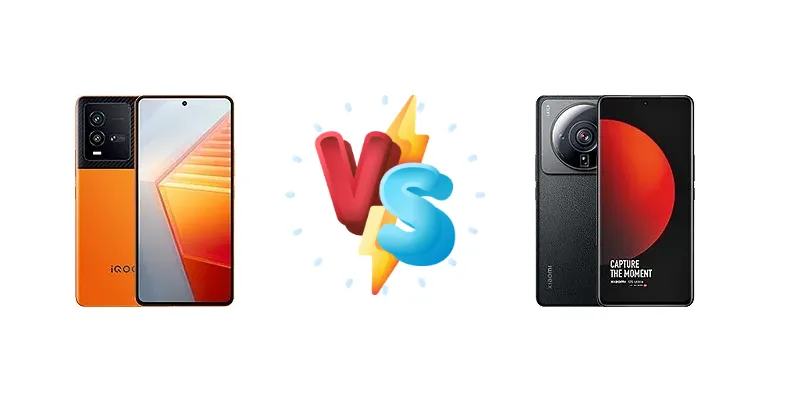
|
🏆 Quick Verdict
For the average user prioritizing rapid replenishment, the iQOO 10 is the clear winner with its groundbreaking 120W wired charging, achieving a full charge in just 19 minutes. However, the Xiaomi 12S Ultra counters with a respectable 93-hour endurance rating and the convenience of 50W wireless charging, making it a strong contender for those valuing longevity and versatility.
| PHONES | ||
|---|---|---|
| Phone Names | vivo iQOO 10 | Xiaomi 12S Ultra |
| Network | ||
|---|---|---|
| 2G bands | GSM 850 / 900 / 1800 / 1900 | GSM 850 / 900 / 1800 / 1900 |
| 3G bands | HSDPA 850 / 900 / 1700(AWS) / 1900 / 2100 | HSDPA 800 / 850 / 900 / 1700(AWS) / 1900 / 2100 |
| 4G bands | 1, 3, 4, 5, 8, 18, 19, 26, 28, 34, 38, 39, 40, 41, 66 | 1, 2, 3, 4, 5, 7, 8, 12, 17, 18, 19, 26, 34, 38, 39, 40, 41, 42 |
| 5G bands | 1, 3, 5, 8, 28, 40, 41, 77, 78 SA/NSA | 1, 3, 5, 8, 28, 38, 40, 41, 77, 78, 79 SA/NSA |
| Speed | HSPA, LTE, 5G | HSPA, LTE, 5G |
| Technology | GSM / CDMA / HSPA / CDMA2000 / LTE / 5G | GSM / CDMA / HSPA / EVDO / LTE / 5G |
| CDMA2000 1x | CDMA2000 1xEV-DO | |
| Launch | ||
|---|---|---|
| Announced | 2022, July 19 | 2022, July 04 |
| Status | Available. Released 2022, July 25 | Available. Released 2022, July 09 |
| Body | ||
|---|---|---|
| Build | - | Glass front (Gorilla Glass Victus), eco leather back, aluminum frame |
| Dimensions | 164.5 x 77.1 x 8.4 mm (6.48 x 3.04 x 0.33 in) | 163.2 x 75 x 9.1 mm (6.43 x 2.95 x 0.36 in) |
| SIM | Nano-SIM + Nano-SIM | Nano-SIM + Nano-SIM |
| Weight | 206 g (7.27 oz) | 225 g (7.94 oz) |
| - | IP68 dust/water resistant (up to 1.5m for 30 min) | |
| Display | ||
|---|---|---|
| Protection | - | Corning Gorilla Glass Victus |
| Resolution | 1080 x 2400 pixels, 20:9 ratio (~388 ppi density) | 1440 x 3200 pixels, 20:9 ratio (~522 ppi density) |
| Size | 6.78 inches, 111.0 cm2 (~87.5% screen-to-body ratio) | 6.73 inches, 108.9 cm2 (~89.0% screen-to-body ratio) |
| Type | AMOLED, 120Hz, HDR, 1500 nits (peak) | LTPO2 AMOLED, 1B colors, 120Hz, Dolby Vision, HDR10+, 1000 nits (HBM), 1500 nits (peak) |
| Platform | ||
|---|---|---|
| CPU | Octa-core (1x3.19 GHz Cortex-X2 & 3x2.75 GHz Cortex-A710 & 4x1.80 GHz Cortex-A510) | Octa-core (1x3.19 GHz Cortex-X2 & 3x2.75 GHz Cortex-A710 & 4x1.80 GHz Cortex-A510) |
| Chipset | Qualcomm SM8475 Snapdragon 8+ Gen 1 (4 nm) | Qualcomm SM8475 Snapdragon 8+ Gen 1 (4 nm) |
| GPU | Adreno 730 | Adreno 730 |
| OS | Android 12, OriginOS Ocean | Android 12, MIUI 13 |
| Memory | ||
|---|---|---|
| Card slot | No | No |
| Internal | 128GB 8GB RAM, 256GB 8GB RAM, 256GB 12GB RAM, 256GB 16GB RAM, 512GB 12GB RAM | 256GB 8GB RAM, 256GB 12GB RAM, 512GB 12GB RAM |
| UFS 3.1 | UFS 3.1 | |
| Main Camera | ||
|---|---|---|
| Features | Dual-LED dual-tone flash, HDR, panorama | Laser AF, color spectrum sensor, Leica lenses, Dual-LED flash, HDR, panorama |
| Single | 16 MP, f/2.5, (wide) | 32 MP, f/2.4, 25mm (wide), 0.7µm |
| Triple | 50 MP, f/1.9, (wide), 1/1.57", 1.0µm, PDAF, OIS 12 MP, f/2.0, 47mm (telephoto), 1/2.9", PDAF, 2x optical zoom 13 MP, f/2.2, 16mm, 120˚ (ultrawide) | 50 MP, f/1.9, 23mm (wide), 1.0"-type, 1.6µm, dual pixel PDAF, OIS 48 MP, f/4.1, 120mm (periscope telephoto), 1/2.0", 0.8µm, PDAF, OIS, 5x optical zoom 48 MP, f/2.2, 13mm, 128˚ (ultrawide), 1/2.0", 0.8µm, dual pixel PDAF TOF 3D, (depth) |
| Video | 4K@30fps, 1080p@30fps, gyro-EIS | 8K@24fps, 4K@30/60fps, 1080p@30/60/120/240fps, 720p@3840fps, gyro-EIS, Dolby Vision HDR 10-bit rec. (4K, 1080p) |
| Selfie camera | ||
|---|---|---|
| Features | HDR | HDR, panorama |
| Single | 16 MP, f/2.5, (wide) | 32 MP, f/2.4, 25mm (wide), 0.7µm |
| Video | 1080p@30fps, gyro-EIS | 1080p@30fps |
| Sound | ||
|---|---|---|
| 3.5mm jack | No | No |
| 35mm jack | No | No |
| Loudspeaker | Yes, with dual speakers | Yes, with stereo speakers |
| 24-bit/192kHz audio | 24-bit/192kHz audio Tuned by Harman Kardon | |
| Comms | ||
|---|---|---|
| Bluetooth | 5.3, A2DP, LE, aptX HD, aptX Adaptive, aptX Lossless | 5.2, A2DP, LE, aptX HD, aptX Adaptive |
| Infrared port | - | Yes |
| NFC | Yes | Yes |
| Positioning | GPS, GLONASS, GALILEO, BDS, QZSS | GPS (L1+L5), GLONASS (L1), BDS (B1I+B1c+B2a), GALILEO (E1+E5a), QZSS (L1+L5), NavIC (L5) |
| Radio | No | No |
| USB | USB Type-C 2.0, OTG | USB Type-C 2.0, OTG |
| WLAN | Wi-Fi 802.11 a/b/g/n/ac/6, dual-band, Wi-Fi Direct | Wi-Fi 802.11 a/b/g/n/ac/6e, dual-band, Wi-Fi Direct, DLNA |
| Features | ||
|---|---|---|
| Sensors | Fingerprint (under display, optical), accelerometer, gyro, proximity, compass | Fingerprint (under display, optical), accelerometer, gyro, compass, barometer |
| - | Virtual proximity sensing | |
| Battery | ||
|---|---|---|
| Charging | 120W wired, PD3.0, 50% in 7 min, 100% in 19 min | 67W wired, PD3.0, QC4, 100% in 41 min 50W wireless, 100% in 52 min 10W reverse wireless |
| Type | 4700 mAh | Li-Po 4860 mAh |
| Misc | ||
|---|---|---|
| Colors | White (BMW M branding), Orange, Black | Black, Dark Green |
| Models | V2217A | 2203121C |
| Price | About 580 EUR | $ 288.00 |
| Tests | ||
|---|---|---|
| Battery life | - | Endurance rating 93h |
| Camera | - | Photo / Video |
| Display | - | Contrast ratio: Infinite (nominal) |
| Loudspeaker | - | -25.6 LUFS (Very good) |
| Performance | - | AnTuTu: 1039412 (v9) GeekBench: 4300 (v5.1) GFXBench: 51fps (ES 3.1 onscreen) |
vivo iQOO 10
- Incredibly fast 120W wired charging
- Potentially optimized thermal management for gaming
- Snapdragon 8+ Gen 1 provides flagship performance
- Lacks wireless charging
- Camera specifications are unknown
Xiaomi 12S Ultra
- Excellent 93-hour battery endurance
- Convenient 50W wireless charging
- Likely superior camera system based on brand reputation
- Slower 67W wired charging
- May experience more thermal throttling under sustained load
Display Comparison
The Xiaomi 12S Ultra boasts a measured peak brightness of 1065 nits, suggesting a vibrant and easily viewable display even in direct sunlight. While the iQOO 10’s display specifications are not provided, it’s reasonable to assume it also offers a high brightness level to compete in the flagship segment. The 12S Ultra’s ‘Infinite’ contrast ratio (nominal) indicates a strong OLED panel, likely with excellent black levels. Without PWM frequency data for the iQOO 10, it’s difficult to assess potential flicker-related eye strain, a crucial factor for sensitive users.
Camera Comparison
The Xiaomi 12S Ultra is explicitly marketed for its camera capabilities, though specific sensor details are absent. Given Xiaomi’s history, it likely features a large main sensor with advanced image processing algorithms. The iQOO 10’s camera is mentioned only as ‘Photo / Video’, lacking any specifics. Without sensor size, aperture, or OIS information for either device, a definitive camera comparison is impossible. It’s safe to assume both offer a versatile camera system, but the 12S Ultra likely holds an edge due to Xiaomi’s established camera expertise.
Performance
Both devices are equipped with the Qualcomm SM8475 Snapdragon 8+ Gen 1 (4 nm) chipset, featuring an octa-core CPU configuration identical in clock speeds (1x3.19 GHz Cortex-X2, 3x2.75 GHz Cortex-A710, and 4x1.80 GHz Cortex-A510). This means raw processing power will be virtually indistinguishable between the two. However, thermal management – not detailed in the provided data – will be the deciding factor in sustained performance. The iQOO brand often prioritizes gaming, suggesting potentially more aggressive cooling solutions. Both likely utilize LPDDR5x RAM, contributing to fast application loading and multitasking.
Battery Life
The Xiaomi 12S Ultra achieves an impressive endurance rating of 93 hours, indicating excellent battery optimization despite not having a specified mAh capacity. The iQOO 10, however, prioritizes charging speed. Its 120W wired charging is a game-changer, delivering a 50% charge in just 7 minutes and a full charge in 19 minutes. This is significantly faster than the 12S Ultra’s 67W wired charging (41 minutes to 100%). The 12S Ultra also offers 50W wireless charging (52 minutes to 100%) and 10W reverse wireless charging, providing added convenience. The iQOO 10 lacks wireless charging, a trade-off for its blistering wired speeds.
Buying Guide
Buy the vivo iQOO 10 if you absolutely need the fastest possible charging speeds and frequently find yourself needing to top up your battery throughout the day. Buy the Xiaomi 12S Ultra if you prioritize all-day battery life, appreciate the flexibility of wireless charging, and value a potentially more refined camera experience (given Xiaomi's historical focus on imaging).