
vivo iQOO 10 vs iQOO 9 Pro: A Detailed Showdown
| Phones Images | |||||
|---|---|---|---|---|---|
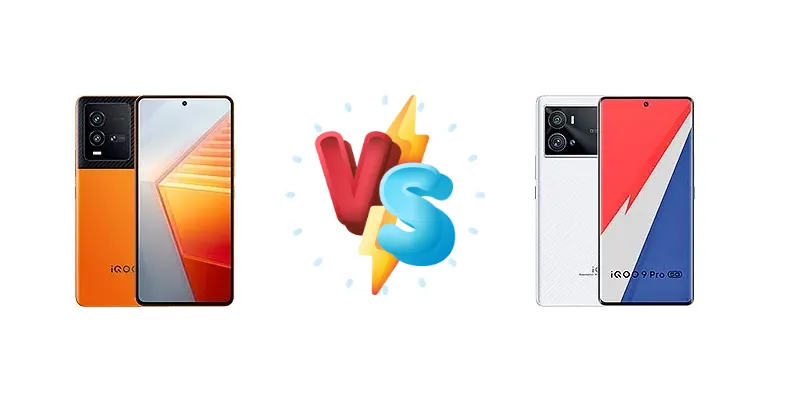
|
🏆 Quick Verdict
The iQOO 10 boasts a newer, more efficient Snapdragon 8+ Gen 1 and blazing-fast 120W charging. However, the iQOO 9 Pro offers wireless charging, reverse wireless charging, and potentially a slightly more refined camera experience. For pure speed and charging, the iQOO 10 wins, but the 9 Pro provides more versatility.
| PHONES | ||
|---|---|---|
| Phone Names | vivo iQOO 10 | vivo iQOO 9 Pro |
| Network | ||
|---|---|---|
| 2G bands | GSM 850 / 900 / 1800 / 1900 | GSM 850 / 900 / 1800 / 1900 |
| 3G bands | HSDPA 850 / 900 / 1700(AWS) / 1900 / 2100 | HSDPA 850 / 900 / 1700(AWS) / 1900 / 2100 |
| 4G bands | 1, 3, 4, 5, 8, 18, 19, 26, 28, 34, 38, 39, 40, 41, 66 | 1, 2, 3, 4, 5, 7, 8, 12, 17, 18, 19, 20, 25, 26, 28, 32, 34, 38, 39, 40, 41, 42, 66 |
| 5G bands | 1, 3, 5, 8, 28, 40, 41, 77, 78 SA/NSA | 1, 3, 5, 7, 8, 20, 28, 38, 40, 41, 66, 77, 78, 79 SA/NSA |
| Speed | HSPA, LTE, 5G | HSPA, LTE, 5G |
| Technology | GSM / CDMA / HSPA / CDMA2000 / LTE / 5G | GSM / CDMA / HSPA / CDMA2000 / LTE / 5G |
| CDMA2000 1x | CDMA2000 1x | |
| Launch | ||
|---|---|---|
| Announced | 2022, July 19 | 2022, January 05 |
| Status | Available. Released 2022, July 25 | Available. Released 2022, January 12 |
| Body | ||
|---|---|---|
| Build | - | Glass front (Panda Glass), aluminum frame, glass back or aramid fiber back |
| Dimensions | 164.5 x 77.1 x 8.4 mm (6.48 x 3.04 x 0.33 in) | 164.8 x 75.2 x 8.8 mm |
| SIM | Nano-SIM + Nano-SIM | Nano-SIM + Nano-SIM |
| Weight | 206 g (7.27 oz) | 204 g or 210 g (7.20 oz) |
| - | Splash and dust resistant | |
| Display | ||
|---|---|---|
| Protection | - | Panda Glass |
| Resolution | 1080 x 2400 pixels, 20:9 ratio (~388 ppi density) | 1440 x 3200 pixels, 20:9 ratio (~518 ppi density) |
| Size | 6.78 inches, 111.0 cm2 (~87.5% screen-to-body ratio) | 6.78 inches, 111.0 cm2 (~89.6% screen-to-body ratio) |
| Type | AMOLED, 120Hz, HDR, 1500 nits (peak) | LTPO2 AMOLED, 1B colors, 120Hz, HDR10+, Dolby Vision, 500 nits (typ), 1000 nits (HBM), 1500 nits (peak) |
| Platform | ||
|---|---|---|
| CPU | Octa-core (1x3.19 GHz Cortex-X2 & 3x2.75 GHz Cortex-A710 & 4x1.80 GHz Cortex-A510) | Octa-core (1x3.00 GHz Cortex-X2 & 3x2.50 GHz Cortex-A710 & 4x1.80 GHz Cortex-A510) |
| Chipset | Qualcomm SM8475 Snapdragon 8+ Gen 1 (4 nm) | Qualcomm SM8450 Snapdragon 8 Gen 1 (4 nm) |
| GPU | Adreno 730 | Adreno 730 |
| OS | Android 12, OriginOS Ocean | Android 12, Funtouch 12 (International), OriginOS Ocean (China) |
| Memory | ||
|---|---|---|
| Card slot | No | No |
| Internal | 128GB 8GB RAM, 256GB 8GB RAM, 256GB 12GB RAM, 256GB 16GB RAM, 512GB 12GB RAM | 256GB 8GB RAM, 256GB 12GB RAM, 512GB 12GB RAM |
| UFS 3.1 | UFS 3.1 (V6) | |
| Main Camera | ||
|---|---|---|
| Features | Dual-LED dual-tone flash, HDR, panorama | Dual-LED lash, HDR, panorama |
| Single | 16 MP, f/2.5, (wide) | 16 MP, f/2.5, (wide), 1/3.1", 1.0µm |
| Triple | 50 MP, f/1.9, (wide), 1/1.57", 1.0µm, PDAF, OIS 12 MP, f/2.0, 47mm (telephoto), 1/2.9", PDAF, 2x optical zoom 13 MP, f/2.2, 16mm, 120˚ (ultrawide) | 50 MP, f/1.8, (wide), 1/1.57", 1.0µm, PDAF, gimbal OIS 16 MP, f/2.2, 60mm (telephoto), 1/3.1", 1.0µm, PDAF, OIS, 2.5x optical zoom 50 MP, f/2.3, 15mm, 150˚ (ultrawide), 1/2.76", 0.64µm, AF |
| Video | 4K@30fps, 1080p@30fps, gyro-EIS | 8K@30fps, 4K@24/30/60fps, 1080p@30/60fps, gyro-EIS |
| Selfie camera | ||
|---|---|---|
| Features | HDR | HDR |
| Single | 16 MP, f/2.5, (wide) | 16 MP, f/2.5, (wide), 1/3.1", 1.0µm |
| Video | 1080p@30fps, gyro-EIS | 1080p@30fps, gyro-EIS |
| Sound | ||
|---|---|---|
| 3.5mm jack | No | No |
| 35mm jack | No | No |
| Loudspeaker | Yes, with dual speakers | Yes, with dual speakers |
| 24-bit/192kHz audio | 32-bit/384kHz audio | |
| Comms | ||
|---|---|---|
| Bluetooth | 5.3, A2DP, LE, aptX HD, aptX Adaptive, aptX Lossless | 5.2, A2DP, LE, aptX HD, aptX Adaptive, aptX Lossless |
| Infrared port | - | Yes |
| NFC | Yes | Yes |
| Positioning | GPS, GLONASS, GALILEO, BDS, QZSS | GPS, GLONASS, GALILEO, BDS, QZSS |
| Radio | No | No |
| USB | USB Type-C 2.0, OTG | USB Type-C 2.0, OTG |
| WLAN | Wi-Fi 802.11 a/b/g/n/ac/6, dual-band, Wi-Fi Direct | Wi-Fi 802.11 a/b/g/n/ac/6, dual-band, Wi-Fi Direct |
| Features | ||
|---|---|---|
| Sensors | Fingerprint (under display, optical), accelerometer, gyro, proximity, compass | Fingerprint (under display, ultrasonic), accelerometer, gyro, proximity, compass |
| Battery | ||
|---|---|---|
| Charging | 120W wired, PD3.0, 50% in 7 min, 100% in 19 min | 120W wired, 50% in 8 min, 100% in 20 min 50W wireless 10W reverse wireless |
| Type | 4700 mAh | 4700 mAh |
| Misc | ||
|---|---|---|
| Colors | White (BMW M branding), Orange, Black | Legend (White w/ BMW M branding), Dark Cruise, Orange |
| Models | V2217A | V2172A, I2022 |
| Price | About 580 EUR | About 630 EUR |
| Tests | ||
|---|---|---|
| Battery life | - | Endurance rating 97h |
| Camera | - | Photo / Video |
| Display | - | Contrast ratio: Infinite (nominal) |
| Loudspeaker | - | -24.8 LUFS (Very good) |
| Performance | - | AnTuTu: 862324 (v8), 997948 (v9) GeekBench: 3708 (v5.1) GFXBench: 46fps (ES 3.1 onscreen) |
vivo iQOO 10
- Faster Snapdragon 8+ Gen 1 Chip
- Blazing-fast 120W Charging
- Potentially better thermal management
- Competitive Price
- Likely less versatile camera system
- No wireless charging
- No reverse wireless charging
vivo iQOO 9 Pro
- Excellent Battery Life (97h Endurance Rating)
- Wireless Charging (50W)
- Reverse Wireless Charging (10W)
- Potentially more refined camera
- Slightly older Snapdragon 8 Gen 1 Chip
- Slower charging compared to iQOO 10
- Potentially higher price
Display Comparison
Both phones feature excellent AMOLED displays, but the iQOO 9 Pro's 1000 nits peak brightness gives it a slight edge in outdoor visibility. The iQOO 10 likely has a similar brightness level, but specific measurements are needed for a definitive comparison. The iQOO 9 Pro's 'Infinite' contrast ratio is a marketing term, but suggests deep blacks and vibrant colors. Both offer smooth 120Hz refresh rates for fluid scrolling and gaming.
Camera Comparison
Camera details are limited in the provided specs. However, the iQOO 9 Pro is generally known to have a more versatile camera system, potentially with better image processing. The iQOO 10 likely focuses on speed and computational photography, but may lack the same level of detail and dynamic range. Real-world camera tests are needed for a full assessment.
Performance
The iQOO 10's Snapdragon 8+ Gen 1 is the clear winner here. It's built on a more advanced 4nm process, offering better efficiency and sustained performance compared to the iQOO 9 Pro's Snapdragon 8 Gen 1. While both are incredibly fast, the 8+ Gen 1 will handle demanding games and multitasking with greater ease and less throttling over extended periods. Expect slightly better thermal management on the iQOO 10.
Battery Life
The iQOO 9 Pro boasts an impressive endurance rating of 97 hours, suggesting exceptional battery life. The iQOO 10's battery capacity is likely similar, but the 8+ Gen 1's efficiency could offset any differences. The iQOO 10's 120W charging is significantly faster than the iQOO 9 Pro's 120W wired and 50W wireless, allowing for incredibly quick top-ups.
Buying Guide
The vivo iQOO 10 is ideal for gamers and power users who prioritize raw performance and incredibly fast charging. The vivo iQOO 9 Pro is a better choice for those who value wireless charging, reverse wireless charging, and a potentially more balanced camera system, alongside excellent battery life.