
iQOO 10 vs Realme GT2 Pro: A Deep Dive into Performance and Charging
| Phones Images | |||||
|---|---|---|---|---|---|
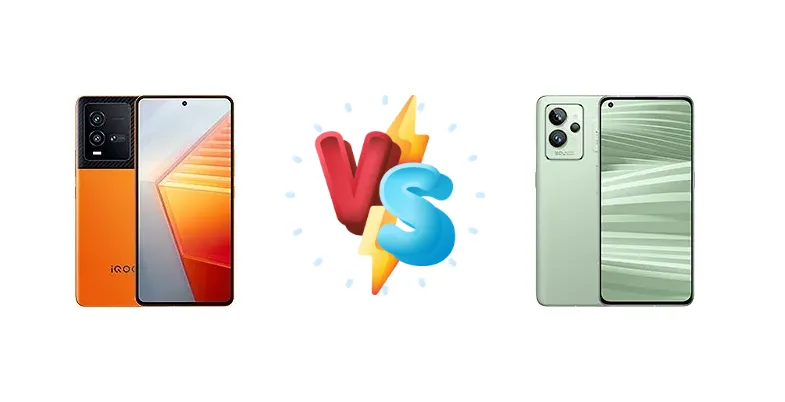
|
🏆 Quick Verdict
For users prioritizing blazing-fast charging and sustained performance, the iQOO 10 emerges as the winner. Its 120W charging dramatically reduces downtime, and the Snapdragon 8+ Gen 1 offers superior thermal management compared to the GT2 Pro's Snapdragon 8 Gen 1. However, the GT2 Pro remains a strong contender with a solid display.
| PHONES | ||
|---|---|---|
| Phone Names | vivo iQOO 10 | Realme GT2 Pro |
| Network | ||
|---|---|---|
| 2G bands | GSM 850 / 900 / 1800 / 1900 | GSM 850 / 900 / 1800 / 1900 |
| 3G bands | HSDPA 850 / 900 / 1700(AWS) / 1900 / 2100 | HSDPA 800 / 850 / 900 / 1700(AWS) / 1900 / 2100 |
| 4G bands | 1, 3, 4, 5, 8, 18, 19, 26, 28, 34, 38, 39, 40, 41, 66 | 1, 2, 3, 4, 5, 7, 8, 12, 13, 17, 18, 19, 20, 25, 26, 28, 66 - International |
| 5G bands | 1, 3, 5, 8, 28, 40, 41, 77, 78 SA/NSA | 1, 3, 5, 7, 8, 20, 28, 38, 40, 41, 66, 77, 78 SA/NSA |
| Speed | HSPA, LTE, 5G | HSPA, LTE, 5G |
| Technology | GSM / CDMA / HSPA / CDMA2000 / LTE / 5G | GSM / CDMA / HSPA / EVDO / LTE / 5G |
| CDMA2000 1x | 1, 2, 3, 4, 5, 7, 8, 12, 13, 17, 18, 19, 20, 25, 26, 28, 34, 38, 39, 40, 41, 42, 66 - China, India | |
| Launch | ||
|---|---|---|
| Announced | 2022, July 19 | 2022, January 04 |
| Status | Available. Released 2022, July 25 | Available. Released 2022, January 08 |
| Body | ||
|---|---|---|
| Dimensions | 164.5 x 77.1 x 8.4 mm (6.48 x 3.04 x 0.33 in) | 163.2 x 74.7 x 8.2 mm (6.43 x 2.94 x 0.32 in) |
| SIM | Nano-SIM + Nano-SIM | Nano-SIM + Nano-SIM |
| Weight | 206 g (7.27 oz) | 189 / 199 g (6.67 oz) |
| - | Splash resistant | |
| Display | ||
|---|---|---|
| Protection | - | Corning Gorilla Glass Victus |
| Resolution | 1080 x 2400 pixels, 20:9 ratio (~388 ppi density) | 1440 x 3216 pixels, 20:9 ratio (~526 ppi density) |
| Size | 6.78 inches, 111.0 cm2 (~87.5% screen-to-body ratio) | 6.7 inches, 108.0 cm2 (~88.6% screen-to-body ratio) |
| Type | AMOLED, 120Hz, HDR, 1500 nits (peak) | LTPO2 AMOLED, 1B colors, 120Hz, HDR10+, 500 nits (typ), 800 nits (HBM), 1400 nits (peak) |
| Platform | ||
|---|---|---|
| CPU | Octa-core (1x3.19 GHz Cortex-X2 & 3x2.75 GHz Cortex-A710 & 4x1.80 GHz Cortex-A510) | Octa-core (1x3.00 GHz Cortex-X2 & 3x2.50 GHz Cortex-A710 & 4x1.80 GHz Cortex-A510) |
| Chipset | Qualcomm SM8475 Snapdragon 8+ Gen 1 (4 nm) | Qualcomm SM8450 Snapdragon 8 Gen 1 (4 nm) |
| GPU | Adreno 730 | Adreno 730 |
| OS | Android 12, OriginOS Ocean | Android 12, upgradable to Android 13, Realme UI 4.0 |
| Memory | ||
|---|---|---|
| Card slot | No | No |
| Internal | 128GB 8GB RAM, 256GB 8GB RAM, 256GB 12GB RAM, 256GB 16GB RAM, 512GB 12GB RAM | 128GB 8GB RAM, 256GB 8GB RAM, 256GB 12GB RAM, 512GB 12GB RAM |
| UFS 3.1 | UFS 3.1 | |
| Main Camera | ||
|---|---|---|
| Features | Dual-LED dual-tone flash, HDR, panorama | Color spectrum sensor, Dual-LED dual-tone flash, HDR, panorama |
| Single | 16 MP, f/2.5, (wide) | 32 MP, f/2.4, 26mm (wide), 1/2.74", 0.8µm |
| Triple | 50 MP, f/1.9, (wide), 1/1.57", 1.0µm, PDAF, OIS 12 MP, f/2.0, 47mm (telephoto), 1/2.9", PDAF, 2x optical zoom 13 MP, f/2.2, 16mm, 120˚ (ultrawide) | 50 MP, f/1.8, 24mm (wide), 1/1.56", 1.0µm, multi-directional PDAF, OIS 50 MP, f/2.2, 15mm, 150˚ (ultrawide), 1/2.76", 0.64µm 3 MP, f/3.3, 20mm (microscope), AF, 40x magnification |
| Video | 4K@30fps, 1080p@30fps, gyro-EIS | 8K@24fps, 4K@30/60fps, 1080p@30/60/240fps, gyro-EIS |
| Selfie camera | ||
|---|---|---|
| Features | HDR | HDR, panorama |
| Single | 16 MP, f/2.5, (wide) | 32 MP, f/2.4, 26mm (wide), 1/2.74", 0.8µm |
| Video | 1080p@30fps, gyro-EIS | 1080p@30fps |
| Sound | ||
|---|---|---|
| 3.5mm jack | No | No |
| 35mm jack | No | No |
| Loudspeaker | Yes, with dual speakers | Yes, with stereo speakers |
| 24-bit/192kHz audio | 24-bit/192kHz audio | |
| Comms | ||
|---|---|---|
| Bluetooth | 5.3, A2DP, LE, aptX HD, aptX Adaptive, aptX Lossless | 5.2, A2DP, LE, aptX HD |
| NFC | Yes | Yes (dual side) |
| Positioning | GPS, GLONASS, GALILEO, BDS, QZSS | GPS (L1+L5), GLONASS, BDS, GALILEO, QZSS, NavIC |
| Radio | No | No |
| USB | USB Type-C 2.0, OTG | USB Type-C 2.0, OTG |
| WLAN | Wi-Fi 802.11 a/b/g/n/ac/6, dual-band, Wi-Fi Direct | Wi-Fi 802.11 a/b/g/n/ac/6, dual-band, Wi-Fi Direct |
| Features | ||
|---|---|---|
| Sensors | Fingerprint (under display, optical), accelerometer, gyro, proximity, compass | Fingerprint (under display, optical), accelerometer, gyro, proximity, compass |
| Battery | ||
|---|---|---|
| Charging | 120W wired, PD3.0, 50% in 7 min, 100% in 19 min | 65W wired, 100% in 33 min |
| Type | 4700 mAh | 5000 mAh |
| Misc | ||
|---|---|---|
| Colors | White (BMW M branding), Orange, Black | Paper White, Paper Green, Steel Black, Titanium Blue |
| Models | V2217A | RMX3301, RMX3300 |
| Price | About 580 EUR | € 221.41 |
| SAR | - | 1.16 W/kg (head) 0.53 W/kg (body) |
| Tests | ||
|---|---|---|
| Battery life | - | Endurance rating 117h |
| Camera | - | Photo / Video |
| Display | - | Contrast ratio: Infinite (nominal) |
| Loudspeaker | - | -26.3 LUFS (Good) |
| Performance | - | AnTuTu: 966251 (v9) GeekBench: 3501 (v5.1) GFXBench: 48fps (ES 3.1 onscreen) |
vivo iQOO 10
- Blazing-fast 120W charging
- More efficient Snapdragon 8+ Gen 1
- Potentially better sustained performance
- Display specs are less detailed
- Camera details are limited
Realme GT2 Pro
- Bright 778 nit display
- Good battery endurance (117h)
- Solid overall flagship experience
- Snapdragon 8 Gen 1 prone to throttling
- Slower 65W charging
Display Comparison
The Realme GT2 Pro boasts a display capable of reaching 778 nits of peak brightness, providing good visibility outdoors. While the iQOO 10’s display specs aren’t provided, the GT2 Pro’s infinite contrast ratio suggests a high-quality AMOLED panel. The lack of LTPO information for the iQOO 10 means it likely lacks the variable refresh rate technology found in many flagships, potentially impacting battery life during dynamic content viewing. The GT2 Pro’s brightness advantage is noticeable in direct sunlight.
Camera Comparison
Both devices feature capable camera systems, but detailed sensor information is limited. Both phones offer photo and video capabilities, but without specifics on sensor size, aperture, or OIS, a direct comparison is difficult. The absence of details on the iQOO 10’s camera setup makes it hard to assess its low-light performance or dynamic range. We can assume both phones will offer competitive image quality in good lighting conditions, but the iQOO 10’s potential for computational photography enhancements remains unknown.
Performance
The iQOO 10’s Snapdragon 8+ Gen 1 (4nm) represents a significant architectural improvement over the Realme GT2 Pro’s Snapdragon 8 Gen 1 (4nm). The ‘+’ variant features a higher clocked Cortex-X2 prime core (3.19 GHz vs 3.00 GHz) and more efficient core design, leading to better sustained performance and reduced thermal throttling. While both utilize the same Cortex-A710 and A510 cores, the iQOO 10’s chipset is demonstrably more efficient. This translates to longer gaming sessions and smoother multitasking. The iQOO 10 is likely to maintain higher clock speeds for longer under load.
Battery Life
The Realme GT2 Pro has an endurance rating of 117 hours, indicating respectable battery life. However, the iQOO 10’s 120W wired charging is a game-changer, achieving 50% charge in just 7 minutes and a full charge in 19 minutes. The GT2 Pro’s 65W charging takes 33 minutes for a full charge. This difference in charging speed significantly impacts usability, especially for users who frequently need to top up their battery. While the GT2 Pro’s endurance rating is good, the iQOO 10’s faster charging mitigates any potential battery capacity disadvantage.
Buying Guide
Buy the vivo iQOO 10 if you need the absolute fastest charging available and prioritize sustained gaming performance without significant throttling. This phone is ideal for power users and mobile gamers. Buy the Realme GT2 Pro if you prefer a more balanced experience with a focus on display quality and a slightly more refined software experience, and aren't as concerned about pushing the chipset to its absolute limits for extended periods.