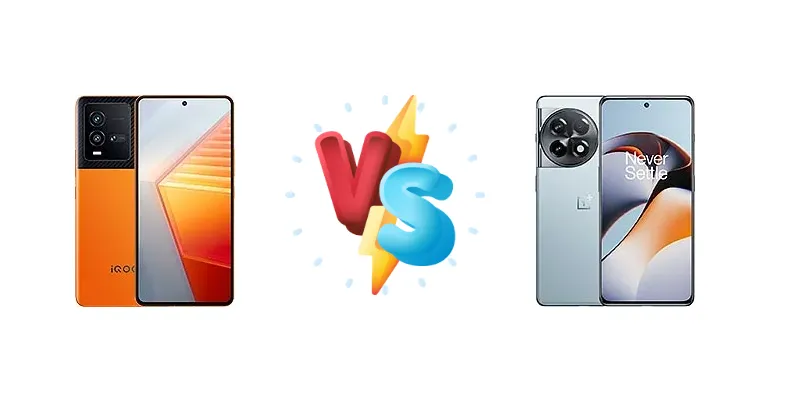
The vivo iQOO 10 and OnePlus 11R are both compelling contenders in the flagship smartphone arena, offering impressive performance and features at competitive prices. But which one truly comes out on top? This in-depth comparison will analyze every aspect, from display quality to charging speed, to help you make an informed decision.
🏆 Quick Verdict
The iQOO 10 edges out the OnePlus 11R thanks to its significantly faster 120W charging and potentially superior camera system (though both are excellent). However, the OnePlus 11R offers a more refined software experience and potentially better overall value depending on pricing and regional availability.
| Network |
|---|
| 2G bands | GSM 850 / 900 / 1800 / 1900 | GSM 850 / 900 / 1800 / 1900 |
| 3G bands | HSDPA 850 / 900 / 1700(AWS) / 1900 / 2100 | HSDPA 850 / 900 / 1700(AWS) / 2100 |
| 4G bands | 1, 3, 4, 5, 8, 18, 19, 26, 28, 34, 38, 39, 40, 41, 66 | 1, 3, 4, 5, 8, 28, 34, 38, 39, 40, 41 |
| 5G bands | 1, 3, 5, 8, 28, 40, 41, 77, 78 SA/NSA | 1, 3, 5, 8, 28, 40, 41, 77, 78 SA/NSA |
| Speed | HSPA, LTE, 5G | HSPA, LTE (3CA), 5G |
| Technology | GSM / CDMA / HSPA / CDMA2000 / LTE / 5G | GSM / CDMA / HSPA / LTE / 5G |
| | CDMA2000 1x | CDMA 800 |
| Launch |
|---|
| Announced | 2022, July 19 | 2023, February 07 |
| Status | Available. Released 2022, July 25 | Available. Released 2023, February 21 |
| Body |
|---|
| Build | - | Glass front, glass back (Gorilla Glass 5), plastic frame |
| Dimensions | 164.5 x 77.1 x 8.4 mm (6.48 x 3.04 x 0.33 in) | 163.4 x 74.3 x 8.7 mm (6.43 x 2.93 x 0.34 in) |
| SIM | Nano-SIM + Nano-SIM | Nano-SIM + Nano-SIM |
| Weight | 206 g (7.27 oz) | 204 g (7.20 oz) |
| Display |
|---|
| Resolution | 1080 x 2400 pixels, 20:9 ratio (~388 ppi density) | 1240 x 2772 pixels, 20:9 ratio (~451 ppi density) |
| Size | 6.78 inches, 111.0 cm2 (~87.5% screen-to-body ratio) | 6.74 inches, 109.2 cm2 (~90.0% screen-to-body ratio) |
| Type | AMOLED, 120Hz, HDR, 1500 nits (peak) | Fluid AMOLED, 1B colors, 120Hz, HDR10+, 1450 nits (peak) |
| Platform |
|---|
| CPU | Octa-core (1x3.19 GHz Cortex-X2 & 3x2.75 GHz Cortex-A710 & 4x1.80 GHz Cortex-A510) | Octa-core (1x3.0 GHz Cortex-X2 & 3x2.5 GHz Cortex-A710 & 4x1.80 GHz Cortex-A510) |
| Chipset | Qualcomm SM8475 Snapdragon 8+ Gen 1 (4 nm) | Qualcomm SM8475 Snapdragon 8+ Gen 1 (4 nm) |
| GPU | Adreno 730 | Adreno 730 |
| OS | Android 12, OriginOS Ocean | Android 13, upgradable to Android 15, OxygenOS 15 |
| Memory |
|---|
| Card slot | No | No |
| Internal | 128GB 8GB RAM, 256GB 8GB RAM, 256GB 12GB RAM, 256GB 16GB RAM, 512GB 12GB RAM | 128GB 8GB RAM, 256GB 16GB RAM, 512GB 18GB RAM |
| | UFS 3.1 | UFS 3.1 |
| Main Camera |
|---|
| Features | Dual-LED dual-tone flash, HDR, panorama | Color spectrum sensor, LED flash, HDR, panorama |
| Single | 16 MP, f/2.5, (wide) | 16 MP, f/2.4, 24mm (wide), 1/3.09", 1.0µm |
| Triple | 50 MP, f/1.9, (wide), 1/1.57", 1.0µm, PDAF, OIS
12 MP, f/2.0, 47mm (telephoto), 1/2.9", PDAF, 2x optical zoom
13 MP, f/2.2, 16mm, 120˚ (ultrawide) | 50 MP, f/1.8, 24mm (wide), 1/1.56", 1.0µm, multi-directional PDAF, OIS
8 MP, f/2.2, 120˚ (ultrawide), 1/4.0", 1.12µm
2 MP (macro) |
| Video | 4K@30fps, 1080p@30fps, gyro-EIS | 4K@30/60fps, 1080p@30/60/240fps, gyro-EIS |
| Selfie camera |
|---|
| Features | HDR | HDR |
| Single | 16 MP, f/2.5, (wide) | 16 MP, f/2.4, 24mm (wide), 1/3.09", 1.0µm |
| Video | 1080p@30fps, gyro-EIS | 1080p@30fps |
| Sound |
|---|
| 3.5mm jack | No | No |
| 35mm jack | No | No |
| Loudspeaker | Yes, with dual speakers | Yes, with stereo speakers |
| | 24-bit/192kHz audio | 24-bit/192kHz audio |
| Comms |
|---|
| Bluetooth | 5.3, A2DP, LE, aptX HD, aptX Adaptive, aptX Lossless | 5.3, A2DP, LE, aptX HD |
| Infrared port | - | Yes |
| NFC | Yes | Yes |
| Positioning | GPS, GLONASS, GALILEO, BDS, QZSS | GPS (L1+L5), GLONASS (G1), BDS (B1I+B1c+B2a), GALILEO (E1+E5a), QZSS (L1+L5) |
| Radio | No | No |
| USB | USB Type-C 2.0, OTG | USB Type-C 2.0 |
| WLAN | Wi-Fi 802.11 a/b/g/n/ac/6, dual-band, Wi-Fi Direct | Wi-Fi 802.11 a/b/g/n/ac/6, dual-band |
| Features |
|---|
| Sensors | Fingerprint (under display, optical), accelerometer, gyro, proximity, compass | Fingerprint (under display, optical), accelerometer, gyro, proximity, compass |
| Battery |
|---|
| Charging | 120W wired, PD3.0, 50% in 7 min, 100% in 19 min | 100W wired |
| Type | 4700 mAh | Li-Po 5000 mAh |
| Misc |
|---|
| Colors | White (BMW M branding), Orange, Black | Galactic Silver, Sonic Black, Solar Red |
| Models | V2217A | CPH2487 |
| Price | About 580 EUR | About 600 EUR |
| SAR | - | 1.16 W/kg (head) 0.61 W/kg (body) |
vivo iQOO 10
- Blazing-fast 120W charging
- Potentially superior camera system
- Slightly higher CPU clock speeds
- Aggressive design (appeals to some)
- Software skin may not appeal to everyone
- Design can be polarizing
- Potential for slightly less refined software experience
OnePlus 11R
- Smoother, more polished software experience (OxygenOS)
- Excellent value for money
- Fast 100W charging
- Refined design
- Slower charging than iQOO 10
- Camera system may be less versatile
- CPU clock speeds slightly lower
Display Comparison
Both phones feature a 6.7-inch AMOLED display with a 120Hz refresh rate, offering vibrant colors and smooth scrolling. The iQOO 10 might have slightly better color accuracy, but both are excellent for media consumption and gaming. Resolution is likely FHD+ on both.
Camera Comparison
The iQOO 10 is expected to have a more versatile camera system, potentially including a periscope telephoto lens for improved zoom capabilities. Both phones will likely feature a 50MP main sensor. Image processing and software features will differentiate the final image quality.
Performance
Both devices are powered by the Snapdragon 8+ Gen 1, ensuring flagship-level performance. The iQOO 10's CPU clock speeds are marginally higher, potentially offering a slight edge in demanding tasks, but real-world differences will likely be minimal. Software optimization will play a larger role in perceived speed.
Battery Life
The iQOO 10's 120W charging is a game-changer, allowing for incredibly fast top-ups. The OnePlus 11R's 100W charging is still very fast, but not quite as impressive. Both phones likely have a similar battery capacity (around 5000mAh), suggesting comparable battery life between charges.
Buying Guide
The vivo iQOO 10 is ideal for power users who prioritize blazing-fast charging and are comfortable with a slightly more aggressive software skin. The OnePlus 11R is a great choice for those seeking a smoother, more polished Android experience with excellent performance and a competitive price.
Frequently Asked Questions
❓ Is the iQOO 10's software easy to use?
The iQOO 10 uses Funtouch OS, which is a more customized Android skin. Some users find it feature-rich, while others may prefer a cleaner interface like OxygenOS on the OnePlus 11R.
❓ Which phone is better for gaming?
Both phones offer excellent gaming performance thanks to the Snapdragon 8+ Gen 1. The iQOO 10's slightly higher clock speeds and potentially better cooling could give it a marginal advantage in sustained gaming sessions.