
iQOO 10 Pro vs. RedMagic 7 Pro: A Deep Dive into Speed and Gaming
| Phones Images | |||||
|---|---|---|---|---|---|
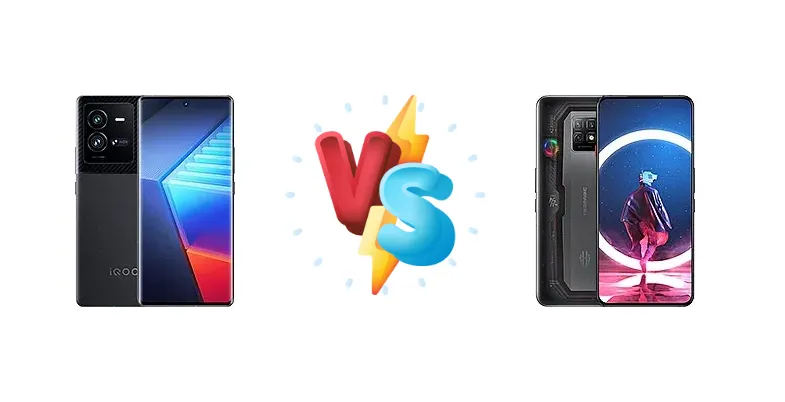
|
🏆 Quick Verdict
For the average user prioritizing all-around performance and incredibly fast charging, the iQOO 10 Pro emerges as the winner. Its Snapdragon 8+ Gen 1 chipset offers a performance and efficiency edge, and the 200W charging is a game-changer. However, dedicated mobile gamers will find the RedMagic 7 Pro’s specialized features more compelling.
| PHONES | ||
|---|---|---|
| Phone Names | vivo iQOO 10 Pro | ZTE nubia RedMagic 7 Pro |
| Network | ||
|---|---|---|
| 2G bands | GSM 850 / 900 / 1800 / 1900 | GSM 850 / 900 / 1800 / 1900 |
| 3G bands | HSDPA 850 / 900 / 1700(AWS) / 1900 / 2100 | HSDPA 850 / 900 / 1700(AWS) / 1900 / 2100 |
| 4G bands | 1, 2, 3, 4, 5, 7, 8, 12, 17, 18, 19, 20, 25, 26, 28, 32, 34, 38, 39, 40, 41, 42, 66 | 1, 2, 3, 4, 5, 7, 8, 12, 17, 18, 19, 20, 26, 28, 34, 38, 40, 41, 66 - International |
| 5G bands | 1, 3, 5, 7, 8, 12, 20, 28, 38, 40, 41, 66, 77, 78, 79 SA/NSA | 1, 3, 5, 7, 8, 20, 28, 38, 41, 77, 78 SA/NSA - International, China |
| Speed | HSPA, LTE, 5G | HSPA, LTE, 5G |
| Technology | GSM / CDMA / HSPA / CDMA2000 / LTE / 5G | GSM / CDMA / HSPA / EVDO / LTE / 5G |
| CDMA2000 1x | - | |
| Launch | ||
|---|---|---|
| Announced | 2022, July 19 | 2022, February 17 |
| Status | Available. Released 2022, July 25 | Available. Released 2022, February 28 |
| Body | ||
|---|---|---|
| Build | - | Glass front (Gorilla Glass 5), glass back, aluminum frame |
| Dimensions | 164.9 x 75.5 x 9.5 mm (6.49 x 2.97 x 0.37 in) | 166.3 x 77.1 x 10 mm (6.55 x 3.04 x 0.39 in) |
| SIM | Nano-SIM + Nano-SIM | Nano-SIM + Nano-SIM |
| Weight | 215.4 g or 216.2 g (7.58 oz) | 235 g (8.29 oz) |
| Display | ||
|---|---|---|
| Protection | - | Corning Gorilla Glass 5 |
| Resolution | 1440 x 3200 pixels, 20:9 ratio (~518 ppi density) | 1080 x 2400 pixels, 20:9 ratio (~387 ppi density) |
| Size | 6.78 inches, 111.0 cm2 (~89.1% screen-to-body ratio) | 6.8 inches, 111.6 cm2 (~87.1% screen-to-body ratio) |
| Type | LTPO3 AMOLED, 1B colors, 120Hz, HDR10+, 500 nits (typ), 1000 nits (HBM), 1500 nits (peak) | AMOLED, 1B colors (China only), 120Hz, 600 nits |
| Platform | ||
|---|---|---|
| CPU | Octa-core (1x3.19 GHz Cortex-X2 & 3x2.75 GHz Cortex-A710 & 4x1.80 GHz Cortex-A510) | Octa-core (1x3.00 GHz Cortex-X2 & 3x2.50 GHz Cortex-A710 & 4x1.80 GHz Cortex-A510) |
| Chipset | Qualcomm SM8475 Snapdragon 8+ Gen 1 (4 nm) | Qualcomm SM8450 Snapdragon 8 Gen 1 (4 nm) |
| GPU | Adreno 730 | Adreno 730 |
| OS | Android 12, Funtouch 12 (International), OriginOS Ocean (China) | Android 12, Redmagic 5.0 |
| Memory | ||
|---|---|---|
| Card slot | No | No |
| Internal | 256GB 8GB RAM, 256GB 12GB RAM, 512GB 12GB RAM | 128GB 8GB RAM, 128GB 12GB RAM, 256GB 12GB RAM, 256GB 16GB RAM, 512GB 16GB RAM, 512GB 18GB RAM, 1TB 16GB RAM |
| UFS 3.1 (V6) | - | |
| Main Camera | ||
|---|---|---|
| Features | Dual-LED lash, HDR, panorama | LED flash, HDR, panorama |
| Single | 16 MP, f/2.5, (wide), 1/3.1", 1.0µm | - |
| Triple | 50 MP, f/1.9, (wide), 1/1.57", 1.0µm, PDAF, gimbal OIS 14.6 MP, f/2.2, 69mm (telephoto), PDAF, OIS, 3x optical zoom 50 MP, f/2.3, 15mm, 150˚ (ultrawide), 1/2.76", 0.64µm, AF | 64 MP, f/1.8, 26mm (wide), 1/1.97", 0.7µm, PDAF 8 MP, f/2.2, 120˚, 13mm (ultrawide), 1/4.0", 1.12µm 2 MP (macro) |
| Video | 8K@30fps, 4K@24/30/60fps, 1080p@30/60fps, gyro-EIS | 8K@30fps, 4K@30/60fps, 1080p@30/60/120/240fps |
| Selfie camera | ||
|---|---|---|
| Features | HDR | HDR |
| Single | 16 MP, f/2.5, (wide), 1/3.1", 1.0µm | 16 MP, f/2.0, 26mm (wide), 1/2.8", 1.22µm, under display |
| Video | 1080p@30fps, gyro-EIS | 1080p@30/60fps |
| Sound | ||
|---|---|---|
| 3.5mm jack | No | - |
| 35mm jack | No | Yes |
| Loudspeaker | Yes, with dual speakers | Yes, with stereo speakers |
| 32-bit/384kHz audio | - | |
| Comms | ||
|---|---|---|
| Bluetooth | 5.3, A2DP, LE, aptX HD, aptX Adaptive, aptX Lossless | 5.2, A2DP, aptX, LE |
| Infrared port | Yes | - |
| NFC | Yes | Yes |
| Positioning | GPS, GLONASS, GALILEO, BDS, QZSS | GPS (L1+L5), GLONASS, BDS, GALILEO |
| Radio | No | No |
| USB | USB Type-C 2.0, OTG | USB Type-C 3.0, OTG, accessory connector |
| WLAN | Wi-Fi 802.11 a/b/g/n/ac/6, dual-band, Wi-Fi Direct | Wi-Fi 802.11 a/b/g/n/ac/6e, dual-band, Wi-Fi Direct |
| Features | ||
|---|---|---|
| Sensors | Fingerprint (under display, ultrasonic), accelerometer, gyro, proximity, compass | Fingerprint (under display, optical), accelerometer, gyro, proximity, compass |
| Battery | ||
|---|---|---|
| Charging | 200W wired, PD3.0, 100% in 10 min 50W wireless 10W reverse wireless | 135W wired, PD3.0, 100% in 15 min (China) 65W wired, PD3.0 (Global) |
| Type | 4700 mAh | Li-Po 5000 mAh |
| Misc | ||
|---|---|---|
| Colors | Black, White (BMW M branding) | Obsidian, Pulsar, Supernova |
| Models | V2218A | NX709J |
| Price | About 870 EUR | About 800 EUR |
vivo iQOO 10 Pro
- Blazing-fast 200W wired charging
- More efficient Snapdragon 8+ Gen 1 chipset
- Likely superior camera system
- Gaming features are less prominent
- Wireless charging may generate heat
ZTE nubia RedMagic 7 Pro
- Dedicated gaming features (triggers, cooling)
- High refresh rate display (implied)
- Long endurance rating (lab tested)
- Less powerful Snapdragon 8 Gen 1 chipset
- Slower charging speeds
- Potentially weaker camera performance
Display Comparison
The nubia RedMagic 7 Pro’s display achieves a measured peak brightness of 447 nits, which is respectable but doesn’t necessarily stand out in the current flagship landscape. While the iQOO 10 Pro’s display specifications aren’t provided, vivo typically employs high-quality AMOLED panels. The RedMagic 7 Pro’s focus on gaming suggests a high refresh rate panel, but the iQOO 10 Pro likely offers a more color-accurate display geared towards general content consumption. The absence of LTPO information for either device makes it difficult to assess power efficiency gains from variable refresh rates.
Camera Comparison
Detailed camera specifications for both devices are limited. The context data only mentions 'Photo / Video' for the RedMagic 7 Pro, suggesting a less emphasized camera system. The iQOO 10 Pro, being a more mainstream flagship, likely features a more sophisticated camera setup with larger sensors and advanced image processing. Without specific sensor sizes or aperture information, it’s difficult to make a definitive judgment, but the iQOO 10 Pro is expected to deliver superior image quality, particularly in low-light conditions. The RedMagic 7 Pro’s camera is likely adequate for casual use but won’t compete with dedicated camera-focused flagships.
Performance
The iQOO 10 Pro’s Snapdragon 8+ Gen 1 (4nm) chipset provides a significant advantage over the RedMagic 7 Pro’s Snapdragon 8 Gen 1 (4nm). The ‘+’ variant boasts higher clock speeds – 3.19 GHz Cortex-X2 vs 3.00 GHz – and improved thermal efficiency due to the refined 4nm process. This translates to sustained performance under load, minimizing throttling during extended gaming sessions. While both utilize the same CPU core configuration (1x Cortex-X2, 3x Cortex-A710, 4x Cortex-A510), the iQOO 10 Pro’s chipset will deliver a noticeable performance uplift. The RedMagic 7 Pro compensates with its active cooling system, but the underlying chipset is less efficient.
Battery Life
The iQOO 10 Pro’s 200W wired charging is its standout feature, achieving a full charge in just 10 minutes. This is significantly faster than the RedMagic 7 Pro’s 135W (China) or 65W (Global) charging, which takes 15 minutes (China) to fully charge. While the RedMagic 7 Pro boasts an endurance rating of 64 hours, this is a lab-based metric and doesn’t account for real-world usage patterns. The iQOO 10 Pro’s 50W wireless and 10W reverse wireless charging capabilities further enhance its versatility, features absent in the RedMagic 7 Pro. The iQOO 10 Pro’s charging speed effectively mitigates any potential battery capacity differences.
Buying Guide
Buy the vivo iQOO 10 Pro if you need a phone that can fully charge in under 10 minutes, offers a strong all-around camera experience, and provides excellent performance for everyday tasks and moderate gaming. Buy the ZTE nubia RedMagic 7 Pro if you prioritize an uncompromising gaming experience with features like active cooling, dedicated gaming triggers, and a high refresh rate display, even if it means sacrificing some camera quality and charging speed.